On this page
Most first-year BTech students hear the same thing in the hostel corridor: internships are for third-years. That is half true. The national plan for Indian engineering colleges gives first-years a different kind of internship, and it starts on your own campus.
Can a first-year BTech student get an internship?
Yes, and the official framework plans for it. The AICTE Internship Policy: Guidelines and Procedures says a minimum of 14 to 20 credits of internship, project work, seminars and similar activities may be counted towards a BTech, with one credit equal to at least 40 to 45 hours of work.
That adds up to about 600 to 700 hours of internship across a BTech, according to the same AICTE policy.
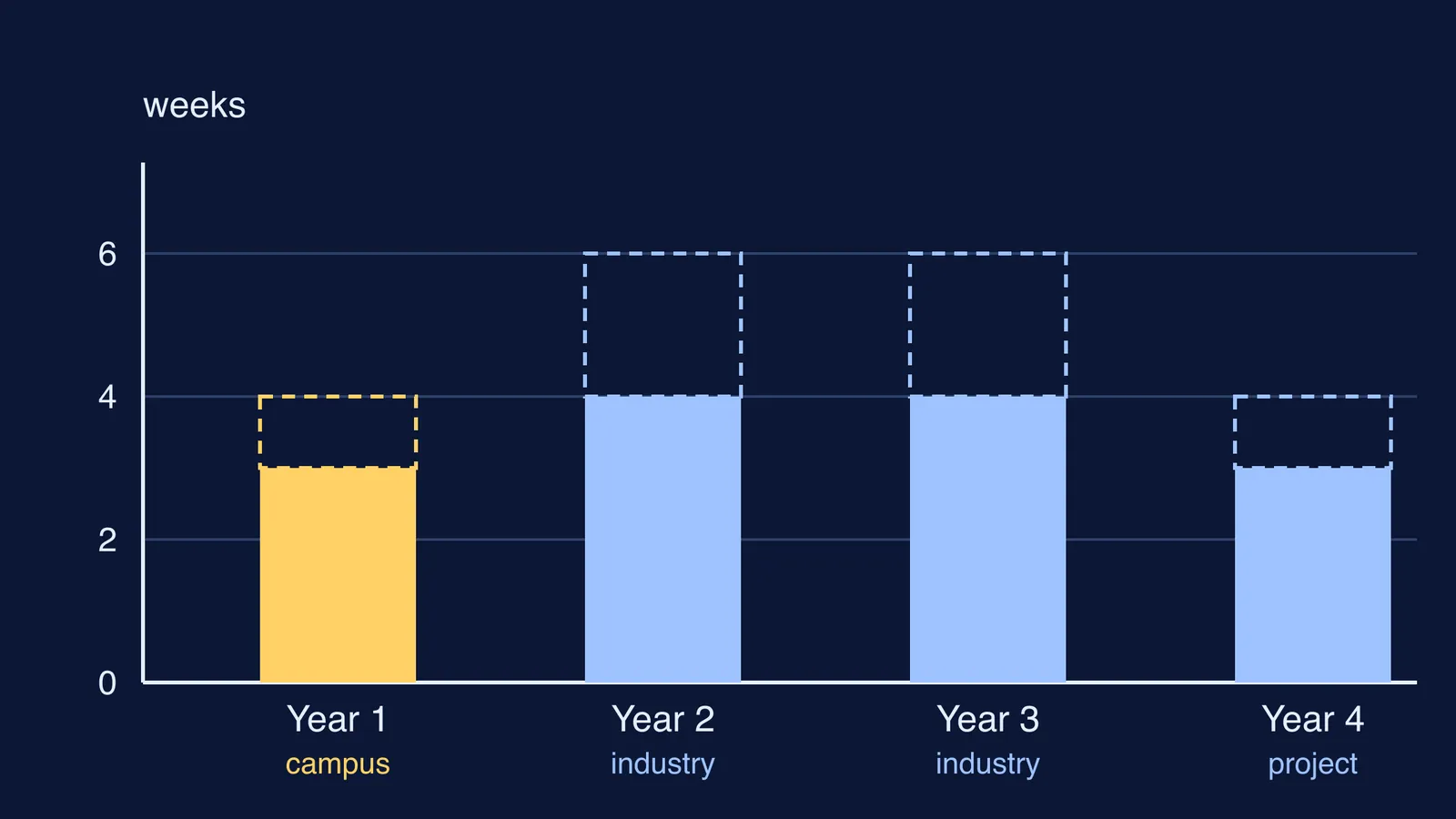
The first slot is the summer vacation after the second semester: 3 to 4 weeks of "Inter/ Intra Institutional Activities", worth 3 to 4 credits. The policy lists what counts, including:
working on a consultancy or research project inside the institute
learning in a departmental lab, tinkering lab or institutional workshop
contributing to the incubation, innovation or entrepreneurship cell
taking part in conferences, workshops and competitions
Industry, government, NGO and MSME internships come in the summers after the fourth and sixth semesters, at 4 to 6 weeks each. For undergraduate degrees in general, the UGC's guidelines for undergraduate internships also place a 2 to 4 credit internship after the fourth semester.
Each university sets its own scheme, so ask your Training and Placement cell how your first summer is credited.
Where should a first-year look for an internship?
Try these routes in order; each makes the next easier.
Campus projects. Pick professors in your department whose work you can follow. Ask to help in their lab, even with data cleaning or soldering. Check the tinkering lab and the innovation or incubation cell too: AICTE's list of first-summer activities names all of these.
Small startups. Start with teams in your own college's incubator, then founders from your city. A team of five has no internship programme, but it often has a task nobody has time for.
Skill-based applications. Some programmes judge your work, not your year. Google Summer of Code accepts contributors who are 18 or older and are students or open-source beginners, and its projects are sized at about 90, 175 or 350 hours. Small open-source fixes now help you get ready.
What do you need before you apply?
You need one thing you made that a stranger can check in two minutes. Use this checklist:
one small project that works: a sensor that logs data, a script that cleans a messy spreadsheet, a simple app for a college club
a short write-up: what problem it solves, how you built it, what broke and how you fixed it
your code or photos in one public link
one sentence on what you want to learn next
Projects often stall on one idea from class, such as a free-body diagram in a robotics build. When that happens, the Fermi Concept Library has a lesson for every concept in physics, chemistry, biology, mathematics and computing, so you can fill the gap and get back to building.
What should you write to a professor or startup founder?
Keep it to five lines. Here is a worked example for a professor:
Subject: First-year student, can I help with your sensor work?
"Dear Prof. [Name], I am a first-year BTech student in [branch]. I read your paper on [topic] and understood the part about [one specific point]. I built a small temperature logger with an Arduino ([link]). I would like to help in your lab this summer with any task, including testing and data cleaning. Could I meet you briefly in your office hours?"
For a startup, swap the paper for their product: name one thing you tried, one small improvement you could build, and link your project. Then send it to one person at a time and follow up once, a week later. No reply is normal and says nothing about you.
A plan for your first year
The AICTE schedule gives you until the end of the second semester. Use it like this:
Semester 1: keep your grades steady, join one technical club, and note which professors' work interests you.
Winter break: build your one small project and write it up.
Early semester 2: email professors and campus incubator teams, a few at a time.
Late semester 2: confirm your summer work and ask how it will be credited.
Summer: do the work, keep a daily log, and ask for a certificate or a short letter at the end.
If the search starts to feel heavy, talk to a friend, a mentor or your college counsellor, or call the national Tele MANAS helpline on 14416.
Not sure which skill to build first? Fermi's AI tutor works out what you already know and builds a plan for the session, so you can start your project with a clear first step.