On this page
Every placement season, the same debate echoes through hostels and college canteens: should you spend your time chasing a 9.0 CGPA or building a stronger portfolio of skills? The short answer is that you need both, but they do completely different jobs.
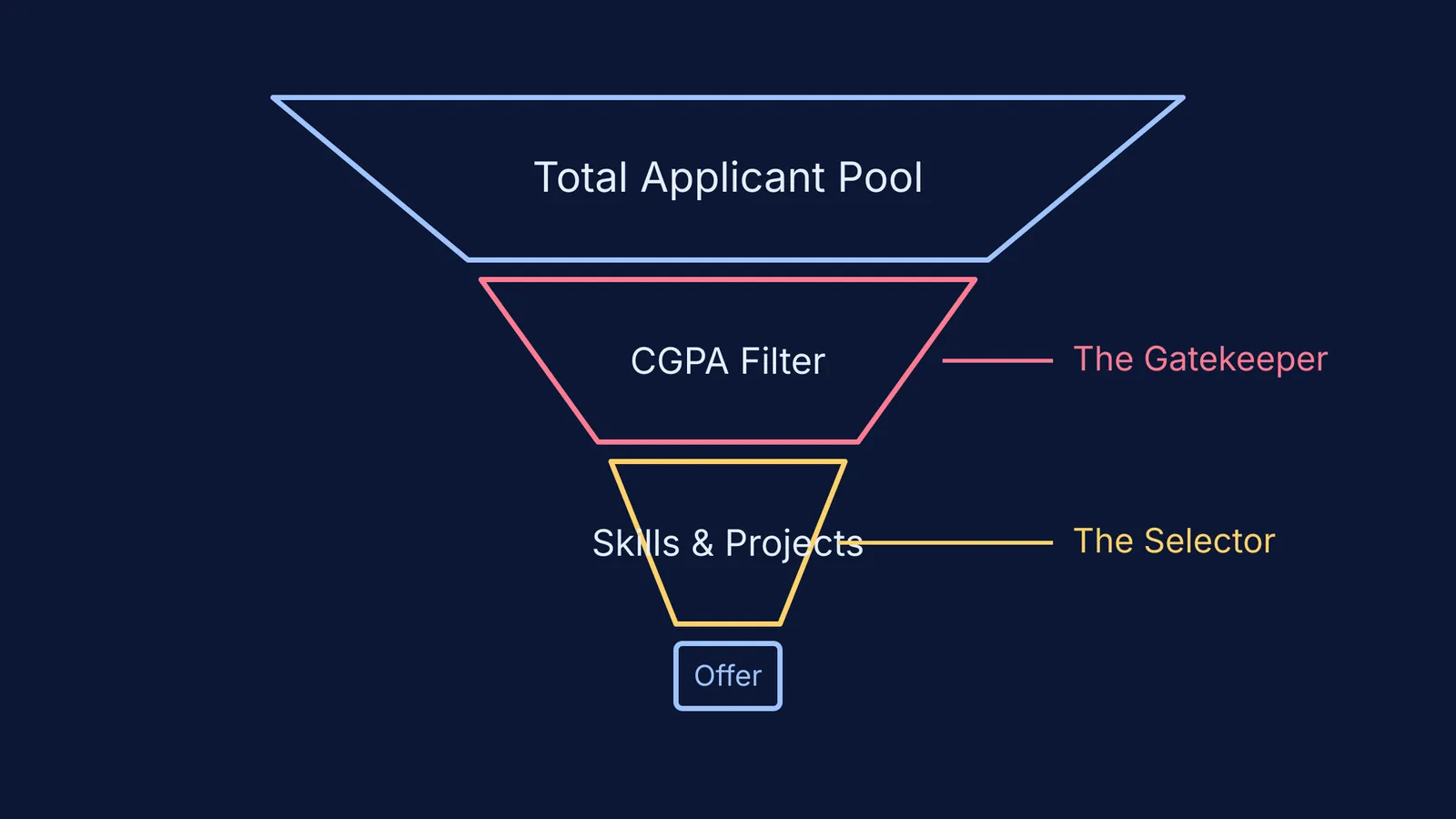
If you treat a job application like getting into a nightclub, your Cumulative Grade Point Average (CGPA) is the bouncer checking your ID at the door. Your technical and soft skills are what get you onto the dance floor. Knowing how to balance these two demands is the secret to a successful campus placement strategy.
Is CGPA a selection tool or a rejection filter?
In high-volume hiring markets like India, companies receive thousands of applications for a handful of roles. To manage this high volume, recruiters use your CGPA as a mass rejection filter. It is rarely used to select the best candidate.
According to HirePro's "The New Reality in College Hiring" report, there is a large perception gap between how students and employers view grades. Students ranked CGPA as the number one factor for placement success. Corporates, on the other hand, ranked it tenth on their list of priorities.
For most mass recruiters in India, a CGPA of 6.5 or 7.0 is a hard cut-off. If you fall below it, the applicant tracking software automatically deletes your application before a human ever sees it. For elite product companies, this "gatekeeper" cut-off usually hovers around 7.5 or 8.0.
However, once you cross that threshold, the marginal value of a higher score drops fast. A student with an 8.5 CGPA and excellent technical skills will almost always beat a student with a 9.5 CGPA who lacks practical experience. Extra marks do not compensate for missing skills.
Are employers dropping GPA requirements?
Yes, and the trend is accelerating globally. Surveys across hiring platforms show a steady decline in the importance of academic grades as a screening tool. Employers are shifting toward skills-based hiring because grades suffer from inflation and rarely predict how well someone will perform in a team environment. The skills that matter more as AI spreads—such as critical problem-solving, active listening, and adaptability—are notoriously hard to measure with a written university exam. A transcript shows that you can memorise a syllabus, but it does not prove that you can debug a broken server at midnight.
What do interviews actually test?
Once you clear the CGPA hurdle, the interview becomes a strict test of your "selector" criteria: technical proficiency and soft skills.
If you are a computer science student, you will be tested on data structures, algorithms, and system design. Interviewers look for "proof of work". They want to see GitHub repositories, live projects, open-source contributions, and internship certificates. These artefacts prove that you can build things.
If you struggle with foundational concepts during interview prep, Fermi's AI tutor can work out what you already know and build a plan for the session, helping you fix the exact gap holding you back. Because technical rounds are highly interactive, practising how you explain your reasoning out loud is just as important as arriving at the correct answer.
How do you balance grades with projects?
You cannot ignore your college coursework entirely, but you must study efficiently so you have time left over for real-world practice.
Study smarter, not longer: Use active recall and the Cornell note-taking method to retain information faster. This frees up your evenings for coding or design projects.
Do not cram without breaks: Research shows that what to do in a study break matters just as much as the study session itself. Stepping away helps consolidate your memory, meaning you spend less time re-reading the same textbook page.
Pick projects that overlap: Try to choose semester projects that align with your career goals. If you want to work in data science, build your final-year academic project around machine learning. You earn your college credits while simultaneously adding a major project to your resume.
Practise mock interviews: Form a group with your friends and interview each other. Treat communication as a technical skill that requires deliberate practice.
Ultimately, your CGPA buys you the ticket to the interview. Your skills win you the job.