On this page
Sossina Haile is a materials scientist who built a fuel cell whose electrolyte is a dry, salt-like crystal called a solid acid. If you are studying electrochemical cells in Class 12, her work tests what you already know: two half-reactions, an electrolyte that lets ions through, and a voltage you can turn into Gibbs energy.
Who is Sossina Haile?
Haile was born in Addis Ababa, Ethiopia, in 1966, and her family left the country in the mid-1970s after soldiers arrested and nearly killed her father, the historian Getatchew Haile (Wikipedia biography). She earned her B.S. and PhD (1992) at MIT and an M.S. at the University of California, Berkeley (Northwestern group page). The same page records that she joined Northwestern University in 2015 after 18 years on the faculty at Caltech, and that she "has established a new class of fuel cells based on solid acid electrolytes". In 2010 she received the Chemical Pioneers Award of the Chemical Heritage Foundation (e-conversion talk page).
What is a solid acid fuel cell?
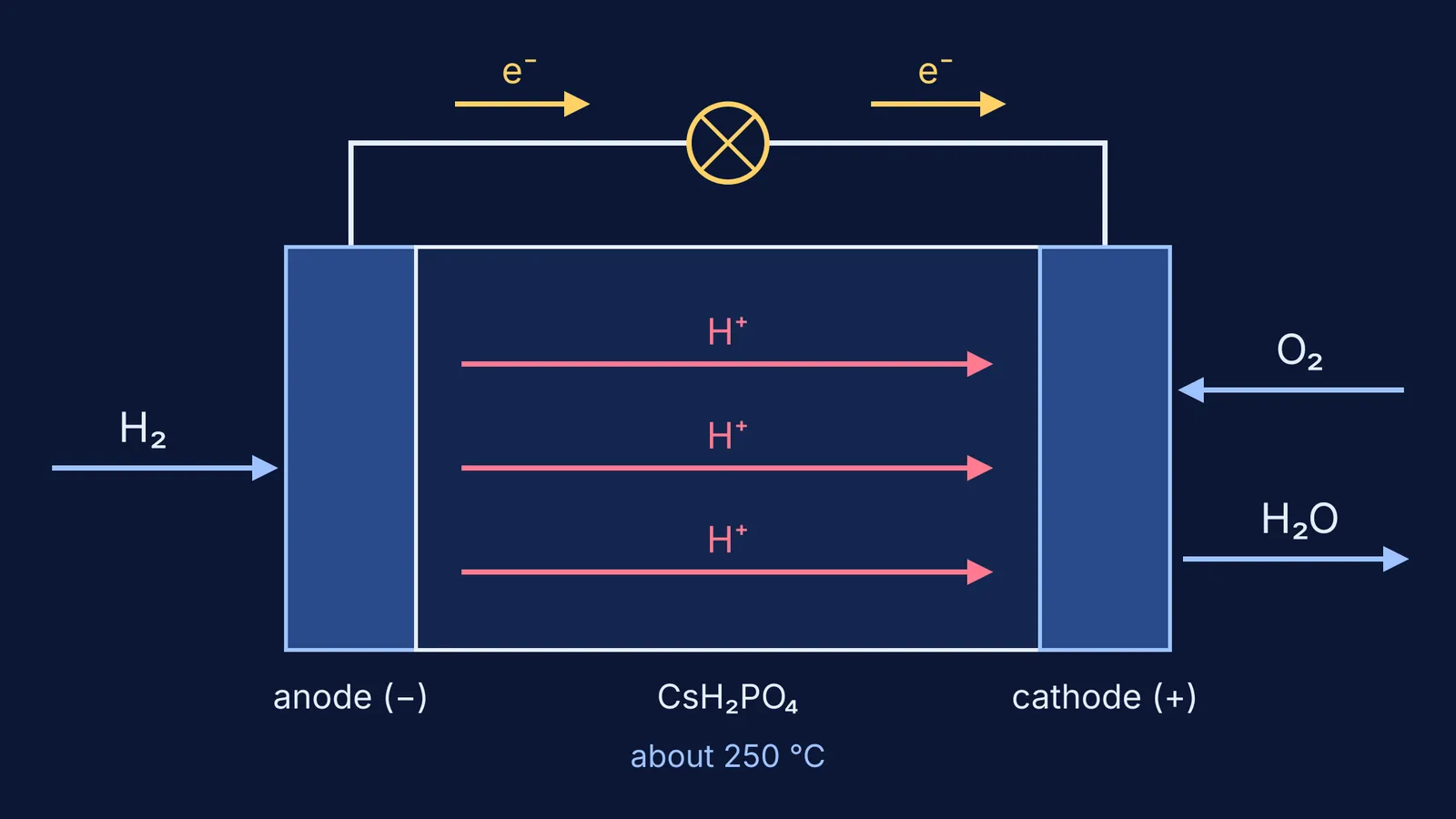
A fuel cell is a galvanic cell that is fed continuously: hydrogen goes to the anode, oxygen to the cathode, and electricity flows as long as the fuel keeps coming. The electrolyte between the electrodes must let ions through but not electrons. In a solid acid fuel cell that electrolyte is a solid acid such as CsHSO4 or CsH2PO4, which carries protons (H+) without needing water.
The reactions are the ones you write in board exams for an acidic hydrogen–oxygen cell:
Anode (oxidation): H2 → 2H+ + 2e−
Cathode (reduction): ½O2 + 2H+ + 2e− → H2O
Overall: H2 + ½O2 → H2O
Protons cross the solid electrolyte; electrons take the outer wire through the load.
Why did Haile use a solid acid instead of a polymer membrane?
Polymer electrolyte membrane (PEM) fuel cells run at around 80 °C (US Department of Energy). Haile's 2001 paper in Nature explained the catch: these membranes need humid conditions, which keeps them below 100 °C, and they let methanol and hydrogen leak through (Haile et al., Nature 2001, abstract on PubMed). Solid acids move protons without water and stay stable up to about 250 °C. Until then they had not been considered viable fuel cell electrolytes, because they dissolve in water and become extremely soft (ductile) above about 125 °C.
Her team tested a CsHSO4 membrane about 1.5 mm thick at 150–160 °C and measured an open-circuit voltage of 1.11 V and a short-circuit current density of 44 mA cm−2 (PubMed abstract).
In 2004 the group reported continuous, stable power from both hydrogen–oxygen and direct methanol fuel cells at about 250 °C, using a humidity-stabilised CsH2PO4 electrolyte (Boysen et al., Science 2004, abstract on PubMed).
Why that temperature? Haile's seminar abstract at Ohio State explains that CsH2PO4 changes phase at 228 °C. Another abstract reports hydrogen cells above 400 mW cm−2 at 250 °C and high tolerance to CO, H2S and NH3 in the fuel (e-conversion talk page).
How do you connect her cell to ΔG = −nFE?
Take her 2001 numbers and treat them like a Class 12 numerical. The Faraday constant is 96,485 C mol−1 (NIST), and the open-circuit voltage was 1.11 V (PubMed abstract).
Find n. Each H2 gives up 2 electrons, so n = 2.
Gibbs energy: ΔG = −nFE = −2 × 96,485 × 1.11 J ≈ −214 kJ per mole of H2. Negative means spontaneous.
Faraday's law: at 44 mA per cm², one hour passes 0.044 × 3600 = 158.4 C through each square centimetre.
Moles of electrons: 158.4 ÷ 96,485 ≈ 0.00164 mol. Divide by 2 to get about 0.00082 mol of H2, or 0.82 mmol per cm² per hour.
A quick sense check: the measured voltage is a little below the textbook standard value for the hydrogen–oxygen cell, because a real cell loses some energy. That gap is what our post on why a fuel cell's maximum efficiency is ΔG/ΔH builds on.
If you lose marks on steps like these, the usual slip is n or a missing unit conversion. The Fermi Problem Library has worked problems with a step-by-step solver that explains the reasoning, so you can see which step you got wrong instead of only the final answer.
What should you take into your exam?
A fuel cell is a galvanic cell with a continuous supply of reactants.
The electrolyte decides which ion moves. In Haile's cells it is H+, so water forms at the cathode.
ΔG = −nFE and Faraday's law turn one voltage and one current into energy and fuel use.
For more practice, read our guide to common mistakes in electrochemistry numericals, and the story of William Grove and the first working fuel cell to see where Haile's work began. If you want to see how ions and electrons split between the electrolyte and the wire, the Fermi Simulation Lab has interactive simulations for ideas that are easier to see than to read.