

On this page
When you burn hydrogen in air, the energy released at constant pressure is its enthalpy of combustion, ΔH. Conventional power plants use that heat to boil water, create steam, and spin a turbine. By contrast, an electrochemical fuel cell extracts electrical energy directly from the reaction without an intermediate thermal step, as outlined by the U.S. Department of Energy.
Because this conversion is direct rather than thermal, you cannot measure its limit with heat engine cycles. Thermodynamics dictates that the maximum non-expansion work obtainable at constant temperature and pressure equals the negative change in Gibbs free energy: W_elec,max = −ΔG. Therefore, the maximum theoretical efficiency is defined by the dimensionless ratio η_max = ΔG / ΔH.
Why is fuel cell efficiency defined as ΔG/ΔH?
The foundation of this metric is the identity ΔG = ΔH − TΔS, where T is absolute temperature and ΔS is the reaction entropy change. Rearranging gives:
ΔH = ΔG + TΔS
In a reversible process at constant temperature, TΔS represents the unavoidable heat exchanged with the surroundings to satisfy the second law of thermodynamics. When disorder decreases (ΔS < 0), the system must reject heat equal to T|ΔS|. Because enthalpy represents the total chemical heating value, the fraction converted into electrical work under reversible conditions is:
η_max = W_elec,max / (−ΔH) = (−ΔG) / (−ΔH) = ΔG / ΔH
Recognizing that electrical work tracks ΔG rather than ΔH is essential when converting from cell EMF to Gibbs energy and equilibrium constants.
How do you calculate hydrogen-oxygen fuel cell efficiency?
For a hydrogen-oxygen fuel cell forming liquid water, the overall reaction is:
H₂(g) + 0.5 O₂(g) → H₂O(l)
Standard thermodynamic data from the NIST Chemistry WebBook for water gives ΔH° = −285.83 kJ/mol and standard entropy S° = 69.95 J/(mol·K) at 298.15 K. Corresponding NIST values for reactant gases are S° = 130.68 J/(mol·K) for diatomic hydrogen and S° = 205.15 J/(mol·K) for oxygen.
The step-by-step calculation proceeds as follows:
Entropy change: ΔS° = 69.95 − [130.68 + 0.5 × 205.15] = −163.31 J/(mol·K)
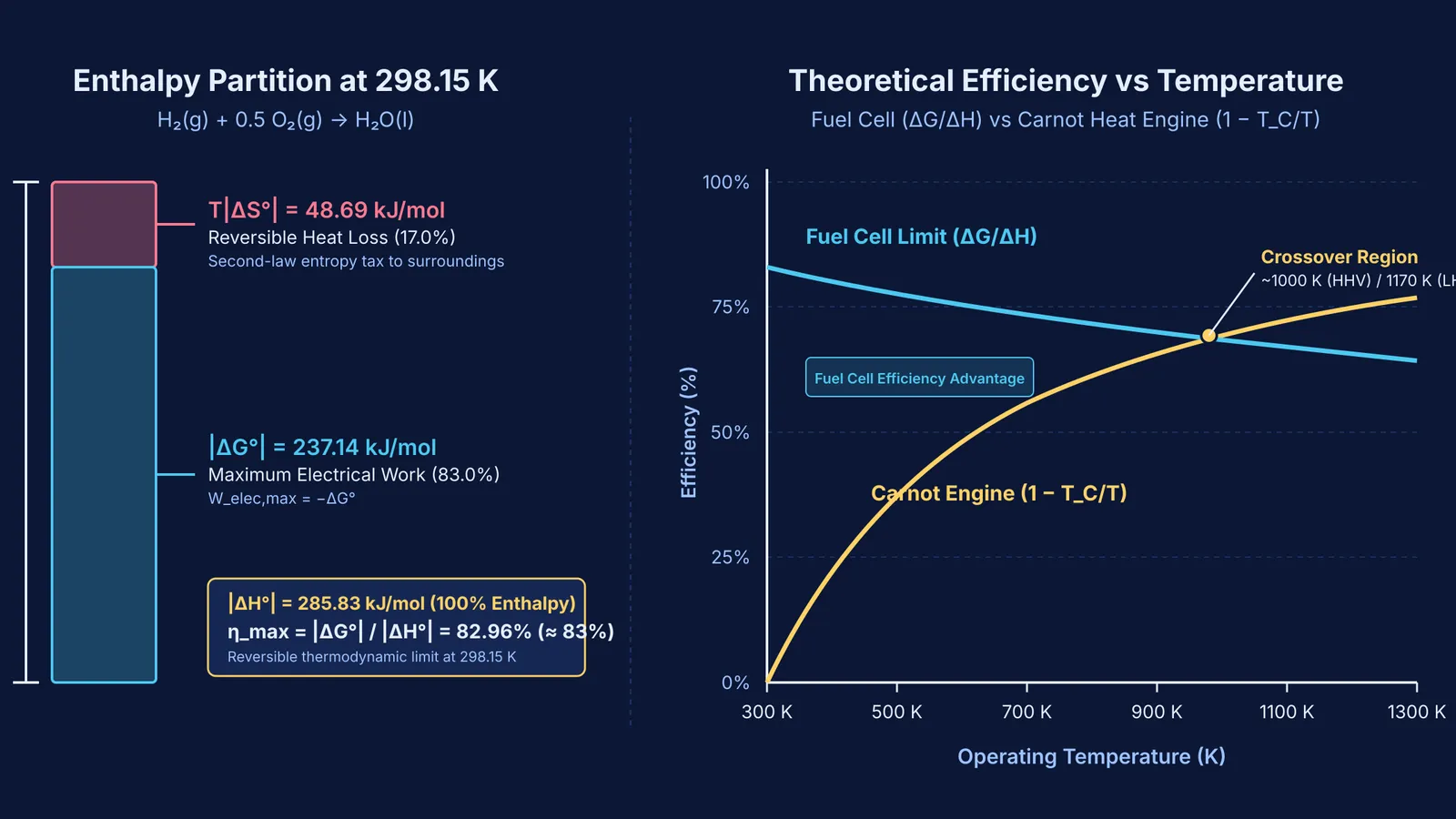
Entropic heat at 298.15 K: TΔS° = 298.15 K × (−0.16331 kJ/(mol·K)) = −48.69 kJ/mol
Maximum electrical work: ΔG° = ΔH° − TΔS° = −285.83 − (−48.69) = −237.14 kJ/mol
Theoretical efficiency: η_max = ΔG° / ΔH° = (−237.14) / (−285.83) = 0.8296, or 82.96% (about 83%).
With n = 2 electrons transferred per molecule of H₂, the reversible cell EMF is E° = −ΔG° / (nF) = 1.229 V. Comparing this with the thermoneutral voltage E_th = −ΔH° / (nF) = 1.481 V yields the same thermodynamic ratio: E° / E_th = ΔG° / ΔH° = 82.96% (or 1.229 V / 1.481 V ≈ 83.0%).
Why are fuel cells not limited by the Carnot cycle?
Heat engines burn fuel to produce thermal energy, expanding a working fluid between a hot source (T_H) and a cold sink (T_C) with a theoretical ceiling governed by the Carnot efficiency: η_Carnot = 1 − T_C / T_H. In a thermodynamic analysis in the International Journal of Hydrogen Energy, Yousef Haseli demonstrated that hydrogen fuel cells can theoretically exceed Carnot efficiency because their conversion does not route chemical energy through an intermediate heat-to-work cycle. Ever since William Grove built the first 'gas battery' in 1839, fuel cells have converted chemical energy directly into electrical current at isothermal electrode interfaces.
This fundamental difference creates an inverse temperature trend. Between a cold reservoir at 300 K and a source at 600 K (about 327 °C), a heat engine has a Carnot ceiling of only 50%. A hydrogen-oxygen fuel cell at 300 K, however, has a theoretical limit of roughly 83%. While Carnot efficiency rises as operating temperature climbs, fuel cell theoretical efficiency declines because the negative reaction entropy causes −TΔS to erode |ΔG|. In standard engineering literature, these two theoretical curves intersect near a crossover temperature of approximately 1000 K to 1170 K (about 727 °C to 897 °C). Below this crossover range, fuel cells maintain a decisive theoretical efficiency advantage.
For students tackling thermodynamics in JEE Advanced, the Fermi Problem Library provides worked problems with a step-by-step solver that explains the reasoning rather than printing an answer.
Can a fuel cell ever exceed 100% efficiency?
Theoretically yes, if the reaction entropy change is positive (ΔS > 0). Consider the direct oxidation of solid carbon to carbon monoxide:
C(s) + 0.5 O₂(g) → CO(g)
Thermodynamic data from the NIST Chemistry WebBook for carbon monoxide illustrates how producing 1 mole of gas from 0.5 moles of gaseous oxygen yields a positive reaction entropy (ΔS° ≈ +89.3 J/(mol·K)). Because ΔS is positive, the term −TΔS becomes negative, making |ΔG| strictly greater than |ΔH|. The theoretical efficiency η_max = ΔG / ΔH therefore exceeds 100%.
This does not violate the conservation of energy. The cell cools as it operates, absorbing ambient heat equal to Q = TΔS from its surroundings and converting both chemical enthalpy and absorbed thermal energy into electricity.
In practical hardware, losses from electrode overpotentials, internal resistance, and mass transport resistance reduce operating voltages from 1.23 V down to 0.65 V–0.80 V. According to the U.S. Department of Energy, real-world fuel cells deliver operating electrical efficiencies between 45% and 60%. Understanding how these practical departures arise—much like measuring reaction energies in a bomb calorimeter—bridges pure thermodynamic principles and applied energy engineering.
To explore these behaviors visually, use the Fermi Simulation Lab for interactive simulations of ideas easier to see than to read, or review core definitions across the Fermi Concept Library.


