On this page
The National Entrance Screening Test (NEST) is the entrance exam for the five-year integrated MSc at NISER Bhubaneswar and UM-DAE CEBS Mumbai, both set up by the Department of Atomic Energy in 2007, according to the NEST 2026 information brochure. For 2026 it listed 200 seats at NISER and 57 at CEBS, with the exam on 6 June. NEST 2027 dates had not been announced when we wrote this, so check nestexam.in first. Still choosing an institute? Read our comparison of IISER, IISc BS and NISER.
What is the NEST exam pattern?
From the NEST 2026 brochure:
Four sections: biology, chemistry, mathematics and physics, each with 20 single-correct MCQs worth 60 marks.
Correct answers earn +3, wrong answers −1, blanks 0.
3 hours, computer-based, in Hindi and English. Calculators are not allowed, but a simple on-screen calculator is provided.
The syllabus mainly follows the CBSE curriculum and NCERT books for classes XI and XII, and some questions may need science up to class 10.
Eligibility includes at least three of the four sciences in classes XI and XII, and at least 60% in class XII (55% for SC, ST and Divyangjan candidates).
How does the NEST merit list work?
The brochure's merit list rules work in four steps:
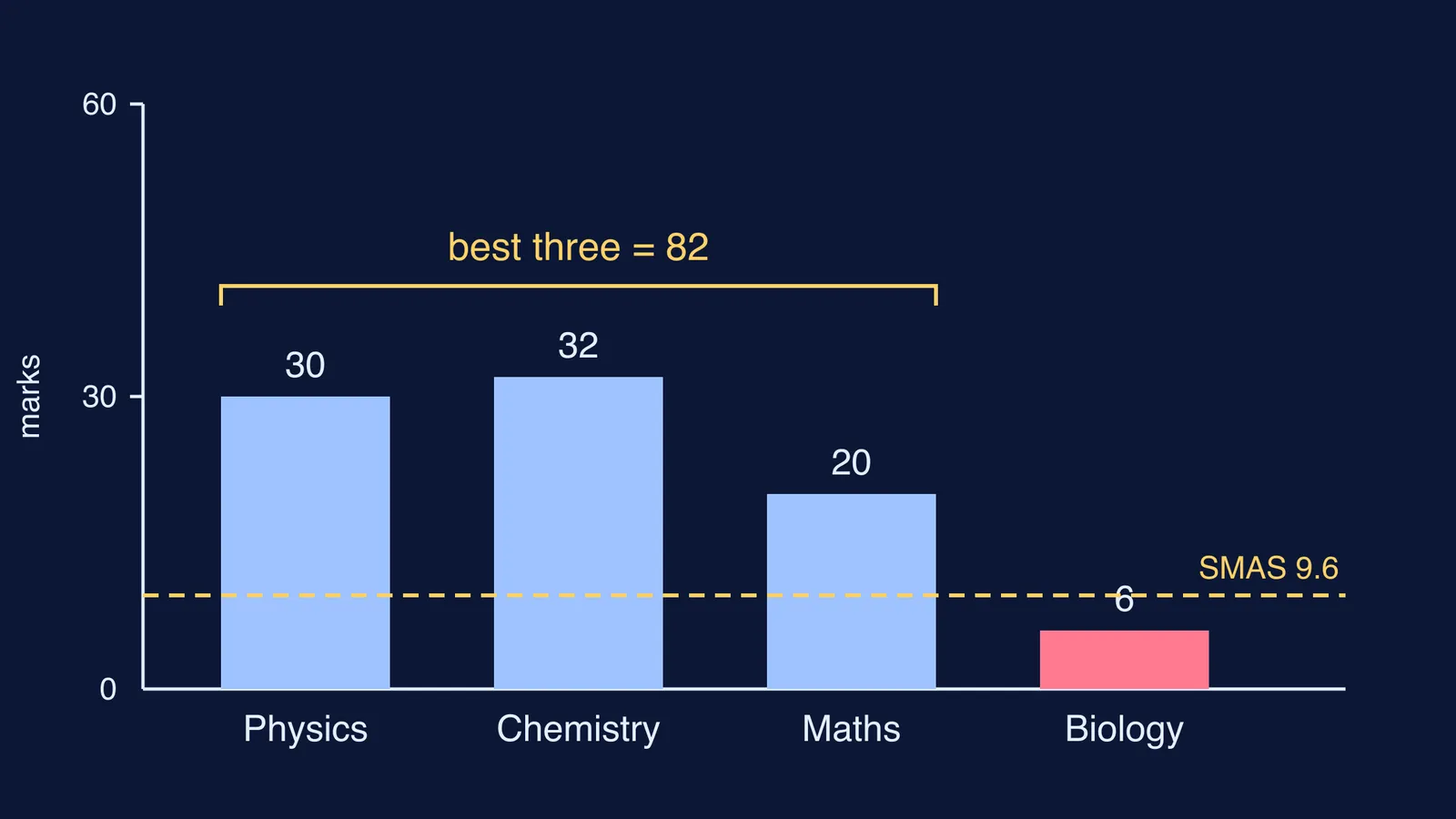
Each section has its own cut-off, the Section-wise Minimum Admissible Score (SMAS): 20% of the average of the best 100 scores in that section. OBC candidates need 90% of that figure; SC and ST candidates, 50%.
You must reach the SMAS in at least three sections. If you clear all four, your total is your best three.
Totals become percentiles, and you need a Minimum Admissible Percentile, announced with the results, to get a rank.
Ties are broken by your best two sections, then your best section. Any tie left is broken at admission by class XII, then class X marks.
A merit rank does not by itself guarantee a call for admission.
What does a worked NEST score look like?
The brochure's example SMAS is 9.6 marks (for chemistry); assume it holds for every section. Riya, an imaginary student, scores 30 in physics (11 right, 3 wrong), 32 in chemistry (12 right, 4 wrong), 20 in mathematics (8 right, 4 wrong) and 6 in biology (4 right, 6 wrong). Biology is below 9.6, but she clears the other three, so her total is 30 + 32 + 20 = 82.
Had she rushed mathematics to 5 right and 7 wrong, it would score 8, below the SMAS. With two qualifying sections she would get no total at all.
Which sections should you choose in NEST?
Pick three anchor sections. For most JEE students that is physics, chemistry and mathematics, with biology fourth. Biology students often anchor on biology, chemistry and physics instead.
The brochure gives 180 minutes for 80 questions, about 2 minutes 15 seconds each. A workable split is 50 minutes per anchor and 30 minutes for the fourth, done last.
The +3/−1 marking also tells you when to guess. With four options, a blind guess averages 3 × ¼ − 1 × ¾ = 0 marks. Rule out one option and it averages +⅓; rule out two and it averages +1. Guess only after eliminating at least one.
How do you prepare for NEST after boards and JEE?
Board and JEE preparation already covers much of the NCERT-based syllabus, so NEST mostly needs practice in its own format. A review of ten learning techniques by Dunlosky and colleagues (2013) rated only two as high utility: practice testing and spreading study over time. So build the plan on timed past papers from nestexam.in.
Before boards: one timed past NEST paper a month, plus class 10 science for your fourth section.
After JEE, week one: take a full paper and score each section with +3/−1. Flag any section near the cut-off (9.6 of 60 in the brochure's example; the real figure depends on each year's top scores).
Week two: fix your weakest anchor from NCERT. If your mistakes come from using the wrong method, the Fermi Problem Library has worked problems with a step-by-step solver that explains the reasoning rather than printing an answer.
Week three: two more full papers, practising section order and time split. Our guide to building a mock from past papers shows how to set one up at home.
Last few days: light review, the official mock test on the NEST website if it is open, and logistics. In 2026 candidates were told to arrive 60 minutes early, could not enter after 2:30 PM, and had to carry admit card and photo ID in a transparent pouch.
If a paper shows a whole topic missing, the Fermi Concept Library has a lesson for every concept in physics, chemistry, biology and mathematics. If three exams in one season start to feel heavy, talk to someone you trust, or call Tele MANAS on 14416.
Wondering where NEST leads? See what a BS-MS research degree leads to. For this week: download one past NEST paper, set a 3-hour timer, and score each section against the brochure's example cut-off of 9.6.