On this page
In most study groups, whoever knows the answer explains it and everyone else nods. Peer instruction flips the order: everyone commits to an answer alone, then you try to convince each other with reasons. Physicist Eric Mazur introduced it in his Harvard physics courses in 1991.
What is peer instruction?
Peer instruction is a teaching method in which students answer a short concept question individually, then discuss it with classmates and answer again (Crouch and Mazur, American Journal of Physics, 2001).
In Mazur's classes, students get one or two minutes to choose an answer alone. The instructor then asks them to try to convince each other by explaining the underlying reasoning, usually for two to four minutes. Students vote again, and the instructor explains the answer (Crouch and Mazur, 2001). Our profile of Eric Mazur and peer instruction tells how he got there.
Does explaining to classmates actually help you learn?
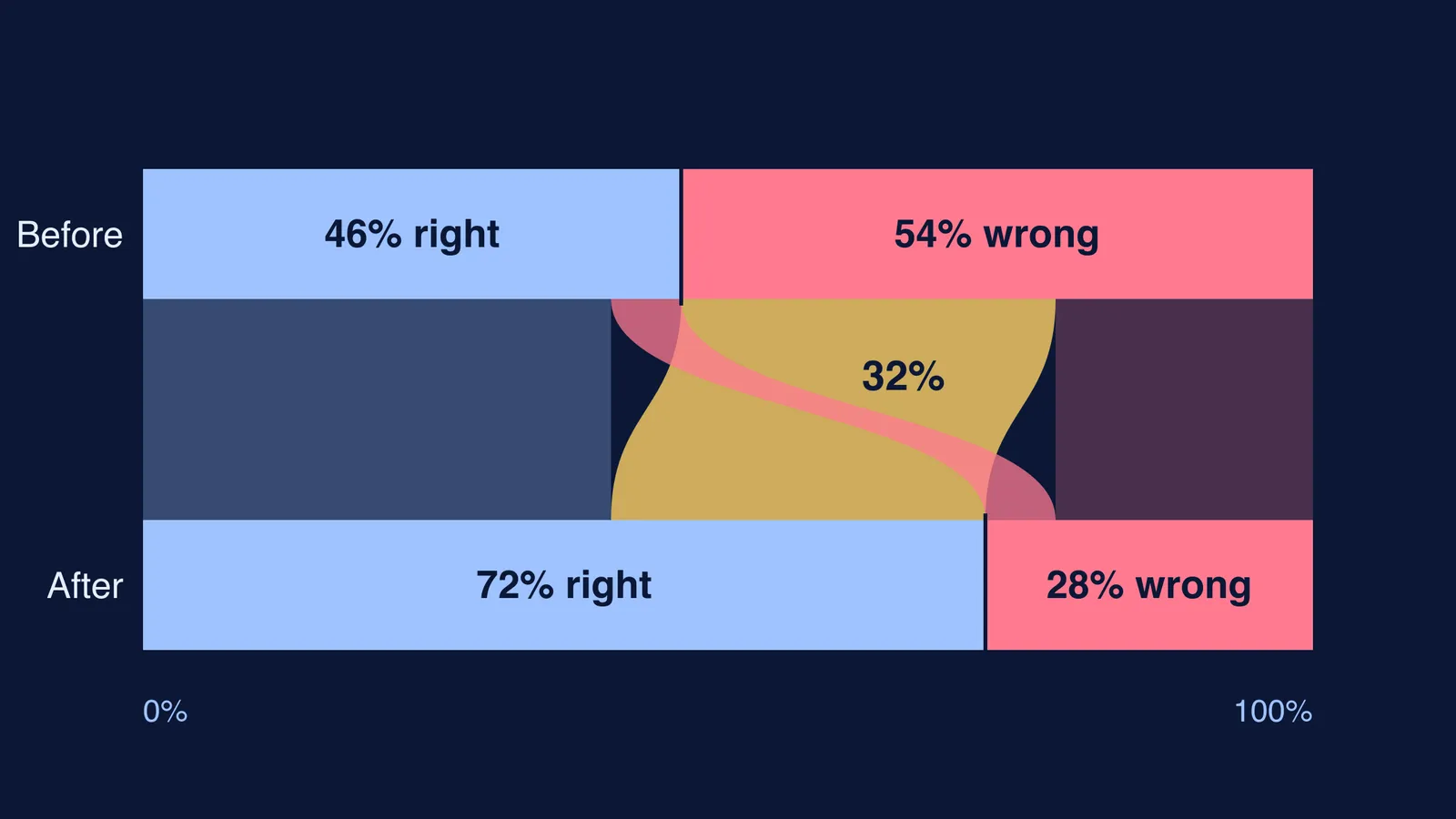
The classroom data points that way. Crouch and Mazur analysed answers to every concept question in one Harvard physics semester, Fall 1997 (American Journal of Physics, 2001):
32% of answers went from incorrect to correct after discussion.
Only 6% went from correct to incorrect.
40% were correct both times, and 22% were wrong both times.
The same paper reports that discussion raised the number of correct answers substantially as long as 35% to 70% of students got the question right at first, with the biggest improvement when about half did. On the Force Concept Inventory, a standard test of physics concepts, the course's normalized gain rose from 0.25 with traditional lectures in 1990 to 0.49 in 1991, the first year of peer instruction (Crouch and Mazur, 2001).
Maybe the student who knows just tells everyone else? A genetics-course study tested this with a second, similar question answered alone after discussion. The authors concluded that "peer discussion enhances understanding, even when none of the students in a discussion group originally knows the correct answer" (Smith and colleagues, Science, 2009).
A follow-up found that peer discussion followed by an instructor's explanation helped more than either alone, and that the strongest students were not helped by the explanation alone (Smith and colleagues, CBE Life Sciences Education, 2011). That suggests discussion matters even for the topper of your group, and that you still need a check at the end.
How do you run peer instruction in a study group?
One round takes about 12 minutes for three to five people. The person who picks the question changes every round.
Choose a concept question with a clear answer, ideally multiple choice, from NCERT exercises, a past paper or a worksheet. Aim for one that roughly half of you will get right.
Two minutes alone: write an answer, one line of reasoning, and how sure you are (sure, unsure, guessing). No talking.
Reveal together. If everyone agrees and is sure, pick a harder question.
Four minutes of convincing. Reasons only; "Sir said so" does not count.
Revote, in writing.
Check the answer key, or ask your teacher.
Each person answers one twin question alone: same idea, new situation.
Useful lines for step 4: "What would have to be true for your answer to work?", "Can you draw it?" and "Which law are you using, and does it apply here?"
Worked example: the artery question
This concept question appears in the 2001 paper: a blood platelet drifts with the blood from a narrow, partly blocked part of an artery into a wider part. Does its speed increase, stay the same or decrease?
Riya says it increases, because the wider part has more room. Arjun says it decreases and writes the continuity equation, A1v1 = A2v2: the same volume of blood passes every point each second, so where the area is bigger, the speed must be smaller. Riya sees that her "more room" idea never used the fact that the flow is fixed, and switches. The answer key says decreases.
Twin question: you squeeze the end of a garden hose to make it narrower. What happens to the water's speed there? (It increases.)
If no one can explain a concept, look it up before the next round; the Fermi Concept Library has its own lesson for every concept in physics, chemistry, biology, mathematics and computing. For twin questions, the Fermi Problem Library has worked problems with a step-by-step solver that explains the reasoning rather than printing an answer.
What goes wrong in peer instruction study groups?
One person always explains. Rotate who speaks first, and ask the quietest person to defend their answer.
Questions are too easy or too hard, so there is nothing to argue about.
You skip the check, and a confident group talks itself into a wrong answer.
To give each person a fixed job, borrow the roles in our guide to running a study group with AI; to practise explaining alone, try the Feynman technique. On days no friend is free, Fermi's AI tutor notices where you are stuck and decides whether to explain, ask or show, checking your understanding as it goes.