On this page
It is 11 pm and you have just finished your twenty-fifth projectile problem. The last ten felt easy, which is a sign they may have added little that you will still have next month.
What is overlearning, and does it actually help?
Overlearning is practice that continues after you can already get something right: in the words of Rohrer and colleagues, "Once material has been learned to a criterion of one perfect trial, further study within the same session constitutes overlearning."
In their experiments with 218 college students learning geography facts or word definitions, people who overlearned recalled far more than the others one week later, but that difference "decreased dramatically" on tests given later, up to nine weeks after study (Applied Cognitive Psychology, 2005). The authors called overlearning "an inefficient strategy" for remembering material for long periods.
Maths looks the same. In Rohrer and Taylor (2006), 216 college students learned one type of maths problem. In one experiment, some solved three practice problems and others solved nine in a single session; the extra six problems had no effect on test scores one or four weeks later. In another, students solved 10 problems either in one session or split across two sessions a week apart. The split made no difference on a test one week later, but the split group did far better on a test four weeks later.
How many practice questions are enough for a topic?
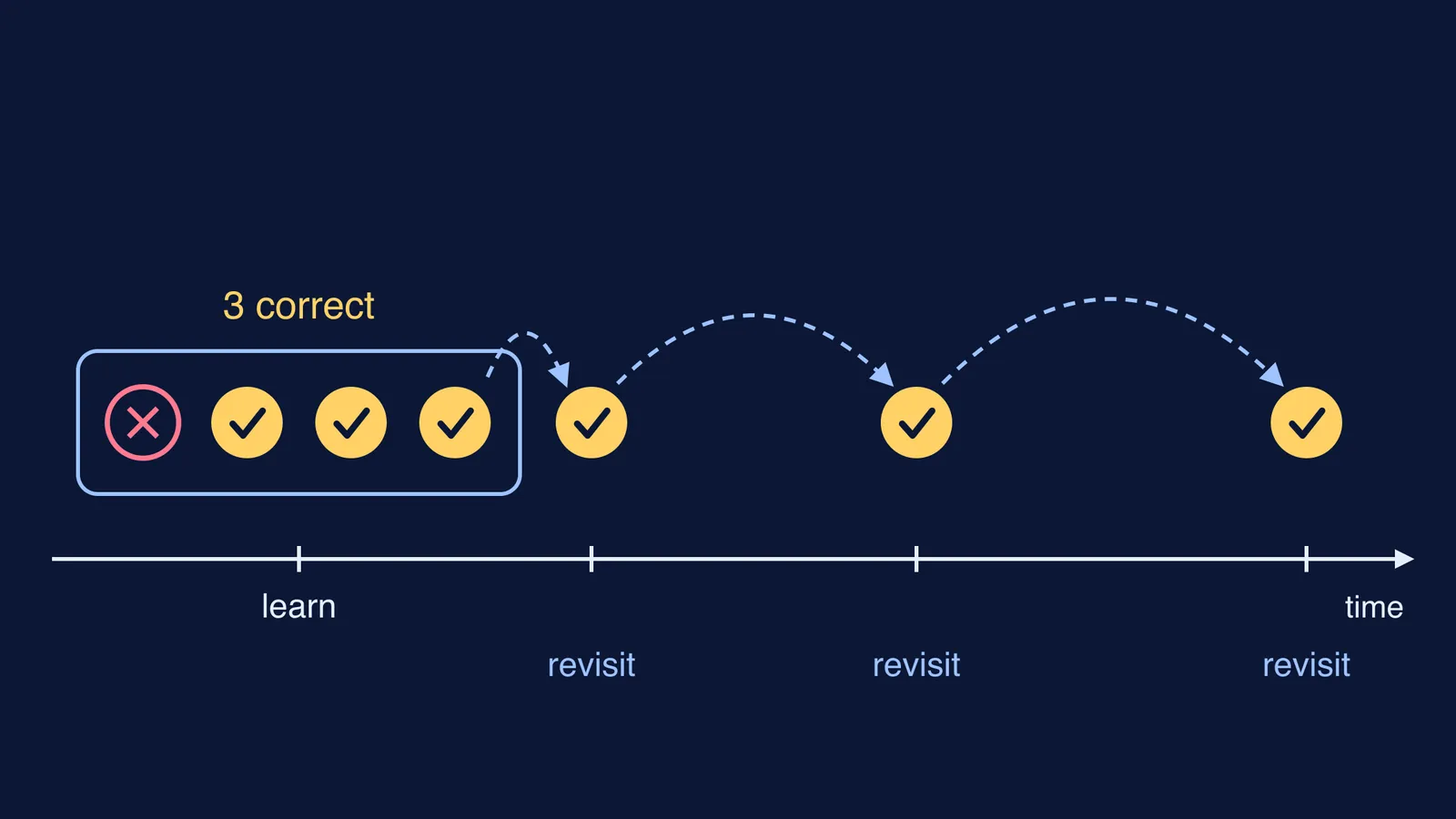
The clearest number comes from Rawson and Dunlosky (2011), who ran three experiments with 533 students learning concepts. Their advice to students: practise recalling each concept until you get it right 3 times, then relearn it 3 more times at widely spaced intervals. Extra correct answers on day one helped at first, but the benefit shrank once students came back for later sessions.
Their students were recalling definitions, not solving numericals, so for problem-solving we borrow the number as a rule of thumb rather than a proven threshold. Here is the rule:
Correct: the full answer, without looking at the solution or a hint.
Unseen: a problem you have not solved before. Redoing an old one tests your memory of the answer, not the method.
Mixed: shuffled in with problems from other chapters, so you must decide which idea to use.
Why mixed? In a classroom study with 126 seventh-grade students over three months, shuffling different kinds of problems into the practice sets (instead of blocking them by type) produced higher test scores one day and 30 days later, with the bigger gap at 30 days.
What does this look like for one chapter?
Say you are working on projectile motion for school or JEE Main physics.
Learn the idea and go through two or three worked examples.
Build a mixed set: new projectile problems shuffled with problems from 1D kinematics, relative velocity and Newton's laws.
Work through it. When you miss a projectile problem, read the solution, find the exact step that went wrong, then try a fresh one.
Stop when you have three correct, unseen projectile problems. Move to another topic.
Write three revisit dates in your planner, with growing gaps (for example a few days, about two weeks, about a month).
At each revisit, try one unseen mixed problem. If it is right, you are done for that day. If not, relearn and keep going until you get one right.
Spacing practice out and testing yourself are the two techniques rated "high utility" in a major review of study methods.
When should you keep practising past three?
Your three came with hints. Peeking at the formula sheet means the count has not started.
You keep making the same mistake. That is a gap in the idea, not a shortage of practice. The Fermi Concept Library has a lesson for every concept in physics, chemistry, biology and mathematics, so you can fix the idea before you go back to problems.
You pick the wrong method. The Fermi Problem Library has worked problems with a step-by-step solver that explains the reasoning rather than printing an answer.
You are training for speed. Timed mixed sets are a separate goal; start them once the topic is learned.
If you do not know where to begin, Fermi's AI tutor works out what you already know and builds a plan for the session, so revisits do not become another twenty-five problems.
How can parents check practice without counting problems?
"How many did you do today?" rewards volume. Try these instead:
"Show me three you had not seen before, mixed with an older chapter."
"Which one did you get wrong, and what was the step that went wrong?"
"When are you coming back to this chapter?"
Tonight, stop at three. Put the next one in your planner.