On this page
Every time you factor a cubic in class by writing its coefficients in a row and running a quick multiply-and-add, you are using a method named after Paolo Ruffini. He was born on 22 September 1765 in Valentano, in the Papal States, and died in Modena on 10 May 1822, according to his MacTutor biography at the University of St Andrews. He graduated from Modena in 1788 in philosophy, medicine and surgery, took a mathematics degree soon after, and practised medicine alongside his mathematics. He gave algebra two things: a fast way to divide polynomials, and the first published claim that some equations have no formula.
Who invented synthetic division?
In 1802 the Italian Society of Forty offered a gold medal for the best method of finding the roots of a numerical equation of any degree, and in 1804 the medal went to Ruffini, according to the Catholic Encyclopedia entry on Ruffini. The same entry says Ruffini published what is now called Horner's method fifteen years before William Horner's first paper on it appeared in 1819. That is why some books say "Horner's scheme" for the same arithmetic.
Ruffini's rule is a method for dividing a polynomial by a binomial of the form x − r. It is a special case of synthetic division in which the divisor is a linear monic factor (Wikipedia: Ruffini's rule).
How does Ruffini's rule work? A worked example
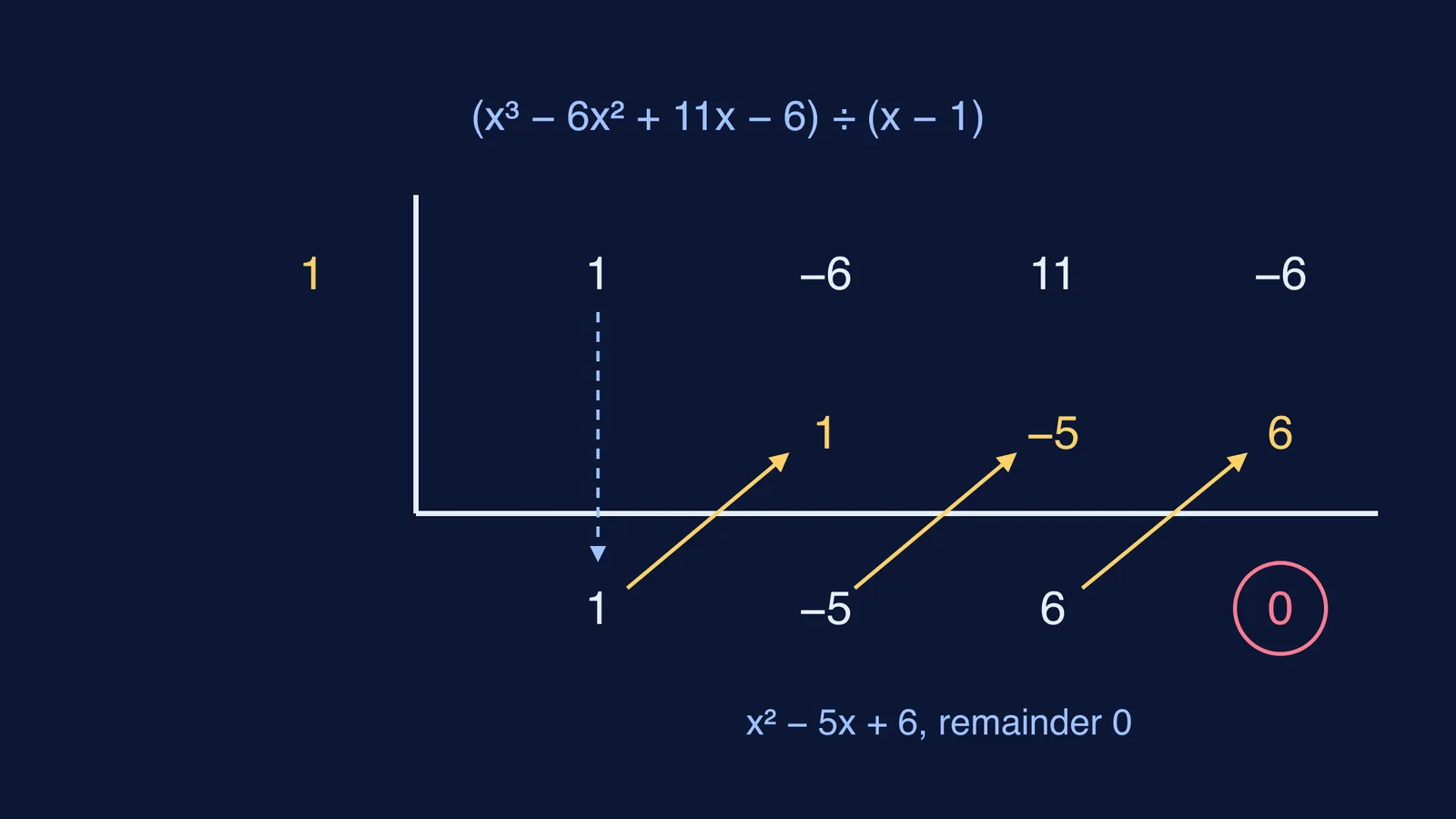
Take P(x) = x³ − 6x² + 11x − 6. Try x = 1: P(1) = 1 − 6 + 11 − 6 = 0, so (x − 1) is a factor. Now divide.
Write the coefficients in a row: 1, −6, 11, −6. Write the root, 1, to the left.
Bring the first coefficient straight down: 1.
Multiply it by the root (1 × 1 = 1), write that under the next coefficient, and add: −6 + 1 = −5.
Repeat: −5 × 1 = −5, and 11 + (−5) = 6.
Repeat: 6 × 1 = 6, and −6 + 6 = 0.
Read the bottom row. The last number, 0, is the remainder. The others, 1, −5, 6, are the quotient: x² − 5x + 6.
So P(x) = (x − 1)(x − 2)(x − 3). The diagram above shows these steps.
Degree does not matter. For the quintic x⁵ − 2x⁴ − x + 2 with r = 2, the coefficients are 1, −2, 0, 0, −1, 2 and the bottom row is 1, 0, 0, 0, −1, 0. Remainder 0, quotient x⁴ − 1, so the quintic is (x − 2)(x² − 1)(x² + 1).
Why is there no formula for the quintic?
Quadratics, cubics and quartics have formulas. Ruffini's 1799 book, *General theory of equations in which it is shown that the algebraic solution of the general equation of degree greater than four is impossible*, made the claim that degree five breaks the pattern, and MacTutor notes that no mathematician had published such a claim before him. To argue it, he studied how the roots of an equation can be shuffled, inventing ideas about permutations that later became part of group theory.
The Abel–Ruffini theorem states that there is no solution in radicals to general polynomial equations of degree five or higher with arbitrary coefficients (Wikipedia: Abel–Ruffini theorem). Ruffini's proof had a gap: he assumed that every radical in a solution could be built from the roots using ordinary arithmetic. Niels Henrik Abel closed that gap in a proof published in 1824, which is why both names are on the theorem. Évariste Galois later found a way to decide, for any particular equation, whether it can be solved by radicals.
The theorem does not say quintics are unsolvable. Many, like the one above, factor easily. What cannot exist is one formula in radicals that works for every quintic.
Why was Ruffini ignored?
According to MacTutor, Ruffini sent Lagrange a copy of his book in 1801 and got no response, then sent a second copy, and the wider reaction to his proof was cool. In 1798 he also lost his professorship because, on religious grounds, he could not swear an oath of allegiance to the new Cisalpine Republic. He became rector of the University of Modena in 1814. In 1817 he caught typhus while treating patients during an epidemic and never fully regained his health.
Recognition came late. In 1821 Augustin-Louis Cauchy wrote to him that his memoir "proves completely the impossibility of solving algebraically equations of higher than the fourth degree", as quoted in the same biography. Ruffini died the next year.
If the factor theorem still feels shaky, the Fermi Concept Library has a lesson for every concept in mathematics, with its place in the map. To check a factorisation line by line, the Fermi Problem Library has worked problems with a step-by-step solver that explains the reasoning rather than printing an answer.
Next time you divide a polynomial, write out the Ruffini table before reaching for long division.