

On this page
If you are planning a career in research and pure sciences in India, three sets of public institutes stand out: the Indian Institute of Science (IISc), the Indian Institutes of Science Education and Research (IISERs), and the National Institute of Science Education and Research (NISER). All three offer rigorous undergraduate science degrees designed to train future scientists, but their programmes differ fundamentally in length, course structure, and the point at which students begin independent research.
Here is a breakdown of how the BS (Research), BS-MS, and Integrated MSc programmes compare to help you choose the right path for your scientific career.
What is the difference in programme duration?
The most obvious difference is the length of the degree and what you receive at the end of it.
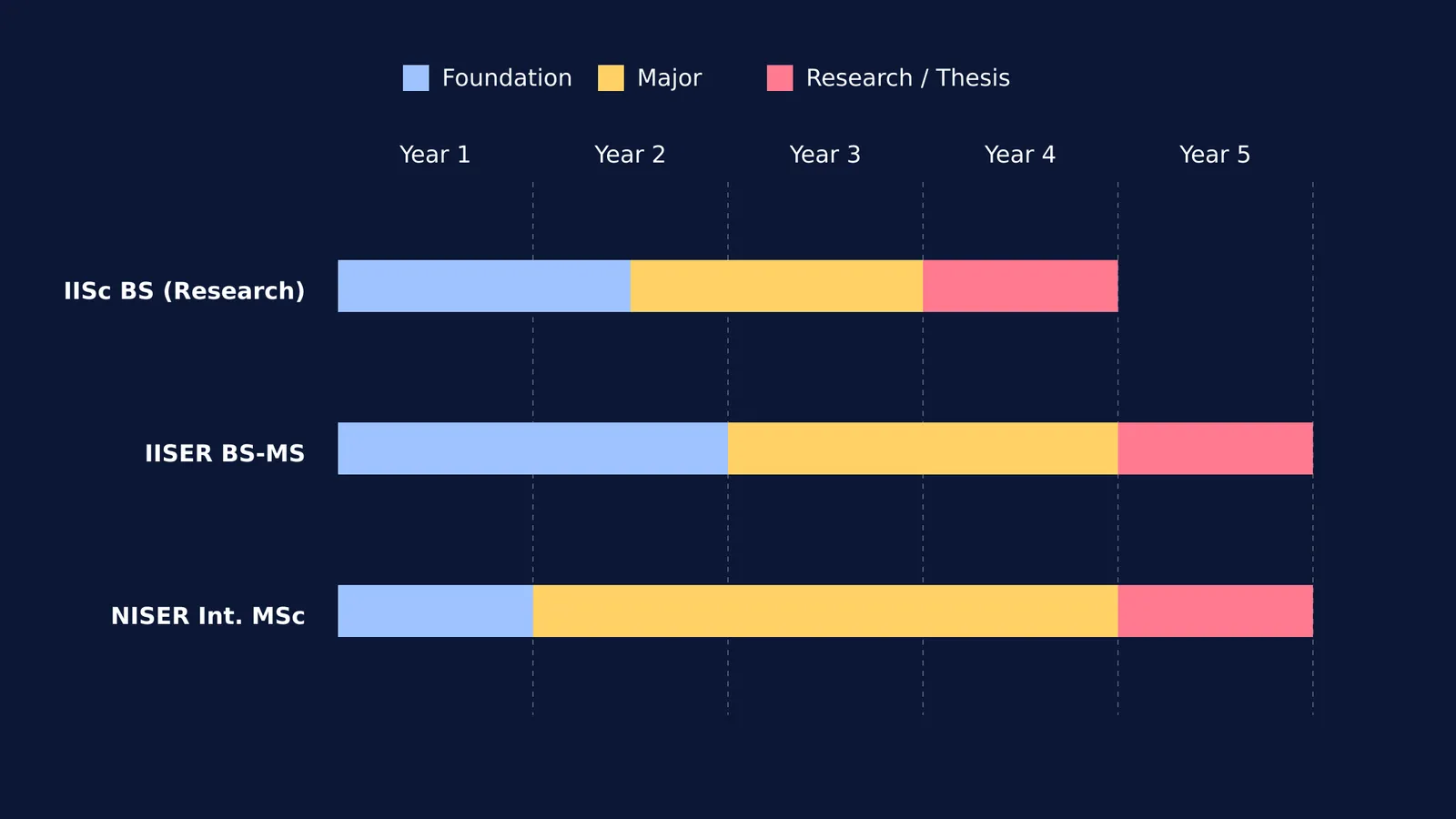
IISc Bangalore offers a four-year Bachelor of Science (Research) degree. It is designed to match international undergraduate standards, allowing students to apply directly for PhD programmes abroad upon graduation. Students also have the option to stay for a fifth year to complete a Master of Science (MS) degree (IISc Admissions).
IISERs (located in Pune, Kolkata, Mohali, Bhopal, Thiruvananthapuram, Tirupati, and Berhampur) primarily offer a five-year BS-MS dual degree. You graduate with both a bachelor's and a master's degree simultaneously. Note that IISER Bhopal also offers a standalone four-year BS programme specifically in Economic Sciences and Engineering Sciences (IISER Bhopal Programmes).
NISER (Bhubaneswar) and UM-DAE CEBS (Mumbai) offer a five-year Integrated MSc degree. Similar to the IISERs, it is a direct transition from basic science to postgraduate research (NISER Academics).
How does the course structure vary?
All three institutions require students to study a broad range of scientific disciplines before specializing, but the duration of this foundation phase differs.
At IISc (IISc Admissions), the foundation curriculum lasts for three semesters (1.5 years). During this time, all students take core courses in physics, chemistry, mathematics, biology, engineering, and humanities. In the fourth semester, students declare their major from options such as Physics, Chemistry, Mathematics, Biology, Materials, or Environmental Science.
The IISERs (IISER Bhopal Programmes) have a slightly longer foundation phase. For the first two years (four semesters), students study all core science subjects—physics, chemistry, mathematics, and biology—along with interdisciplinary electives, regardless of what they intend to major in. Students declare their major at the beginning of their third year. If you find the transition during your first semester at science college challenging, the Fermi Concept Library holds every concept in physics, chemistry, biology, mathematics and computing, each with its own lesson and its place in the map.
NISER (NISER Academics) requires a one-year foundation programme where students take compulsory courses in all four basic sciences. From the second year onwards, they choose their major while still taking some compulsory minor courses in other disciplines to maintain an interdisciplinary approach.
When does research start?
The defining feature of these institutes is their heavy emphasis on hands-on laboratory research, but the timeline depends on the degree structure.
In the IISc BS (Research) programme (IISc Admissions), the entire fourth year (semesters seven and eight) is dedicated to an independent research project. Students work under the supervision of a faculty member, often culminating in a thesis that is equivalent to early-stage graduate work. Before this, many students seek research internships during their summer breaks.
In both the IISER BS-MS (IISER Bhopal Programmes) and NISER Integrated MSc (NISER Academics) programmes, the entire fifth year is dedicated to a master's thesis or research project. Students are excused from regular coursework during this year so they can focus entirely on working in a laboratory, conducting experiments, and writing their thesis. If you are reading scientific papers for your thesis and need to visualize complex models, the Fermi Simulation Lab offers interactive simulations for the ideas that are easier to see than to read.
Which entrance exams are accepted?
Admission channels have been streamlined across these institutes, and you must appear for specific exams depending on where you apply.
IISc BS (Research) admission: As of the 2026 academic cycle, IISc admits students based on their ranks in JEE Advanced or the IISER Aptitude Test (IAT) (IISc Admissions). Note that JEE Main and NEET (UG) are no longer accepted for the BS (Research) programme.
IISERs: Admission is conducted through the IISER Aptitude Test (IAT) (IISER Bhopal Programmes).
NISER and CEBS: Admission is based on the National Entrance Screening Test (NEST), which is a dedicated exam for these two institutes (NISER Academics).
How to choose between IISc, IISER and NISER?
When deciding between these institutes, ask yourself these practical questions:
Do I want a master's degree immediately? If yes, the 5-year programmes at IISER and NISER integrate it. If you want to pursue a PhD abroad immediately after a bachelor's, the 4-year IISc degree is perfectly aligned.
How quickly do I want to specialize? Choose IISc (1.5 years) or NISER (1 year) if you are eager to dive into your major. Choose IISER (2 years) if you want a longer, broader foundation in all sciences.
Am I interested in the Department of Atomic Energy? If working with BARC or DAE facilities is a long-term goal, NISER offers a direct academic and professional pathway.


