On this page
The BS-MS dual degree at the Indian Institutes of Science Education and Research (IISER) is designed to train scientists. Throughout the program, you focus heavily on fundamentals, interdisciplinary coursework, and a final-year research project. But when the degree ends, you are not forced into a single track.
While academia remains the most common route, the rigorous training in mathematics, programming, and data analysis opens doors to the technology and pharmaceutical industries. Here is what the actual career landscape looks like for an IISER graduate today.
What is the PhD route like?
If you want to run a laboratory, direct clinical trials, or teach at a university, a PhD is mandatory. For an IISER student, the transition is natural. The fifth year of the BS-MS program is entirely dedicated to a master's thesis, which acts as a trial run for doctoral research and provides the publications and recommendation letters needed for strong applications.
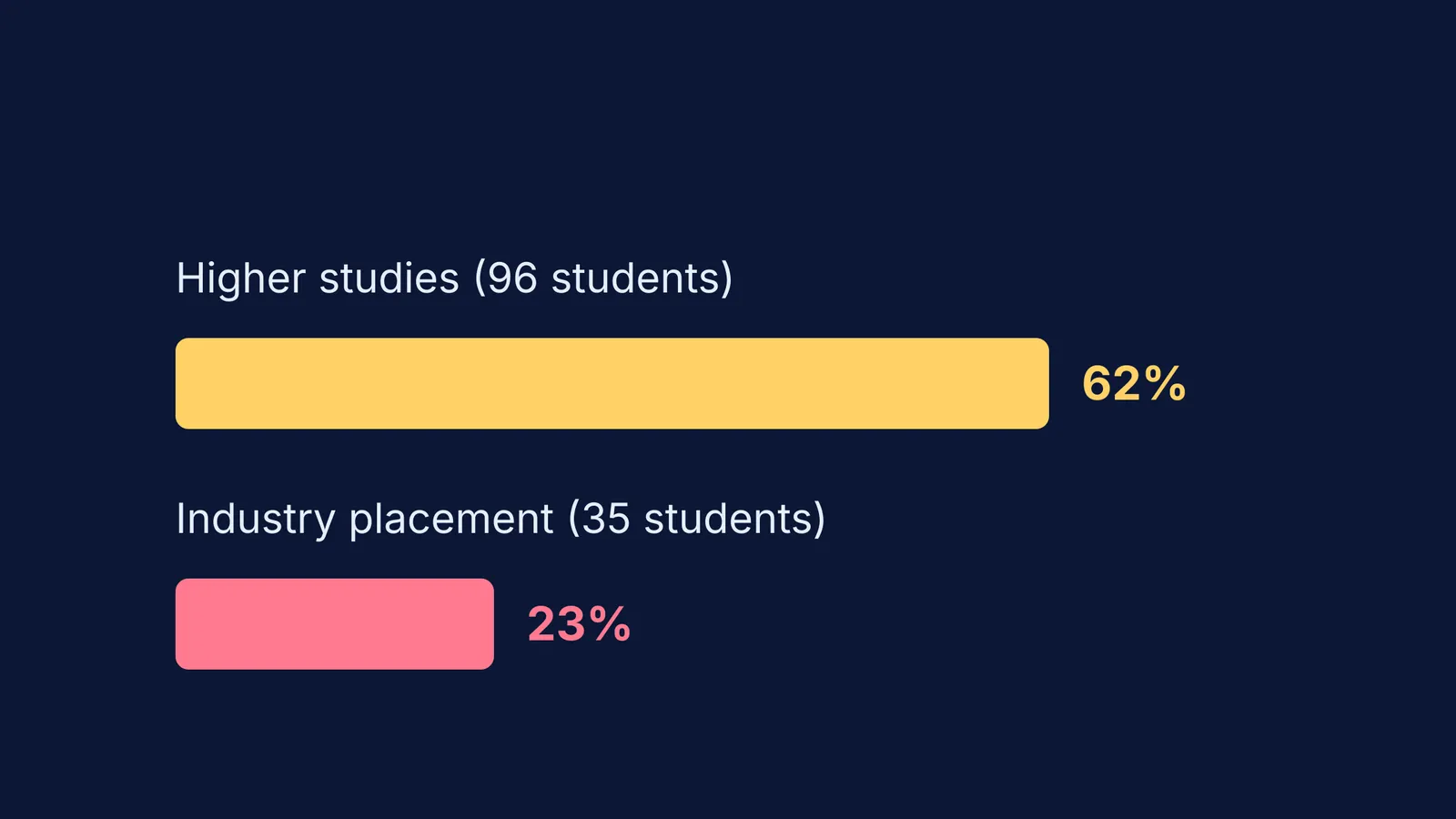
The numbers reflect this design. According to the National Institutional Ranking Framework (NIRF) 2024 report for IISER Bhopal, 96 out of 155 graduates (62%) in the 2024 batch chose to pursue higher studies. Graduates routinely secure funded PhD positions at institutions like the Max Planck Institutes, MIT, Stanford, and IISc Bangalore.
What are the industry prospects?
Not everyone wants to spend several more years in a lab. In recent years, campus placements at IISERs have steadily risen, driven by the demand for strong analytical skills.
In the 2024 batch at IISER Bhopal, 35 students entered the workforce through campus placements, securing a median salary of ₹14.5 lakh per year.
Graduates typically find roles in two main sectors:
Data science and tech: The heavy mathematics and computing foundation makes IISER graduates highly competitive for roles as data analysts and machine learning engineers at companies like Deloitte, Amazon, and TCS Research.
Pharmaceuticals and FMCG: Chemistry and biology majors often join R&D divisions at companies like Dr. Reddy's Laboratories, Biocon, and Hindustan Unilever, working on drug discovery or materials science.
Government research: how do you join ISRO and BARC?
Many students enter an IISER hoping to work for the Indian Space Research Organisation (ISRO) or the Bhabha Atomic Research Centre (BARC). It is a viable path, but it is not automatic.
Unlike graduates from NISER, who can skip the written exam for BARC if their CGPA meets a certain threshold, IISER students must qualify through competitive exams. To join BARC as a Scientific Officer, you must clear the OCES/DGFS online exam or hold a high GATE score, followed by a rigorous interview. ISRO recruits science graduates for Scientist 'SC' positions through its own entrance tests or GATE scores.
These interviews famously test your grasp of first principles rather than your ability to recall formulas. If you need to rebuild your fundamentals before a technical interview, the Fermi Concept Library holds every concept in physics, chemistry, biology, mathematics and computing, each with its own lesson and its place in the map.
How do you choose your path?
Deciding what to do after your fifth year is daunting. Instead of waiting until your final semester, use this three-question framework during your fourth year to test your fit for academia versus industry.
How do you handle open-ended failure?
In a PhD, you are solving problems where nobody knows the answer, and your experiments will fail more often than they succeed. If you previously wondered why some JEE aspirants plateau despite studying every day, you will find that research requires a completely different kind of stamina. If you prefer solving defined problems with clear, near-term impact, look toward industry or data science.
Did you enjoy your summer internships?
IISER students undertake summer projects from their first year. There are many excellent research internships for science undergraduates in India across national labs. Try to do one internship in a purely academic lab and another in an industrial or applied setting. Which environment felt like a place you could spend your working week?
Are you prepared for the timeline?
A PhD takes several years, during which you will earn a modest stipend. Industry roles offer immediate financial independence and structured career progression. You must weigh your intellectual curiosity against your financial goals.
The BS-MS degree is demanding, but it buys you versatility. Whether you end up sequencing genomes, building machine learning models, or designing satellite trajectories, the underlying skill—learning how to think scientifically—remains exactly the same.