

On this page
A bought test series is someone else's guess at your exam. A mock you build from previous year questions (PYQs) uses the examiner's own questions, in the proportions the examiner chose, and it costs nothing. It also teaches while it measures. In a study in Psychological Science, Henry Roediger and Jeffrey Karpicke found that students who took recall tests on prose passages remembered more after two days and after a week than students who restudied, though restudying did better on a test five minutes later and made students feel more confident. A 2017 meta-analysis by Olusola Adesope and colleagues found practice tests more beneficial for learning than restudying.
Here is how to build one in an evening, with JEE Main as the worked example.
What should a self-made mock look like?
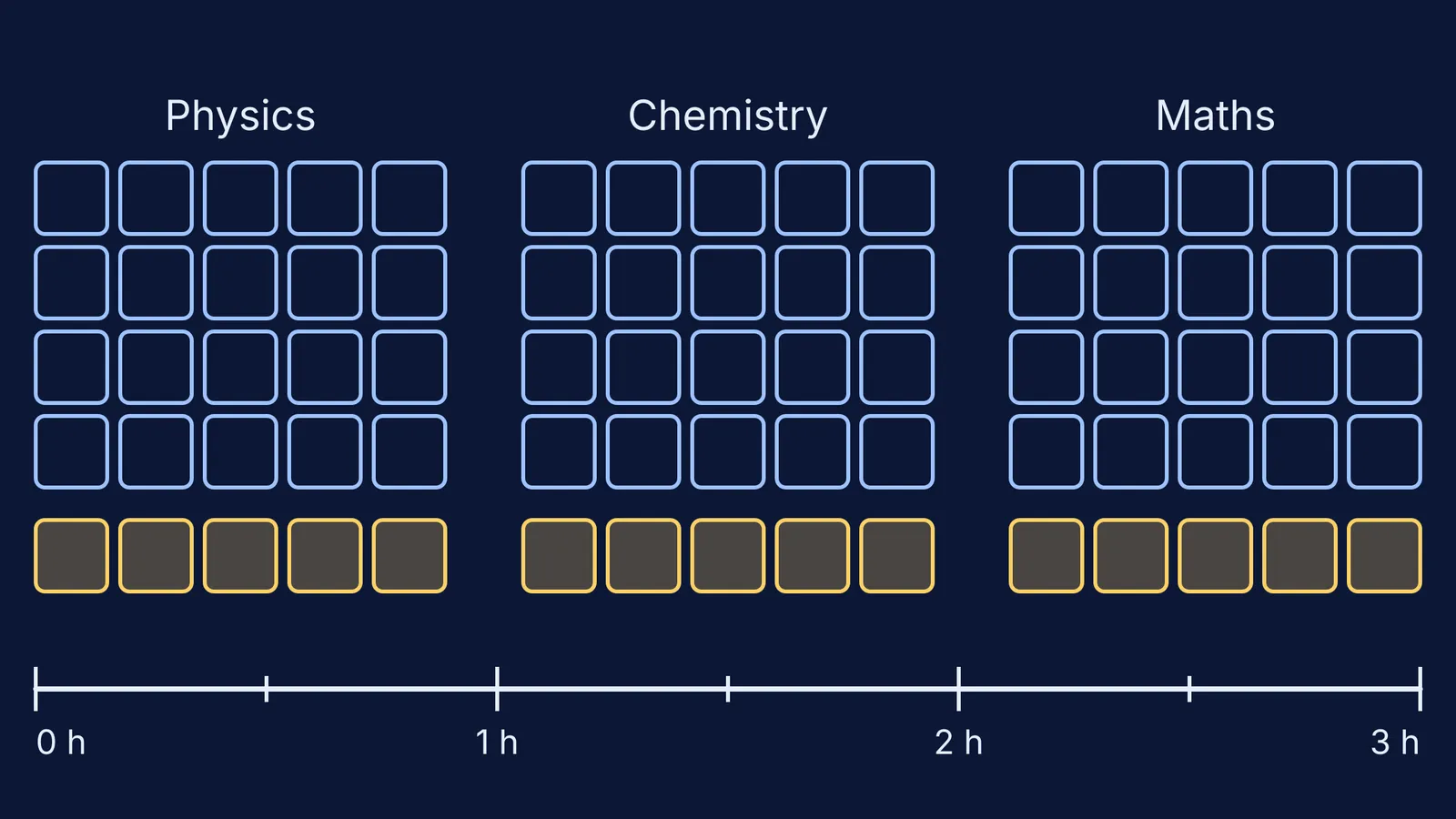
Copy the shape of the real paper from the current official bulletin, not from memory. According to NTA's JEE (Main) 2027 Information Bulletin, Paper 1 (B.E./B.Tech.) has:
75 questions: 25 each in Physics, Chemistry and Mathematics
20 multiple-choice questions (Section A) and 5 numerical-value questions (Section B) in each subject
300 marks and 3 hours (4 hours for PwD candidates eligible for a scribe)
+4 for a correct answer, −1 for a wrong one and 0 for unanswered, in both sections
That works out to 2.4 minutes per question on average. For NEET-UG, boards or any other exam, open that exam's latest official bulletin or sample paper and copy its shape the same way.
Where do I find previous year questions?
NTA posts recent papers on the JEE Main website under "Question Papers". At the time of writing it lists B.Tech. shifts from April 2026, such as the 2 April 2026 Shift 1 paper. Check each chapter against the current JEE Main syllabus and drop questions from anything no longer listed.
How do I pick questions by chapter weight?
Chapter weight means how many questions a chapter has had in recent papers. Our guide to using JEE Main chapter weightage covers how to read it; here you measure it yourself from the official NTA papers.
Choose four recent shifts. In each subject that gives you 100 questions to tally.
Write down only the chapter of each question. Don't solve anything yet.
Divide each chapter's tally by four. That is its number of slots in a 25-question section, because 100 ÷ 4 = 25.
Round, then adjust until each subject has exactly 20 MCQ slots and 5 numerical slots.
Fill each slot with a question on that chapter, ideally from a shift outside your tally.
Put the answer key in a separate file you don't open until you finish.
Worked example: Electrostatics has 9 tallies in your Physics sheet. 9 ÷ 4 = 2.25, so it gets 2 slots. A chapter with 3 tallies gets 0.75, which rounds to 1. Chapters with a single tally share whatever slots are left after rounding.
How do I time and mark it like the real exam?
Sit it in one 3-hour block, the duration in NTA's bulletin for Paper 1. Phone in another room, a clock, rough sheets and nothing else. In Section B, give whole numbers: the bulletin says numerical answers should be rounded off to the nearest integer. Our full-length mock rehearsal guide covers the rest of the setup.
Then mark with the real scheme, subject by subject. Worked example: in Physics you get 15 right, 6 wrong and leave 4 blank. That is 15 × 4 = 60, minus 6, so 54 out of 100. Counting only correct answers, you would have written 60 and missed that the wrong guesses cost you 6 marks.
Record four numbers per subject: correct, wrong, blank, and marks lost to negatives. If you also note the minute you start each question, a time log per question shows where your three hours went.
What do I do after marking?
Give every wrong or blank question one label:
Concept gap: you didn't know the idea.
Wrong method: you knew the idea but set the problem up badly.
Slip: a sign, unit or arithmetic error.
Time: you could do it but never reached it.
Concept gaps send you back to the chapter. The Fermi Concept Library gives each concept in physics, chemistry, biology and mathematics its own lesson and its place in the map. For wrong-method errors, redo the question yourself first, then compare your setup with the Fermi Problem Library, whose step-by-step solver explains the reasoning rather than printing an answer. Slips and time problems are fixed by the next mock, not by more reading.
Build your next mock with the same weights and new questions, then compare the four numbers, not just the total.


