

On this page
Why do students run out of time in mock tests?
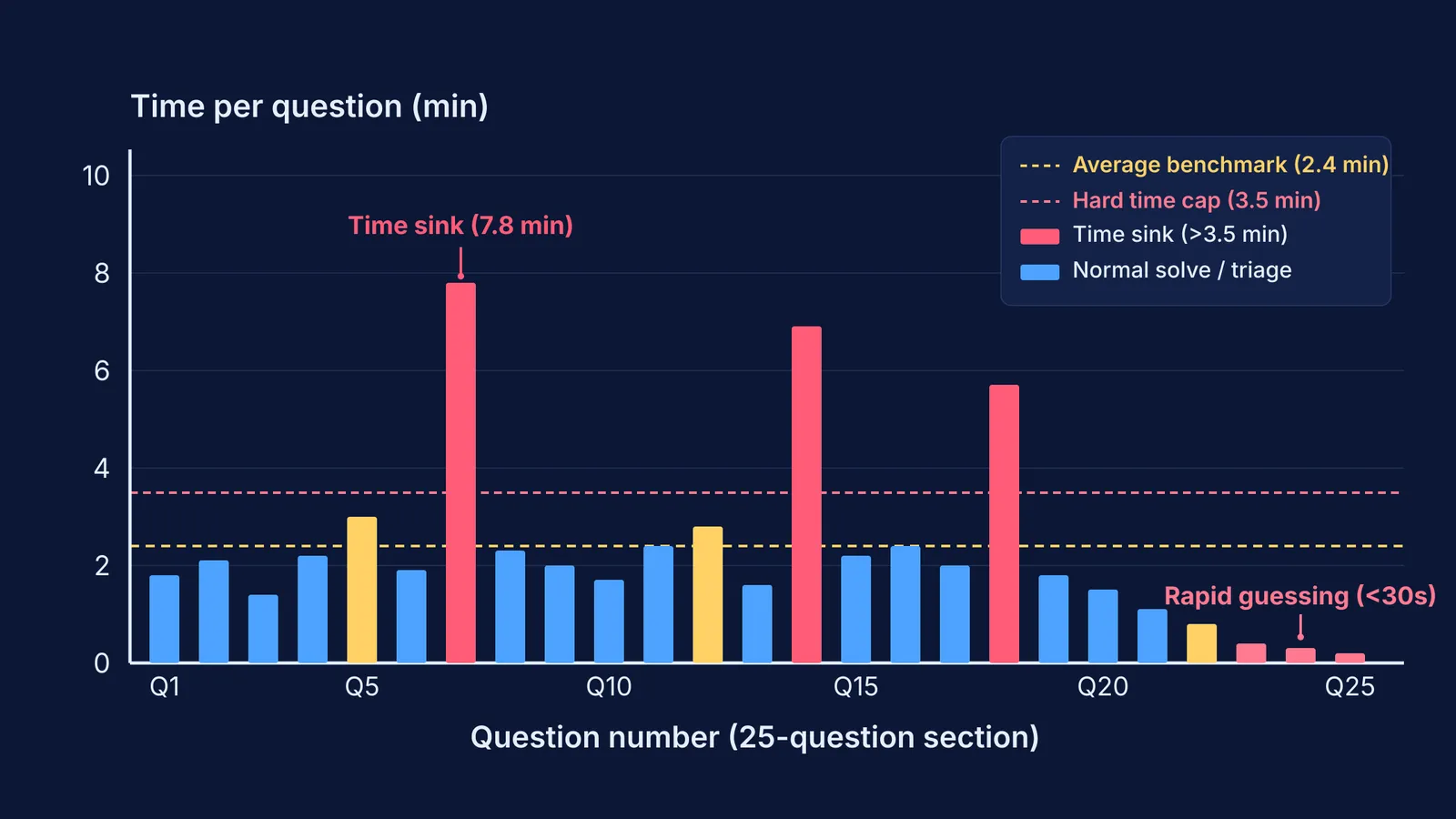
In major competitive exams, time per question is tightly bounded. According to National Testing Agency guidelines, JEE Main requires attempting 75 questions in 180 minutes, giving an average benchmark of 2.4 minutes per question. In NEET-UG, candidates face 180 questions in 200 minutes, leaving approximately 67 seconds per item. Yet during a three-hour test, time disappears unevenly into stubborn problems rather than a steady rhythm.
When a question feels familiar but resists a solution, students instinctively persist. In a 1988 study in the *Journal of Experimental Psychology: Learning, Memory, and Cognition*, Thomas O. Nelson and R. Jacob Leonesio identified this trap as the "labor-in-vain effect." Learners consistently allocate the most time to the items they find hardest, yet this extra effort yields almost no measurable gain in correct recall. Spending seven minutes wrestling with a calculation rarely turns a wrong answer into a right one.
The real damage appears at the end of the test. Research in *Applied Measurement in Education* by Steven L. Wise and Xiaojing Kong showed that time deficits trigger "rapid guessing," where students pick answers without processing the text. Burning fifteen minutes on two early roadblocks forces frantic guessing on the final ten questions, sacrificing easy marks.
How do you track time per question on rough sheets?
According to National Testing Agency examination conduct rules, wristwatches and personal timers are prohibited in test centres. While computer-based test interfaces display a countdown clock for the overall session, none track the minutes spent on the current problem. The simplest tracking tool that works inside strict exam environments is the rough sheet margin timestamp.
Before the test begins, draw a vertical line down your rough paper to create a three-centimetre margin on the left side. Whenever you begin a question, check the screen countdown and write the remaining minutes beside your working. If the clock shows 152 minutes when you start Question 4, write `152`. If you begin Question 5 at 149 minutes, write `149`.
The difference is immediate: Question 4 took three minutes (`152 − 149 = 3`). Recording raw clock numbers takes two seconds and requires no mid-test mental arithmetic. For fast-paced sections like NEET biology, note timestamps every five questions (such as Questions 1, 6, 11, and 16) to establish clear checkpoints.
This habit works smoothly alongside the JEE Main computer-based test screen, where the countdown timer stays pinned in the top corner.
What is a time-sink audit?
A time log becomes valuable the moment the mock ends. Under official JEE Main scoring rules (+4 for correct answers, −1 for incorrect answers), losing marks on a question you spent five minutes on represents a severe double penalty. During post-mock review, compile your timestamps alongside your answer key to run a focused diagnostic, as outlined in our guide on how to analyse a mock test. Sort every attempted question into three buckets:
Fast Solves: Solved correctly within or below benchmark time.
Productive Grinds: Solved correctly, but taking 1.5 to 2 times benchmark time.
Time Sinks: Questions taking over 1.5 times benchmark time that ended in an incorrect response, negative marking, or abandonment.
Time sinks are the primary driver of score plateaus. Sinking eight minutes into a question to score −1 mark also steals the time needed to solve three accessible two-minute questions later in the paper.
Reviewing Productive Grinds and Time Sinks usually reveals convoluted algebraic paths. The Fermi Problem Library provides worked problems with a step-by-step solver that explains the reasoning rather than printing an answer, helping you spot cleaner derivations. If a time sink stemmed from a missing foundation, the Fermi Concept Library covers every concept in physics, chemistry, biology, mathematics and computing, each with its own lesson and its place in the map.
How should you set question time caps for your next mock?
Auditing time sinks allows you to establish non-negotiable boundaries. In a 2000 study published in the *Journal of Experimental Psychology: Learning, Memory, and Cognition*, Lisa K. Son and Janet Metcalfe found that under time pressure, learners achieve far better results when focusing on their "Region of Proximal Learning"—moderately challenging items within reach—rather than struggling with the hardest problems.
Apply this finding by enforcing three rules in your next mock:
The 90-second triage rule: If you cannot identify a solution pathway within 90 seconds, flag the question and move on immediately.
The 1.5× benchmark hard cap: Cap any single JEE Main problem at 3.5 minutes and any NEET numerical at 90 seconds. If you reach this ceiling without being steps away from an answer, abandon the question.
The two-pass discipline: In Round 1, solve only direct definitions and confident standard applications, securing the majority of straightforward marks early in the test. In Round 2, use your banked buffer for flagged medium-difficulty questions.
Logging margin timestamps and enforcing hard question caps keeps your pacing disciplined, protects easy marks, and prevents exam-hall panic, supporting families looking to help children learn without adding pressure.


