
On this page
Your first stipend or part-time income is a good time to set up money habits, because the amounts are small and mistakes are cheap. The order matters more than the product: a cash cushion first, then a boring monthly investment, and a short list of things to avoid.
Why should you build an emergency fund before investing?
An emergency fund is money kept aside only for surprises: a laptop that dies before exams, a medical bill, a last-minute ticket home. Without it, the first surprise forces you to sell investments at whatever price the market offers.
The National Institute of Securities Markets notes that most financial advisors suggest an emergency fund of three to six months of household expenses (NISM, Save for Emergencies). The same page says keeping it at home or in the bank are appropriate, and that liquid mutual funds can also be used, because safety and quick access matter more here than returns.
For a student whose fees and hostel are paid by family, "expenses" means your own monthly spending: food outside the mess, phone, travel, books. Start with one month, then build towards three.
How do SIPs and index funds work?
A Systematic Investment Plan (SIP) is a way to invest a fixed amount in a mutual fund scheme at regular intervals, such as once a month, instead of a lump sum, and instalments can be as little as ₹500 a month (Mutual Funds Sahi Hai, AMFI).
An index fund is a passive mutual fund that copies a market index instead of a fund manager picking stocks (Mutual Funds Sahi Hai). Its returns differ slightly from the index because of costs, which is called tracking error.
The Nifty 50 holds 50 companies weighted by free-float market capitalisation (NSE Indices factsheet, 30 October 2026). The same factsheet is a useful reality check: counting dividends, the index lost 9.45% over the year to 30 October 2026, while its five-year total return was 6.70% a year. Shares go down as well as up, so put money in an equity fund only if you will not need it for at least five years.
SEBI's investor site explains that a direct plan, bought straight from the fund house, has a lower expense ratio than a regular plan because no commission is paid to an intermediary (SEBI Investor Website).
If the maths of compounding feels fuzzy, the Fermi Concept Library covers every concept in mathematics, each with its own lesson, so you can see why small monthly amounts grow the way they do.
What should college students avoid when investing?
Futures and options (F&O). A SEBI study found 93% of individual traders in equity F&O made losses between FY22 and FY24, with aggregate losses above ₹1.8 lakh crore (SEBI press release, 23 September 2024).
Paid tips from unregistered people. SEBI asks the public to deal only with registered investment advisers and research analysts, and to check registration on its website first (SEBI caution).
Guaranteed-return schemes and shared passwords. Anyone promising fixed high returns, or asking for your UPI PIN or OTP, is a red flag. Our guide to staying safe while using UPI as a student covers the common tricks.
What should you do with your first stipend or salary?
Here is a worked example for a student earning a ₹20,000 monthly stipend who spends ₹12,000 a month on essentials. Change the numbers to match yours.
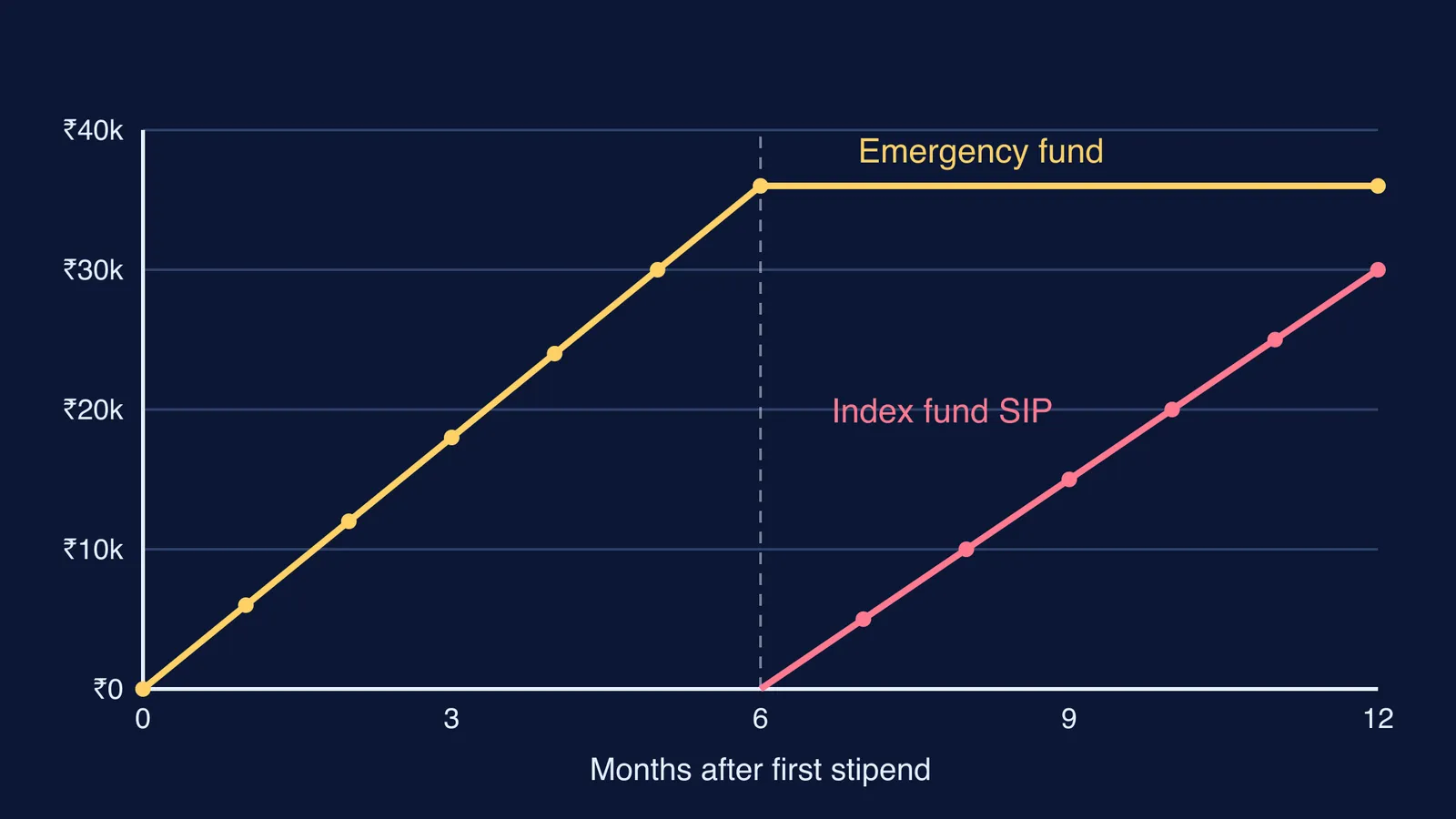
Months 1 to 6: build the cushion. Set aside ₹6,000 a month in a separate savings account. After six months you have ₹36,000, three months of essentials, the lower end of the NISM range.
Spend the rest without guilt. ₹2,000 a month is for wants: a meal out, a trip, a course.
Month 7 onwards: start the SIP. Move ₹5,000 of the ₹6,000 into a monthly SIP in a direct-plan Nifty 50 index fund. Keep ₹1,000 going to savings for goals under five years away, such as a new phone.
Set the date. Schedule the SIP for two or three days after the stipend arrives, so it happens before you can spend the money.
Review once a year, not once a day. Raise the SIP when your income rises. Refill the emergency fund first if you ever use it.
By month 12 in this example, you have ₹36,000 in the emergency fund and ₹30,000 invested, before any market gains or losses.
Plan with the amount that actually reaches your account: check whether students pay tax on an internship stipend, and see what else to do with internship stipend money.
This week, open a separate savings account for your emergency fund and move your first amount into it.