

On this page
Getting your first stipend from an internship is a milestone. It is often the first time you decide how to manage money you earned yourself. While it is tempting to spend it all at once, making a plan early sets up habits that last long after the internship ends.
What to do with internship stipend money?
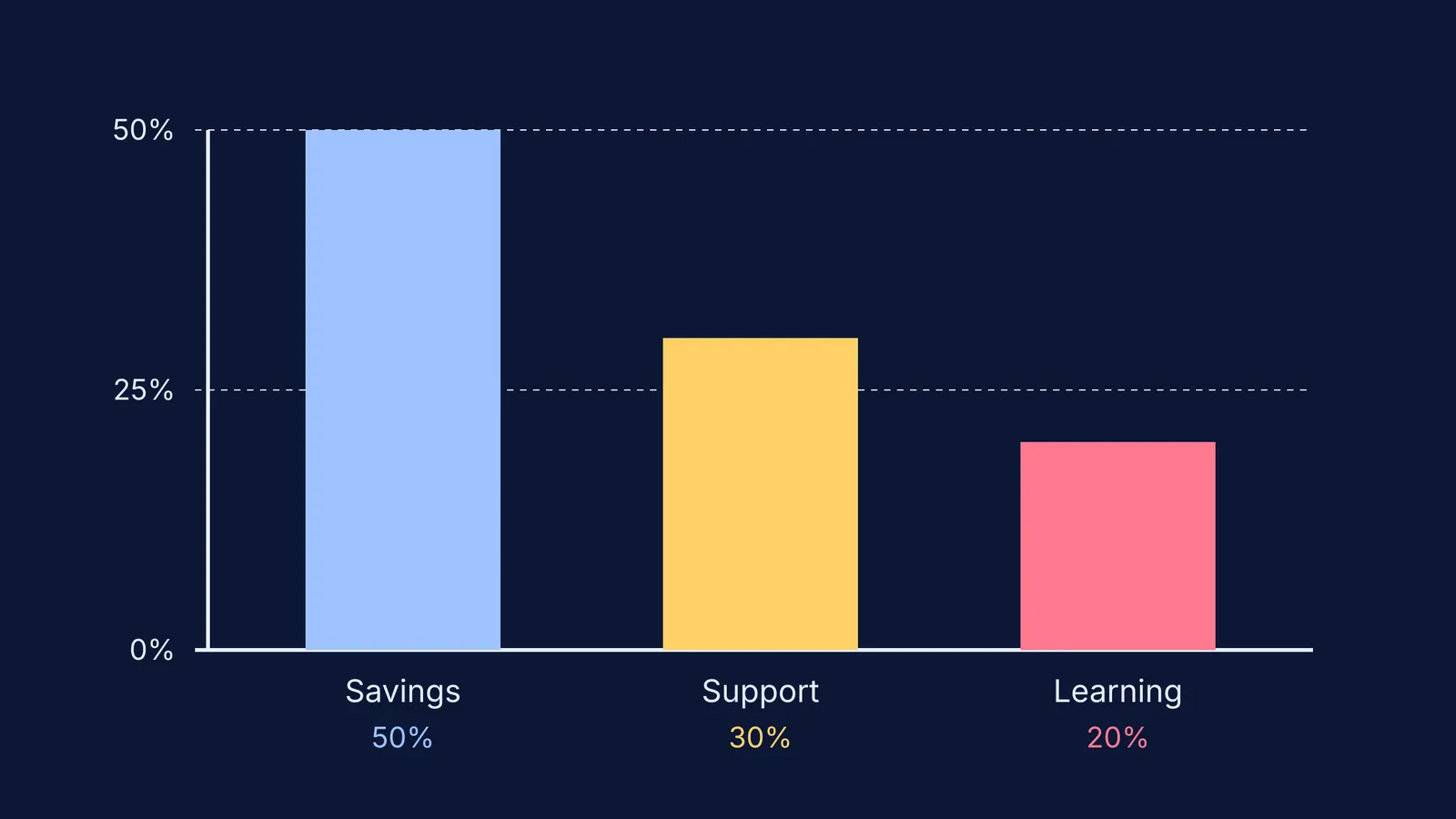
If you are wondering what to do with internship stipend money, dividing it into clear categories—saving, supporting, and learning—makes the choice easier. Having a mental model prevents the money from slowly disappearing on everyday expenses. The most common framework for a student living at home is the 50/30/20 split.
When you allocate your money before it arrives, you take the emotional weight out of spending it.
How much should you save?
The most important step is to set aside a fixed portion before you spend anything else. The exact amount depends on whether you live at home or pay your own rent.
For students who live at home and have their basic costs covered, a good target is to save 50 per cent of the stipend. According to the OECD's 2022 PISA study, 15-year-old students who are high performers in financial literacy are 72% more likely to save money than low performers. Building this habit early means you will have a contingency fund ready when you eventually move out or look for a full-time role.
If you are studying in a hostel or PG and paying your own expenses, aim to save 20 per cent instead. This acts as an emergency fund for unexpected costs, such as travel for interviews, medical bills, or a security deposit for your next move. Setting up an automatic transfer from your main account to a separate savings account on the day you get paid ensures the money is saved before you can spend it.
Should you invest your first salary?
Many students wonder if they should immediately put their stipend into the stock market or mutual funds. While investing is a powerful tool for the long term, your first priority as a student should be liquidity.
An emergency fund must be easily accessible. Until you have saved enough to cover three to six months of basic living expenses, a simple high-yield savings account is often the best place for your money. Once that buffer is built, you can look into longer-term investments. For now, the most valuable investment you can make is in your own skills.
Investing in your own learning
Your internship is a stepping stone to your career. Data from the National Association of Colleges and Employers shows that paid interns receive an average of 1.61 job offers after graduation, compared to 0.77 for non-interns. Since you are already on a strong path, reinvesting 20 per cent of your stipend into your own skills can accelerate your progress and lead to better opportunities.
Consider using this money to access quality resources that are normally out of a student budget. You could pay for a certification, buy textbooks, fund a personal project, or subscribe to a platform that deepens your core knowledge. For example, if you need to strengthen your foundation in the sciences, the Fermi Concept Library holds every concept in physics, chemistry, biology, mathematics and computing. If you prefer structured guidance, you can explore university-level Courses taught by working scientists.
Alternatively, you can explore free official learning resources in India such as NPTEL and SWAYAM, and save this portion of the money for future university fees.
Family support and small rewards
The remaining portion of your stipend can be used to support your family and reward yourself. Earning your first salary is a proud moment for your parents. Buying them a thoughtful gift, paying for a family dinner, or contributing to a household bill is a meaningful way to share your success. It marks a shift from being entirely dependent to being a contributing member of the household.
You should also set aside a small amount for yourself. The goal of budgeting is not to restrict all joy, but to spend intentionally. Whether it is buying a book, upgrading your study desk, or enjoying a meal out during study breaks, a small reward reinforces the value of your hard work.
By setting these clear rules for your first stipend, you build financial discipline early. If you are a parent reading this to guide your teen, sharing this framework is a practical way to help children learn without adding pressure.


