

On this page
You finally landed that internship and got your first stipend. It feels like a salary, but is it taxed like one? Whether you are a college student doing a summer project or a fresh graduate in a trainee role, understanding how the tax system views your stipend is an important first step into the professional world.
Do students need to pay tax on an internship stipend?
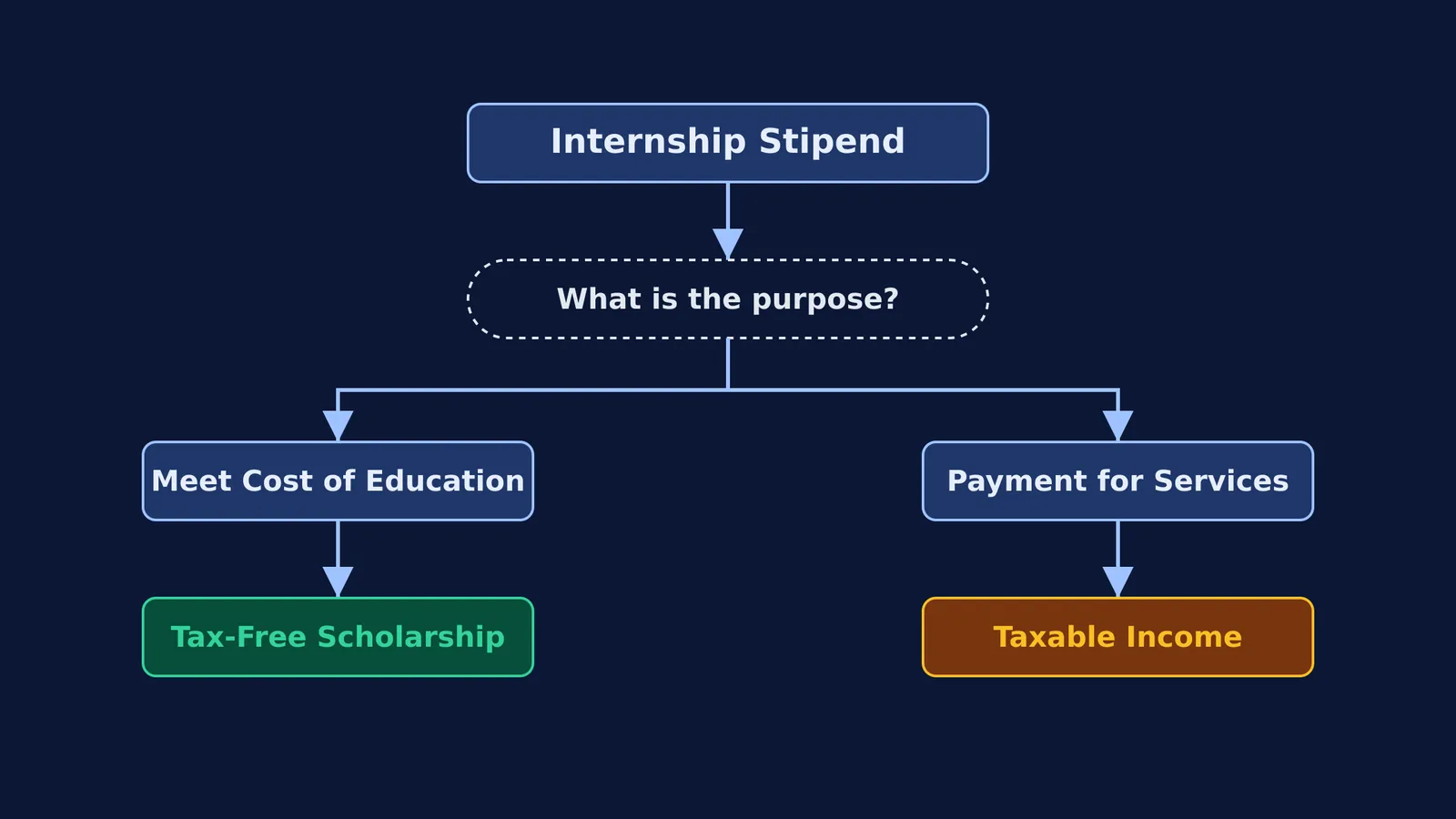
It depends entirely on whether you are being paid to learn or being paid to work. The Income Tax Act of 1961 does not define the word "stipend" directly in its primary clauses. Therefore, the taxability depends entirely on the underlying intention behind the payment. To decide if your stipend is taxable, the tax department looks at the nature of the relationship between you and the organization paying you. If the payment is a grant to support your studies, it is treated one way. If it is compensation for your labour, it is treated completely differently.
Which stipends are fully exempt from tax?
If a university, a government body, or a research institution pays you a stipend so you can cover your tuition, buy textbooks, and afford a hostel room while you study, it is considered a scholarship. According to the Income Tax Act, any scholarship granted to meet the cost of education is entirely tax-free (Income Tax India). This is a blanket exemption, meaning there is no upper limit to how much you can receive tax-free, as long as it is genuinely for educational purposes.
For example, if a PhD scholar receives a monthly research fellowship to fund their academic work and living expenses, the entire amount remains exempt from tax. The same logic usually applies to stipends paid to Chartered Accountancy (CA) articles during their articleship, as their work is considered a mandatory part of their educational training and curriculum. In these cases, the stipend is not a salary but an educational support grant.
When is an internship stipend treated as taxable income?
However, when you join a corporate internship, the dynamic changes entirely. You are no longer receiving an educational grant; instead, you are trading your time, effort, and skills for money. As noted on Wikipedia, a stipend is generally intended to cover expenses for an unpaid role. However, when a recipient is classified as an employee or a professional performing services for the company's benefit, the payment is legally treated as taxable income.
This covers almost all MBA internships, engineering internships at software firms, and medical internships in private hospitals where the intern acts as part of the regular workforce. If you are writing code, marketing a product, attending daily stand-up meetings, or working regular hours with fixed deliverables, your stipend is essentially a salary in disguise. It will be taxed under the head "Income from Salaries" if you have a formal employment contract, or "Income from Other Sources" if you are treated as a temporary professional consultant.
What happens if it is taxable?
The good news is that even if your stipend is legally taxable, you probably will not have to pay any income tax out of your own pocket. Under the new tax regime, individuals with a total income up to ₹7,00,000 pay no tax due to the enhanced tax rebate under Section 87A (ClearTax).
This means that unless your internship stipend and any other earnings combined push your total annual income over the ₹7,00,000 threshold in a single financial year, your actual tax liability remains zero. For most students, a few months of internship stipend will not exceed this generous limit.
How does this work in practice?
Let’s say you are an engineering student who lands a highly competitive summer internship at a software company, earning a substantial monthly stipend. Because you are performing regular tasks alongside the permanent engineering team, the tax department views this as a clear payment for services rendered rather than a scholarship.
However, as long as your total annual income for the financial year is well below the ₹7,00,000 threshold of the new tax regime, you will not owe any final tax to the government.
Often, you might notice that the amount credited to your bank account is slightly less than what was promised in your offer letter. If the company deducts 10% Tax Deducted at Source (TDS) (ClearTax) before depositing the money into your account, they are simply following the standard government rules for paying professionals. They are required by law to withhold a portion of your payment and deposit it with the tax department against your Permanent Account Number (PAN).
Landing a high-paying tech or research internship requires a solid grasp of your core subjects and excellent problem-solving skills. If you are preparing for technical roles and need to brush up on underlying mathematics or physics, the Fermi Concept Library can help you build that foundational knowledge.
What is your practical checklist?
Check your offer letter: does it explicitly say "educational grant" (which is likely exempt) or "remuneration" (which is likely taxable)?
Check your bank statement and payslips: did the company deduct TDS before transferring your stipend?
Keep your PAN card ready and active: you will absolutely need it to file an ITR and claim your hard-earned refund the following year.
Read more about how other student pathways work: IIT Madras BS degree: how the qualifier works for Class 12 students, TNEA: how Tamil Nadu engineering admission works without an exam, and Ten study techniques rated: inside the 2013 Dunlosky review.


