On this page
Becoming a fitness trainer after Class 12 does not need a medical degree or one national entrance exam. India has two recognised routes, and they suit different students: a skill certificate earned alongside real gym work, or a physical education degree.
What are the recognised routes to become a fitness trainer after 12th?
Fitness qualifications in India's skills system are set by the Sports, Physical Education, Fitness and Leisure Sector Skill Council (SPEFL-SC) and listed on the government's National Qualification Register.
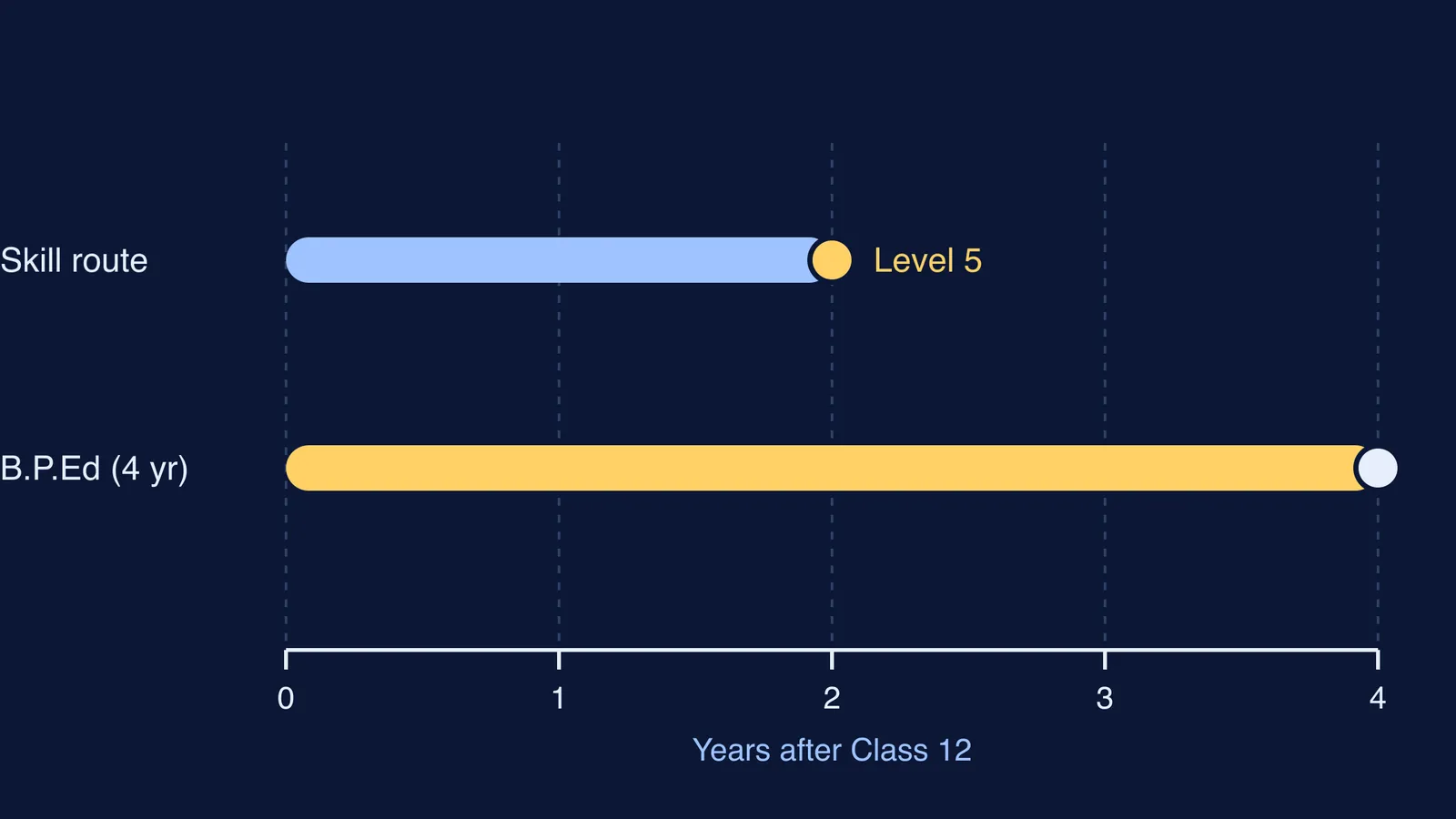
Route 1: a skill council certificate. The Personal Fitness Trainer qualification file.pdf) defines the job as "assessing the fitness levels, planning personalized workout sessions, and monitoring progress to meet the desired fitness goals of the client." It sits at NSQF Level 5 and lists two entry routes: Class 12 or ITI plus two years of experience in the fitness industry, or a Level 4 Fitness Trainer certificate plus three years of experience. The same file lists no licensing requirement for the role, so the certificate is a recognised proof of skill rather than a legal permit.
The Personal Fitness Trainer model curriculum sets the course at 570 hours, including 60 hours of on-the-job training, and gives a minimum job entry age of 20. Its listed validity date has passed, so check the register for the current version.
Route 2: a physical education degree. Lakshmibai National Institute of Physical Education (LNIPE) runs a four-year, eight-semester B.P.Ed that you can join straight after Class 12, according to its 2025-26 prospectus. You need 50% in Class 12 (general and OBC-NCL) or 45% (SC/ST and PwD). Merit is 40% the CUET written test and 60% a sports skill proficiency test, and you must also pass a physical fitness test: a 50 m sprint, standing broad jump, overhead back throw and a 1000 m run or walk. The prospectus also sets a maximum age of 21, relaxed for OBC-NCL and SC/ST candidates.
There are other degree options. Delhi University's IGIPESS admits Class 12 students to a B.Sc. in Physical Education, Health Education and Sports, while its two-year B.P.Ed needs a bachelor's degree first (IGIPESS admissions page). The National Sports University in Manipur offers a BPES and names "fitness health clubs" among the places its graduates can work (NSU programme page). Cut-offs and tests change, so read the current prospectus before you apply.
If school PE teaching appeals more, see our guide to the physical education teacher course after 12th. If injury rehab is the draw, read about the physiotherapy course and career; if food is, compare nutrition research and clinical dietetics.
Which route should you pick?
Pick the skill route if you want to start earning sooner, already train regularly, and can find a gym that will take you on as an assistant while you build experience.
Pick a degree if you want to keep doors open to school teaching, team coaching, sports science or a master's later.
Lean towards LNIPE-style degrees if you are a strong athlete, because the sports skill test carries more weight there than the written test.
Ask your parents which matters more to them: earning sooner or a university degree.
What does a fitness trainer's working day look like?
Your hours follow your clients, not office time. The US Bureau of Labor Statistics notes that many fitness trainers "work variable or part-time schedules that may include nights, weekends, or holidays" (BLS Occupational Outlook Handbook). The same page lists the core tasks: demonstrating exercises, watching technique, adapting programmes as clients progress, enforcing safety rules and giving first aid when needed.
The Indian Personal Fitness Trainer curriculum adds health and fitness assessment, written training plans, periodic re-testing and keeping the gym hygienic.
Here is an example day built from those duties (the times are illustrative, not a rule):
Early morning: one-to-one sessions, each with a warm-up, the main workout and a note on the client's form.
Mid-morning: floor duty, correcting technique, re-racking weights and wiping down equipment.
Afternoon: a break, then planning next week's programmes and updating progress records.
Evening: more sessions, a group class, and a re-test for a client who started a month ago.
How can you prepare while still in school?
Keep a training log for three months: what you did, how it felt, what changed.
Learn first aid from a recognised provider; the curriculum includes responding to medical emergencies.
Practise explaining a movement to a friend in plain words; the curriculum's first module includes role-play on communication and etiquette.
Revise Class 11 and 12 human physiology: muscles, breathing and how the body uses energy.
If that physiology feels shaky, the Fermi Concept Library covers every concept in biology, each with its own lesson, so you can fill gaps topic by topic.
Start this week: pick one route, open its official document, and note the next date that matters to you.