

On this page
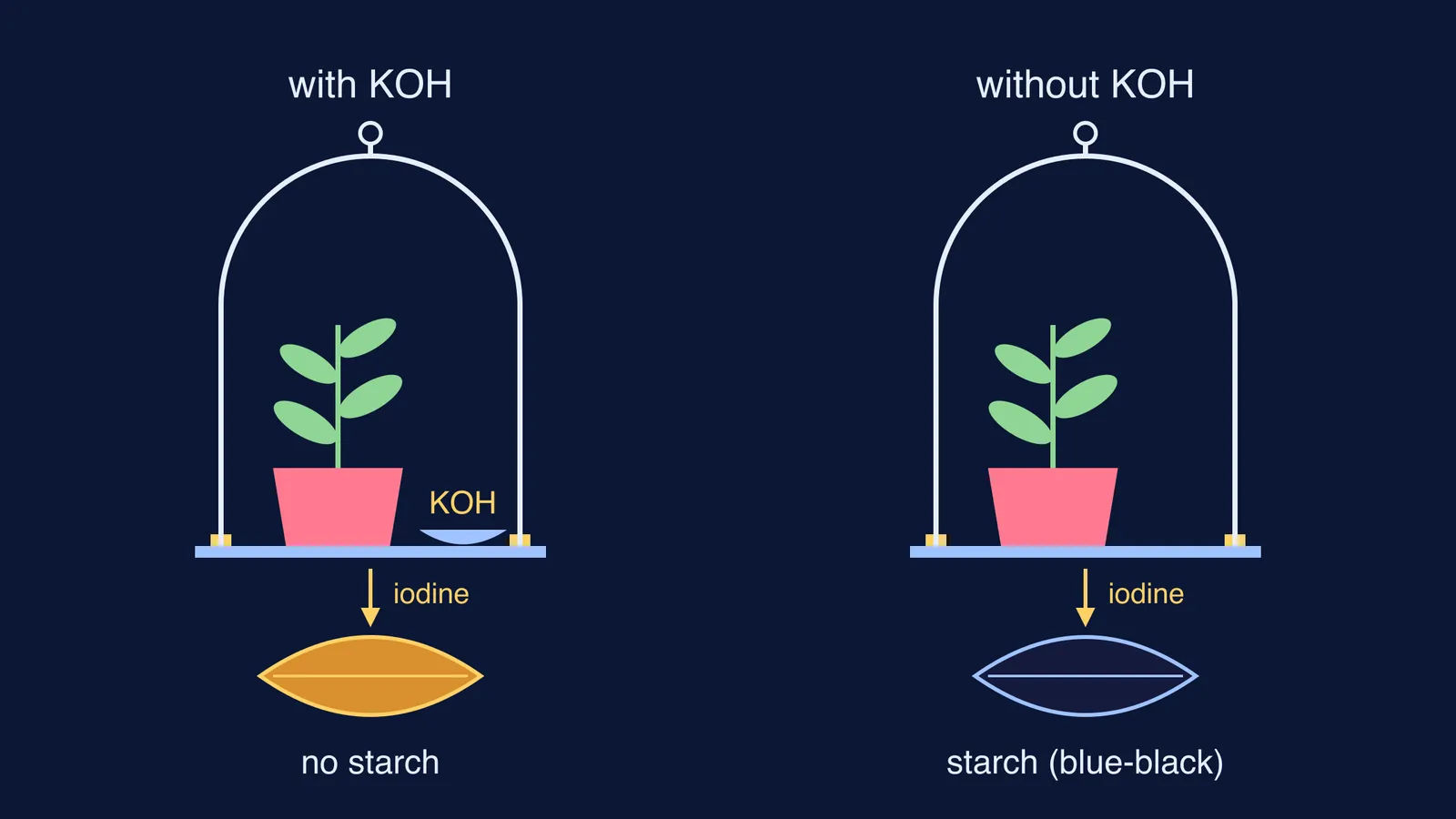
If your Class 10 practical asks you to show that carbon dioxide is necessary for photosynthesis, you are doing Activity 5.2 in NCERT Class 10 Science. Two healthy potted plants of nearly the same size go into a dark room for three days. Each then sits on its own glass plate under a bell jar sealed with vaseline, and one jar also holds a watch-glass of potassium hydroxide (KOH). After about two hours in sunlight, you test a leaf from each plant for starch.
Why is potassium hydroxide used in the bell-jar experiment?
NCERT puts it in one line: "The potassium hydroxide is used to absorb carbon dioxide" (NCERT Class 10 Science, Chapter 5).
Carbon dioxide is an acidic gas and KOH is a strong alkali, so they react to give potassium carbonate and water: 2KOH + CO₂ → K₂CO₃ + H₂O (Wikipedia: potassium carbonate). KOH can also take up CO₂ as potassium bicarbonate: KOH + CO₂ → KHCO₃ (Wikipedia: potassium hydroxide). Either way, the gas is locked up in a potassium salt, leaving the plant in that jar with very little CO₂.
The vaseline seal matters just as much. Without it, outside air would keep topping up the CO₂.
You will meet the same trick again in Class 11. In NCERT Class 11 Biology, part of a leaf is enclosed in a test tube with KOH-soaked cotton, and only the half left in open air tests positive for starch. In NCERT Class 11 Chemistry, a U-tube of concentrated KOH solution absorbs the carbon dioxide when carbon in an organic compound is estimated.
KOH is a caustic alkali, and eyes are particularly vulnerable to it (Wikipedia: potassium hydroxide).
What does the iodine test show on each leaf?
Test each leaf as NCERT's Activity 5.1 describes: dip it in boiling water for a few minutes, heat it in alcohol in a water-bath until the alcohol begins to boil, then dip it in dilute iodine solution for a few minutes and rinse it (NCERT Class 10 Science). Hot water stops further chemical reactions in the leaf, and alcohol removes chlorophyll so the stain is easier to see (Preproom practical notes).
Iodine turns blue-black where starch is present and stays orange or yellow where it is not (Chemistry LibreTexts). NCERT notes that carbohydrate not used straight away is stored as starch, so starch is the evidence.
Leaf from the jar with KOH: stays orange or yellow. Little or no starch, because the KOH kept the CO₂ too low to build it from.
Leaf from the jar without KOH: turns blue-black. Starch was made.
Our variegated leaf starch test guide walks through the same staining steps for the chlorophyll experiment.
Which control do students forget to mention?
The second bell jar. A starch-free leaf on its own proves little: a sealed jar can also change humidity and warmth, and the plant might simply have been unhealthy. Only when an identical plant, sealed in an identical jar in the same sunlight, turns blue-black can you blame the missing CO₂. That is why NCERT's Figure 5.4 shows two set-ups, one with potassium hydroxide and one without. Revision notes make the same point: ideally the plants should be identical and kept at the same temperature for a fair test (Doc Brown's Biology).
The second thing students skip is why both plants were destarched. In Activity 5.1, NCERT keeps the plant in a dark room for three days "so that all the starch gets used up" (NCERT Class 10 Science), and Activity 5.2 repeats the same step. Skip this, and old starch could turn the KOH leaf blue-black.
How do you write this experiment in an exam?
Use this order, which follows NCERT Activity 5.2:
Aim: to show that carbon dioxide is necessary for photosynthesis.
Destarch: two similar potted plants in the dark for three days.
Set-up A: plant on a glass plate beside a watch-glass of KOH, under a bell jar sealed with vaseline.
Set-up B (control): identical, but without KOH.
Why KOH: it absorbs CO₂ (2KOH + CO₂ → K₂CO₃ + H₂O).
Light, then test: about two hours of sunlight; boil, decolourise in alcohol, add iodine.
Observation: A stays orange or yellow; B turns blue-black.
Conclusion: the only difference was the KOH, which removed CO₂, and only the control made starch, so CO₂ is necessary for photosynthesis.
If the acid-base step is the shaky part, the Fermi Concept Library has a lesson for every concept in chemistry and biology, so you can revise alkalis and photosynthesis side by side. Before a viva, Fermi's AI tutor can ask you the "why" questions and check your understanding as it goes.
Next, compare the experiment to show CO₂ is released in respiration. And for where the idea began, read how Jean Senebier showed plants need carbon dioxide in light.


