On this page
Your textbook says plants take in carbon dioxide and give out oxygen. In the 1770s, no one had yet shown the first half of that sentence. Joseph Priestley had seen a plant restore air spoiled by a candle, and Jan Ingenhousz had shown this needed sunlight (Govindjee and Krogmann, 2004). A Geneva pastor named the gas the plant was using.
Who was Jean Senebier?
Jean Senebier (1742–1809) was a Swiss scientist and pastor from Geneva (Govindjee and Krogmann, 2004). The Encyclopædia Universalis records that he became pastor of Chancy in 1769 and was appointed librarian of the city of Geneva in 1775.
His experiments on light and plants filled three books published between 1782 and 1788 (Linda Hall Library). The 1783 title sums up his question: how light, through plants, turns fixed air into pure air (Encyclopædia Universalis).
What did Senebier prove about carbon dioxide and light?
In 1782 Senebier showed that as a plant absorbs carbon dioxide from the air, it releases oxygen, the gas that keeps a flame burning (Govindjee and Krogmann, 2004).
He also showed that the oxygen is made in the leaves (Linda Hall Library).
He showed that carbon dioxide, from the air or dissolved in water, is absorbed by the green parts of a plant and broken down by sunlight: the oxygen is released and the carbon stays in the plant (Encyclopædia Universalis). In that picture, the oxygen comes from carbon dioxide split by light, so a leaf needs both to release it.
That changed carbon dioxide's role in the story. Before Senebier, it was the bad air that plants somehow cleaned. After him, it was the plant's raw material.
How did leaves under water reveal the role of carbon dioxide?
The underwater leaf is older than Senebier's work. In 1754 the Swiss naturalist Charles Bonnet noticed that leaves kept under water and lit up produce bubbles, a gas later shown to be oxygen (Govindjee and Krogmann, 2004). Senebier added that green parts absorb carbon dioxide dissolved in water, not just from the air (Encyclopædia Universalis).
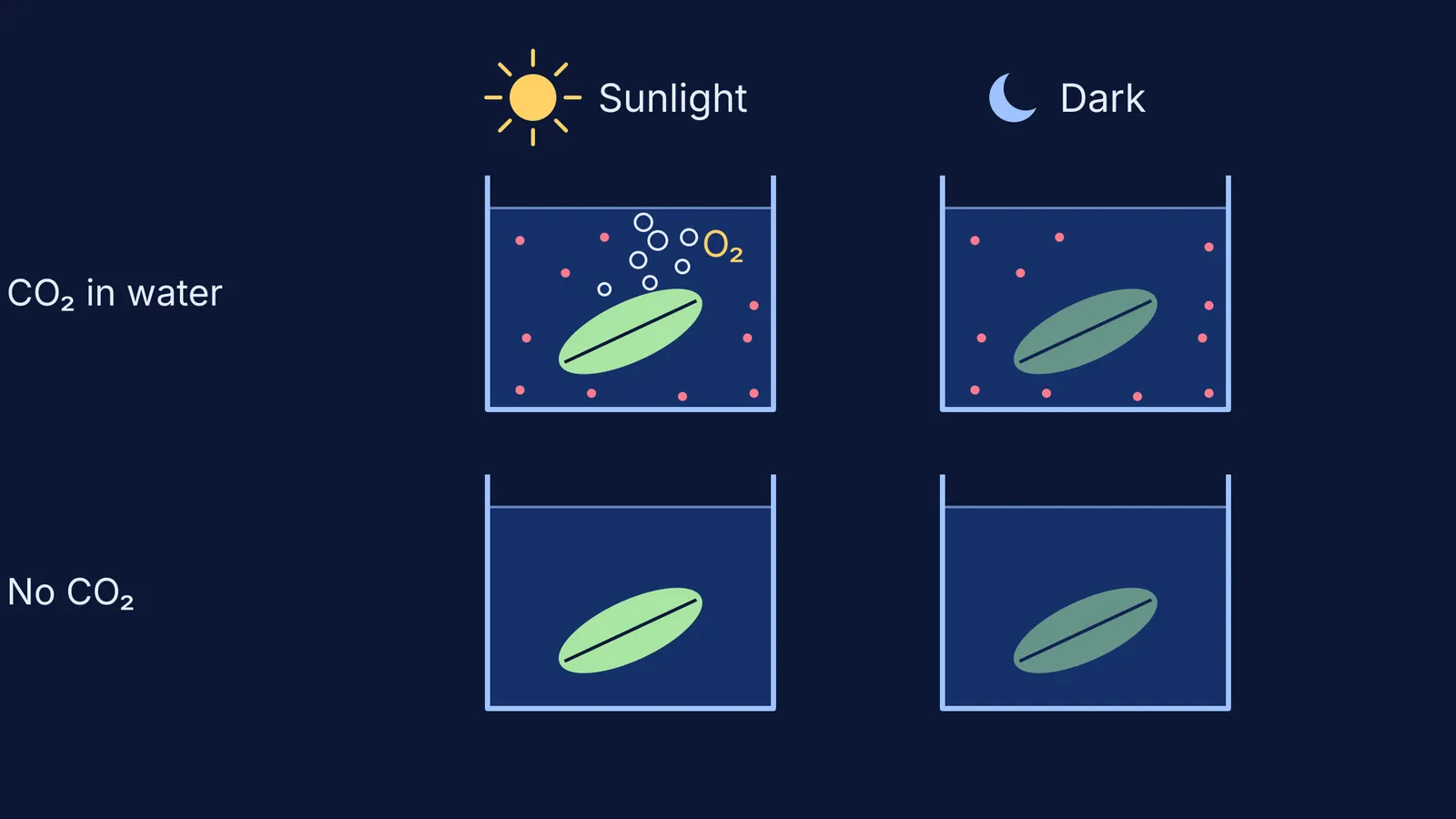
Under water, a leaf can only use the carbon dioxide dissolved around it, so the setup makes a clean test: change the water or the light, and watch for bubbles. Senebier's explanation predicts four cases:
Sunlight, carbon dioxide in the water: oxygen bubbles form.
Sunlight, no carbon dioxide: no oxygen.
Dark, carbon dioxide in the water: no oxygen.
Dark, no carbon dioxide: no oxygen.
Only one combination works. This is the same reasoning behind the term limiting factor in your biology syllabus. If one input is missing, adding more of the other will not bring the rate above zero.
Where does Senebier fit in the history of photosynthesis?
The milestones below come from Govindjee and Krogmann's timeline:
1754: Bonnet sees bubbles from lit leaves under water.
1771–1772: Priestley finds plants purify air spoiled by a candle (see our story on Priestley's mint sprig and bell jar).
1779: Ingenhousz shows the effect depends on sunlight reaching the green parts.
1782: Senebier shows carbon dioxide is absorbed as oxygen is released.
1796: Ingenhousz proposes that carbon dioxide is the source of the plant's carbon.
1804: de Saussure shows water takes part too (read how de Saussure showed plants are built from CO₂ and water).
1845: Julius Robert Mayer states that plants convert light energy into chemical energy.
Senebier's piece is the carbon dioxide on the left of the arrow.
How can you test Senebier's idea yourself?
The floating leaf disc method used in school labs reruns his logic. In Carolina Biological Supply's guide, baking soda (sodium bicarbonate) is the carbon dioxide source. Leaf discs sink once a syringe pulls the gas out of them and liquid takes its place, then float as photosynthesis makes oxygen that replaces some of the liquid. The number floating over time measures the rate.
Here is a four-cup plan that mirrors Senebier's four cases:
Cup A: water with baking soda, under a lamp.
Cup B: plain water with no baking soda, under the same lamp.
Cup C: water with baking soda, covered with a box.
Cup D: plain water, covered with a box.
Put the same number of discs in each cup and count the floaters every minute for 20 minutes.
Write down your prediction before you start. If Senebier was right, cup A should rise clearly ahead of the rest. If a few discs float in cup B, ask what was already dissolved in the water.
Light and carbon dioxide trading places as the limiting factor is easier to see than to read, which is what the interactive simulations in the Fermi Simulation Lab are for. Our walk-through on finding the limiting factor in a photosynthesis simulation uses the same two-input logic. If terms like fixed air or the light reactions still feel shaky, the Fermi Concept Library has a lesson for each concept in biology and chemistry.
Next time you write CO₂ + H₂O in a photosynthesis answer, remember that a Geneva pastor and librarian helped put the CO₂ there.