

On this page
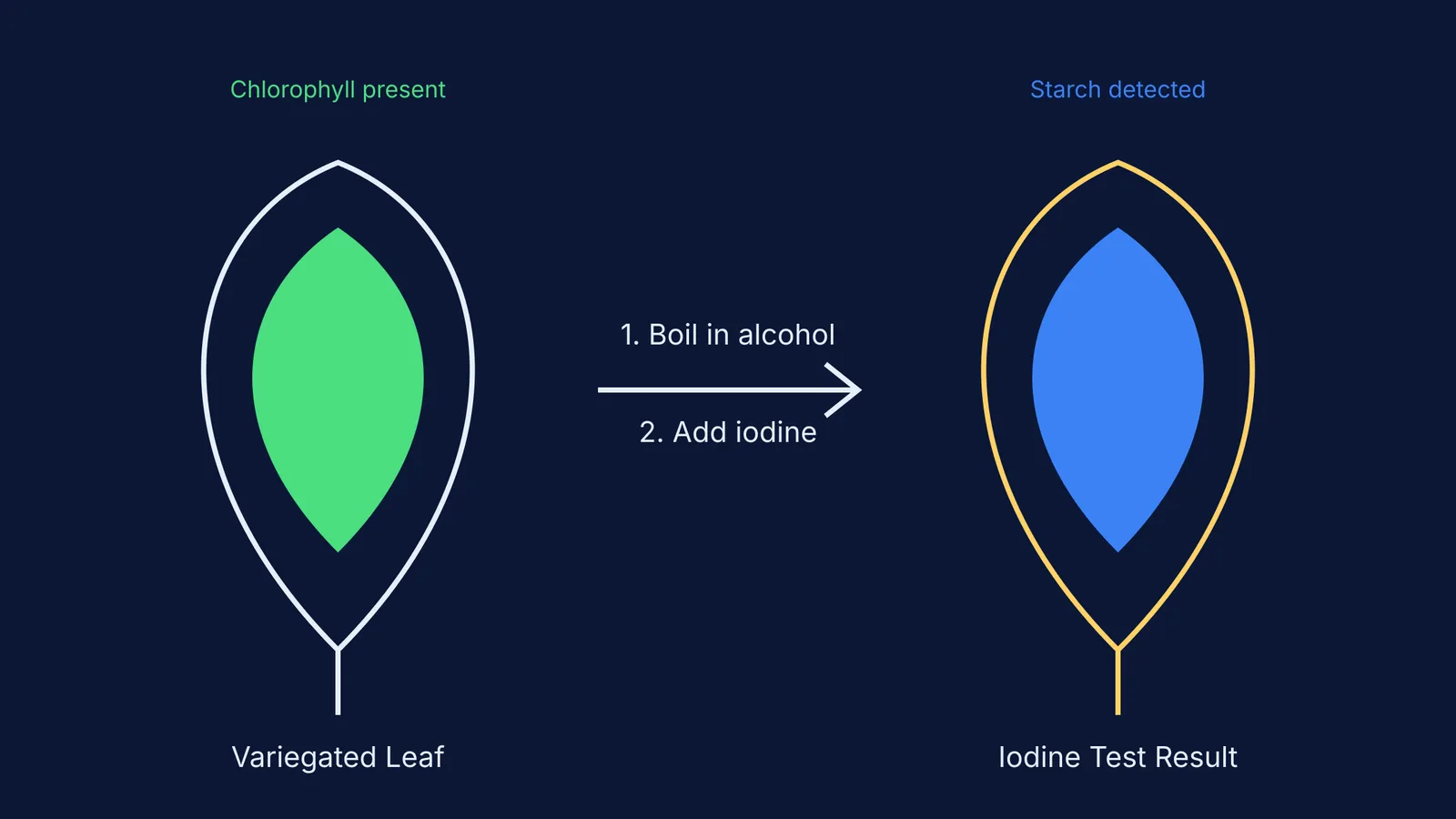
A variegated leaf, like that of a money plant or croton, has patches of green and white. The green areas contain chlorophyll, while the white areas do not. This makes it the perfect natural canvas to prove that chlorophyll is essential for photosynthesis.
Why must you destarch the plant first?
Before you can test a leaf for new starch production, you have to empty its existing reserves. Plants store the glucose they make during photosynthesis as starch. If you skip this step, the entire leaf might test positive, hiding the relationship between chlorophyll and starch production.
To clear these reserves, you must keep the potted plant in a completely dark room for 3 days (NCERT). In the absence of sunlight, photosynthesis stops, and the plant consumes all its stored starch to survive. Next, you place the plant in bright sunlight for about 6 hours (NCERT). This timeframe allows the plant to resume photosynthesis and build up a fresh supply of starch, but only in the regions capable of producing it.
How do you perform the iodine test for starch?
Testing a leaf for starch involves removing its pigments so that the colour change from the iodine reaction is clearly visible. The standard procedure requires carefully boiling the leaf to break down its cells and extract the chlorophyll.
Here is the checklist of practical steps:
Pluck a variegated leaf from the plant after its sunlight exposure.
Trace the leaf on a sheet of paper, carefully marking the boundaries between the green and non-green areas.
Dip the leaf in boiling water for a few minutes to soften the cell walls and stop any further chemical reactions.
Place the leaf in a beaker containing ethanol, and place that beaker into a hot water bath. Heat it until the alcohol boils and the leaf becomes entirely pale and colourless.
Rinse the brittle leaf in warm water to soften it and wash away the alcohol.
Submerge the leaf in a dilute iodine solution for a few minutes, then rinse and observe the colour changes.
What happens during the variegated leaf starch test?
When you apply the iodine solution, a clear pattern emerges on the leaf. The areas that were originally green will turn a deep blue-black colour. This indicates a positive result for starch. The areas that were originally white or yellow will remain a pale, yellowish-brown colour, which is just the natural colour of the iodine solution.
Because starch only appears in the exact locations where chlorophyll was present, you can confidently conclude that chlorophyll is required to capture the sunlight necessary for photosynthesis.
How can a virtual lab improve active learning?
Setting up a water bath, handling hot ethanol, and waiting days for a plant to destarch can make this experiment difficult to repeat if you make a mistake. Virtual labs remove these physical constraints and allow you to focus entirely on the scientific method.
In the Fermi Simulation Lab, you can manipulate the experiment's variables directly. You can predict which parts of a variegated or covered leaf test positive for starch, then run the iodine test virtually. If you want to see what happens when you leave the plant in the dark for a shorter period, or if you want to test leaves covered by black paper strips, the simulation updates the outcome instantly. Fermi's interactive simulations are designed for the ideas that are easier to see than to read.
If you are preparing for practical exams, this active learning approach helps cement the reasoning behind each step. You can review related concepts such as tracing a ray through a glass slab or dive deeper into how plants use light by reading about tropic movements in plants.


