

On this page
CBSE's Class 10 science syllabus for 2026-27 lists "Experimentally show that carbon dioxide is given out during respiration" as practical 7, under Unit II, World of Living. The same document sets internal assessment at 20 marks, of which 5 are for subject enrichment (practical work). Here is how to build it, why the water really rises, and the control that turns a demonstration into an experiment.
How do you set up the KOH and germinating seeds experiment?
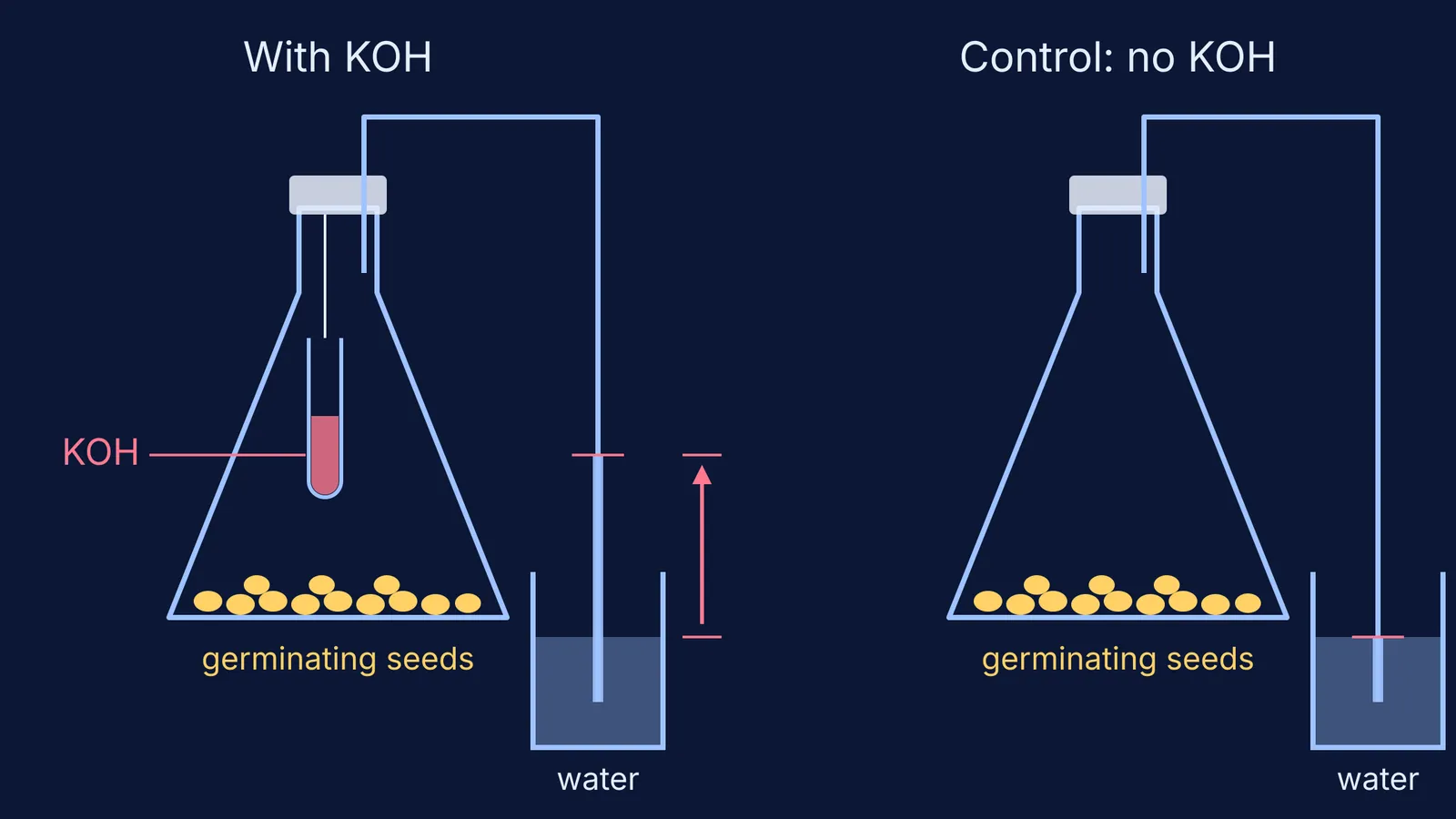
The usual school version, as described by Byju's, uses soaked gram seeds germinated for 3 to 4 days, a conical flask, a small test tube of freshly prepared 20% potassium hydroxide (KOH), thread, a one-holed rubber cork, a bent (U-shaped) delivery tube, a beaker of water and Vaseline.
Put the moistened germinating seeds in the flask.
Hang the KOH tube inside with thread, clear of the seeds.
Fit the cork with one end of the bent tube through it; dip the other end in the water.
Seal every joint with Vaseline so the flask is airtight.
Mark the water level in the tube, leave it for 1 to 2 hours, and mark it again.
The water climbs up the bent tube.
Why does water rise in the bent tube?
Respiration in germinating seeds uses oxygen and gives out carbon dioxide. NCERT's Class 10 chapter on life processes explains that glucose is first split into pyruvate in the cytoplasm; in aerobic respiration, pyruvate is then broken down in the mitochondria, using oxygen, into carbon dioxide and water.
Here is the step most notes skip. For glucose, the NCERT Class 11 chapter on respiration in plants gives C₆H₁₂O₆ + 6O₂ → 6CO₂ + 6H₂O + energy, so the respiratory quotient (CO₂ released divided by O₂ taken in) is 1.0. One molecule of oxygen goes in and one molecule of carbon dioxide comes out, so respiration on its own hardly changes the amount of gas in the flask.
KOH changes that, because it absorbs carbon dioxide; NCERT's Class 11 biology lab manual uses KOH pellets to absorb the CO₂ released by germinating gram seeds in its anaerobic respiration exercise. With the CO₂ removed, the oxygen the seeds use is not replaced. Pressure inside falls below the air pressure outside, and the outside air pushes water up the tube.
Strictly, the size of the rise tracks the oxygen used. What proves that CO₂ was produced is the comparison with a control.
What is the control set-up, and what does it prove?
A control is the same set-up with one thing changed. Work through two controls with made-up round numbers: suppose the seeds use 4 mL of oxygen in two hours, with the respiratory quotient of 1.0 from the NCERT respiration chapter.
Flask A, seeds with KOH: oxygen falls by 4 mL, CO₂ rises by 4 mL, KOH removes those 4 mL. Net: 4 mL less gas. Water rises.
Flask B, seeds with water in place of KOH: oxygen falls by 4 mL, CO₂ rises by 4 mL. Net: about zero. Water barely moves.
Flask C, boiled (dead) seeds with KOH: no respiration, no change.
Flask B is the key comparison. Its only difference from A is the KOH, so the rise in A must come from a gas KOH removes, made by the seeds: carbon dioxide. Flask C shows the rise needs living seeds, not a leak.
One caution: the same NCERT chapter gives a respiratory quotient of about 0.7 when fats are respired, so seeds burning stored fat use more oxygen than the CO₂ they release, and flask B may rise a little. Expect "much less than A", not exactly zero. Our explainer on why RQ is 1, 0.7 or 0.9 for different fuels works through those numbers.
What do examiners ask in the viva?
Practise saying these out loud.
Why germinating seeds? They are alive and growing, so they respire and release CO₂.
Why must the KOH be freshly prepared? KOH left open absorbs CO₂ from the air and then takes up less from the flask.
Why seal the joints with Vaseline? A leak lets outside air in, so the pressure never drops and the water does not rise.
What happens without KOH? Very little, which is exactly what the control shows.
How else can you test for CO₂? Lime water turns milky, as in Activities 5.4 and 5.5 of the NCERT Class 10 life processes chapter.
Label the seeds, KOH tube, cork, bent tube and beaker in your diagram; our list of CBSE Class 10 science diagrams to practise has others in the same style. The KOH-and-pressure reasoning also suits assertion-reason questions in CBSE papers.
If the pressure step feels slippery, the Fermi Concept Library gives every concept in biology and chemistry its own lesson and its place in the map. Before the viva, Fermi's AI tutor notices where you are stuck and checks understanding as it goes, so you can practise explaining why the water rises.
Next time you do this practical, set up flask B beside flask A and compare the two tubes after two hours.


