On this page
If you like biology and read food labels for fun, two careers may pull at you. One turns a patient's diagnosis into meals they can actually eat. The other finds out what food does to health. They often share a master's degree, but the daily work and the person who enjoys it differ.
What does a clinical dietitian do?
The US Bureau of Labor Statistics describes clinical dietitians as professionals who “provide medical nutrition therapy”, building nutrition programmes around each client's health needs. The same page lists the core tasks: assess a person's nutritional needs, counsel them, write meal plans that fit their preferences and budget, then monitor the results and change the plan. Clinical dietitians may specialise in conditions such as kidney disease, diabetes or digestive disorders.
In India the role is named in law. The Schedule of the National Commission for Allied and Healthcare Professions Act, 2021 lists “Dietician (including Clinical Dietician, Food Service Dietician)” under the category Nutrition Science Professional. The work is people-facing: patients, families, doctors and nurses.
What does a nutrition researcher do?
A researcher asks what people across a country eat, what it does to them, and what advice would help. A major home for this work in India is the ICMR-National Institute of Nutrition, which began in 1918 as a Beri-Beri Enquiry Unit in a single-room laboratory at the Pasteur Institute, Coonoor, and moved to Hyderabad in 1958. Its research covers maternal and child nutrition, food safety, nutrient metabolism, risk factors for non-communicable diseases and dietary assessment. For the history of this field in India, read our profile of C. Gopalan and the science of nutrition.
Research ends up on the dietitian's desk. On 7 May 2024 ICMR-NIN released revised Dietary Guidelines for Indians, which set out 17 guidelines. A 2025 review in the Indian Journal of Medical Research, comparing them with other countries' guidelines, notes the estimate that 56.4% of India's total disease burden is due to an unhealthy diet.
How do you become each one in India?
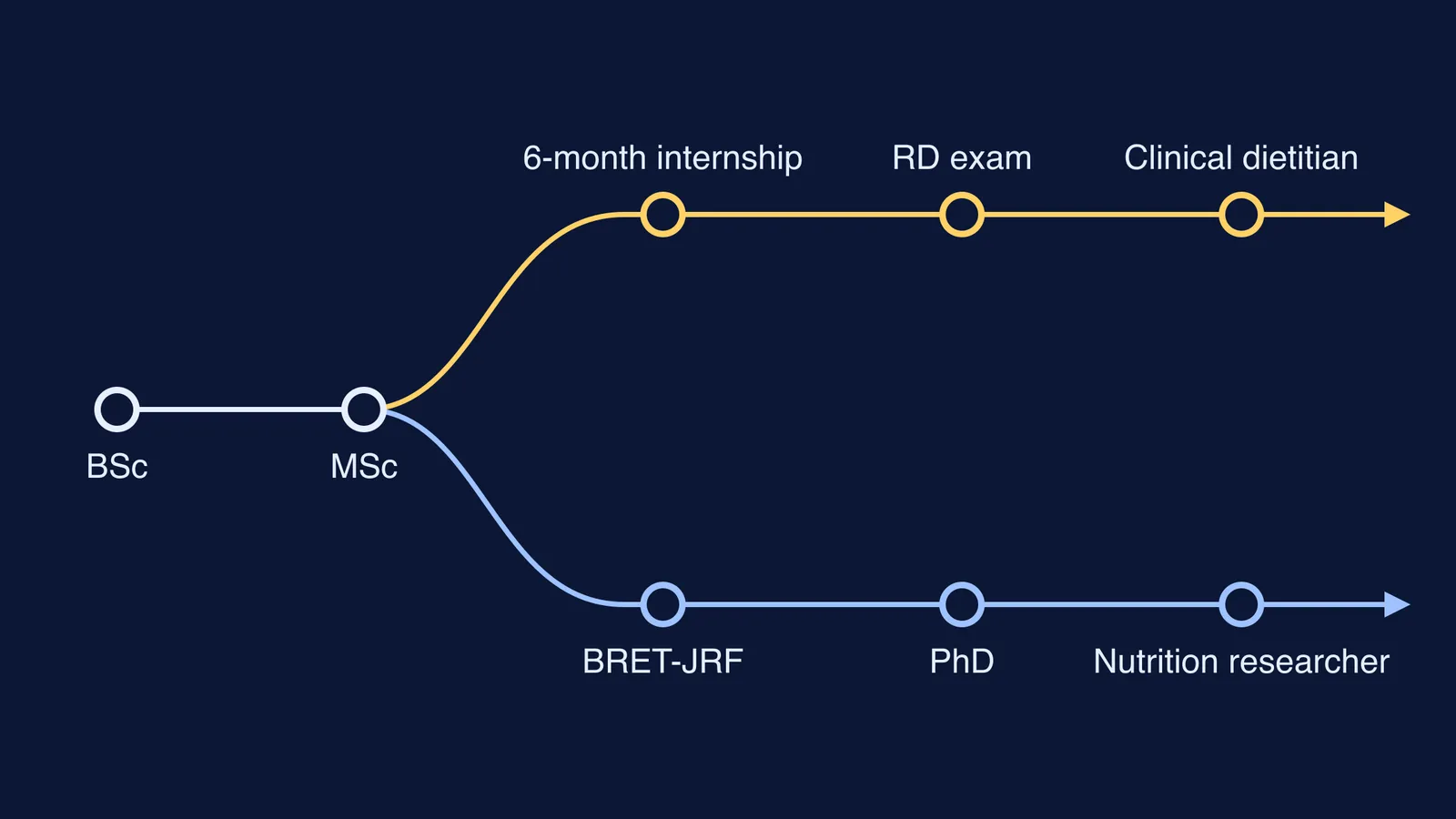
Both usually start with a nutrition degree. Our guide to the BSc in Nutrition and Dietetics covers the syllabus. After that the routes split.
For the clinical route, the Indian Dietetic Association's Registered Dietitian (RD) eligibility rules set out who may sit the RD exam. You need:
A full-time graduate degree in food, nutrition and dietetics, a BSc in Home Science specialising in food and nutrition, or a degree with at least four nutrition-related subjects such as biochemistry, human physiology and diet therapy.
A postgraduate diploma in food, nutrition and dietetics, or an MSc in foods and nutrition, clinical nutrition or dietetics.
Life membership of the IDA before the internship begins.
A six-month continuous internship at a hospital recognised for RD training, or five years as a full-time dietitian in a multispecialty hospital.
For the research route, one door is the ICMR Junior Research Fellowship, now selected through the Biomedical Research Eligibility Test (BRET). Its FAQ lists an MSc in Food and Nutrition among eligible degrees, with at least 55% marks (50% for SC, ST and PwBD candidates), and Nutrition as one of the subject sections. It says a tentative 250 candidates are selected, who then enrol for a PhD on a topic in ICMR health research.
Notice the overlap: the same MSc can lead to either the RD internship or BRET. You do not have to decide in Class 12.
Clinical dietitian vs nutrition researcher: which suits you?
Score yourself on five pairs. Pick the side that sounds more like you.
Do you want to see one person improve this month (dietitian), or find an answer that holds for a whole population (researcher)?
Would you rather spend most of your day with patients and families (dietitian), or with data, samples and a research team (researcher)?
Would you rather adjust a plan quickly when it is not working (dietitian), or keep an experiment running exactly as designed (researcher)?
Do graphs interest you when they help a patient (dietitian), or for their own sake (researcher)?
Do you prefer ward rounds and counselling (dietitian), or projects that take years (researcher)?
Four or five on one side is a clear lean. A split is common, and that MSc keeps both doors open.
Then test it in real life. Ask a hospital dietetics department or a nutrition lab for a short conversation. A script you can use: “I'm a Class 12 student thinking about nutrition as a career. Could I ask you three questions for ten minutes? What does a normal day look like, what do you wish you had studied earlier, and what surprised you about the job?”
What should you get strong in now?
The IDA rules name biochemistry and human physiology, and the BRET syllabus tests basic physiology, genetics, immunology and data interpretation. Learn those properly, not just for marks. If a topic like enzyme kinetics or the nephron keeps slipping, the Fermi Concept Library gives each biology and chemistry concept its own lesson and shows where it sits in the map.
If the population-level questions excite you most, also read about public health careers in India. Start with one conversation this month, with a dietitian or a researcher.