On this page
A pea plant and a soybean plant both get nitrogen from bacteria in their roots, but they send it to the leaves in different molecules. Pea sends amides. Soybean sends ureides. The reason is carbon, and you can check it by counting atoms.
What happens to fixed ammonia inside a root nodule?
Inside a nodule, the bacteria take a special form called bacteroids. According to a 2018 study of pea nodules in the Journal of Experimental Botany, bacteroids "reduce N2 within symbiosomes to ammonia". That ammonia then passes into the plant cell and is "assimilated to glutamine, asparagine, and other amino acids". If the nodule itself still feels hazy, start with our explainer on root nodule formation and leghaemoglobin.
Four enzymes do this work in temperate legumes, says a USDA Agricultural Research Service summary of nodule amide synthesis:
Glutamine synthetase (GS) adds ammonia to glutamate, making glutamine.
Glutamate synthase (GOGAT) uses glutamine and α-ketoglutarate to make more glutamate.
Aspartate aminotransferase passes an amino group from glutamate to oxaloacetate, making aspartate.
Asparagine synthetase uses glutamine's amide nitrogen to turn aspartate into asparagine.
Steps 1 and 2 form the GS-GOGAT cycle; step 3 is a transamination, which our post on reductive amination vs transamination in plants explains.
Why is nitrogen transported as amides in plants?
An amide carries two nitrogen atoms in one molecule: one on the amino group and one on the side-chain amide. Glutamine is C5H10N2O3 and asparagine is C4H8N2O3, according to PubChem's entry for glutamine and its entry for asparagine. So every molecule loaded into the xylem moves two nitrogens instead of one.
The Garneau study states that "asparagine functions as the dominant N transport form in temperate legumes such as pea" and that it is "exported from the nodule via the xylem to the shoot". A 2014 review by Mechthild Tegeder puts fava bean in the same amide-exporting group.
Why do soybean and other tropical legumes export ureides?
Ureides are allantoin and allantoic acid. A 2022 Nature Communications paper on bean nodules says that most temperate legumes use glutamine and asparagine, whereas many legumes of (sub)tropical origin, including soybean and common bean, make ureides instead. Tegeder's review explains the route: the fixed nitrogen goes through purine synthesis, then purine breakdown via xanthine and uric acid.
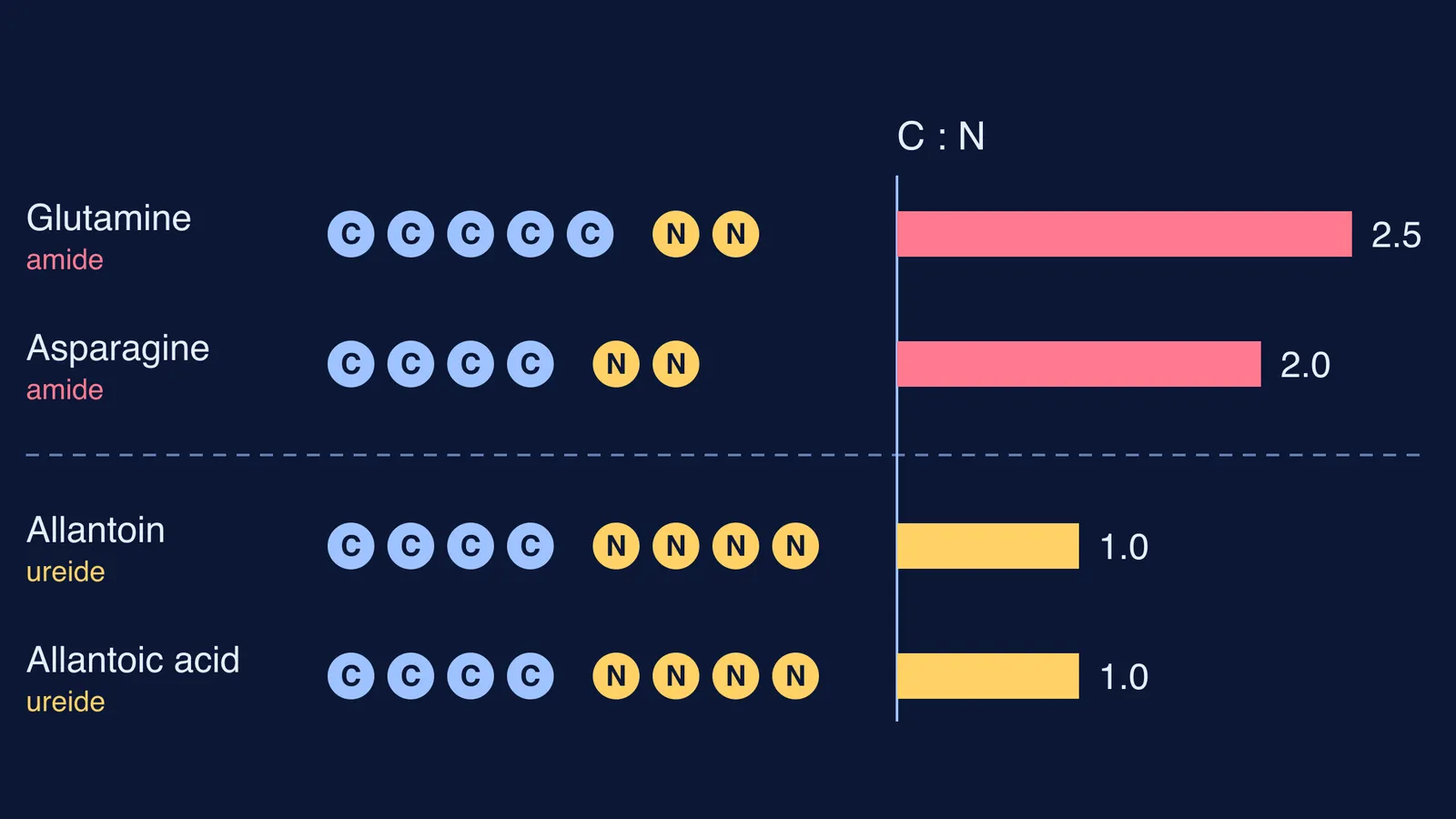
Why take the longer route? Carbon. A 2006 review in the Journal of Experimental Botany says ureides, with a C:N ratio of 1, "are much more conserving of photosynthate than amides with C:N ratios of 2.0 (Asn) or 2.5 (Gln)". The same review, summarising earlier carbon and nitrogen budgets, says ureide-based symbioses need as little as 1.4 g of carbon per g of fixed nitrogen in cowpea, against a minimum of 3.9 g in amide-forming lupin. Those budgets compared ureide-forming cowpea and mung bean with amide-forming lupin and pea.
In soybean, ureides carry most of the load. A 1979 Plant Physiology study by McClure and Israel found that xylem sap from nodulated soybean grown without nitrogen fertiliser held, on average over the season, 78% of its nitrogen as ureides and 20% as amino acids.
The shoot then unpacks the cargo. Tegeder's review says allantoin and allantoic acid are broken down in the shoot, releasing ammonia that is built back into amino acids.
Worked example: how much carbon rides with each nitrogen?
You can check the review's ratios yourself from the formulas. Allantoin is C4H6N4O3 and allantoic acid is C4H8N4O4, according to PubChem's allantoin entry and its allantoic acid entry.
Glutamine: 5 C ÷ 2 N = 2.5 carbons per nitrogen.
Asparagine: 4 C ÷ 2 N = 2.0.
Allantoin: 4 C ÷ 4 N = 1.0.
Allantoic acid: 4 C ÷ 4 N = 1.0.
Now ship 100 nitrogen atoms. As glutamine, 250 carbon atoms go with them. As asparagine, 200. As ureides, 100. Each carbon atom in the xylem is one the leaves had to fix by photosynthesis, which is why the 2006 review calls ureides "conserving of photosynthate".
How do you write this answer in an exam?
A strong answer links root to shoot in order:
Name the source: bacteroids in the nodule reduce N2 to ammonia.
Name the capture: GS-GOGAT makes glutamine, and asparagine synthetase makes asparagine.
Name the cargo: amides (glutamine, asparagine) in pea, ureides (allantoin, allantoic acid) in soybean.
Name the route: the xylem carries them from nodule to shoot.
Give the reason: two nitrogens per amide, and ureides carry one carbon per nitrogen, so they save photosynthate.
If a step in the GS-GOGAT cycle still feels shaky, the Fermi Concept Library gives each concept its own lesson and shows where it sits in the map. To test yourself, the Fermi Problem Library has worked problems with a step-by-step solver that explains the reasoning rather than printing an answer.
Next, read why crop rotation with legumes keeps soil fertile.