On this page
Plants take up nitrogen as nitrate or ammonium and must build it into amino acids before they can use most of it. Two reactions are easy to mix up here: reductive amination, which builds the first amino acid from ammonia, and transamination, which hands that amino group on to make the rest.
What is reductive amination in plants?
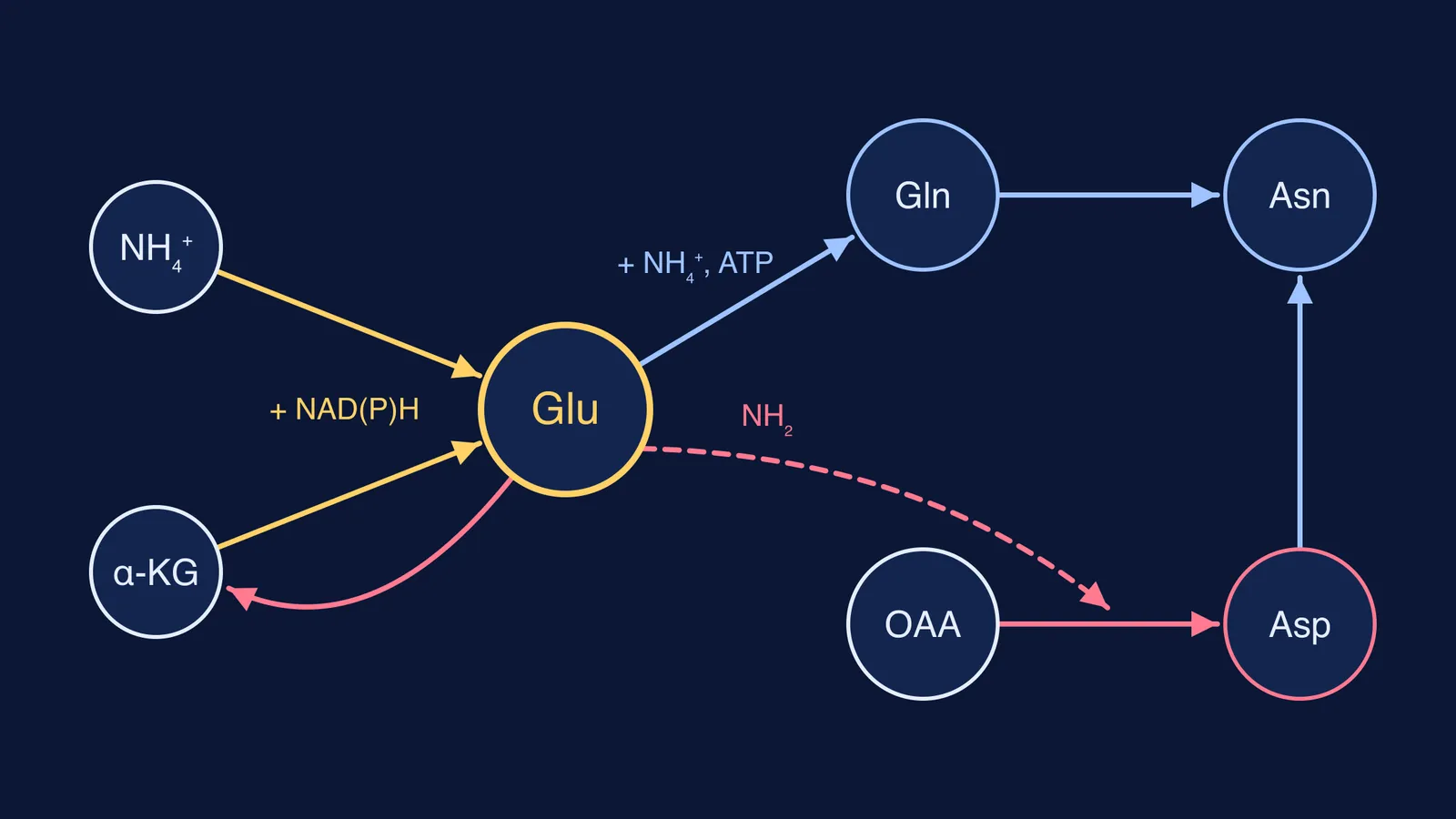
Reductive amination is the reaction in which ammonia is added to a keto acid and reduced, so the keto acid becomes an amino acid. The textbook example uses the enzyme glutamate dehydrogenase, which catalyses the reversible reaction glutamate + H₂O + NAD(P)⁺ ⇌ 2-oxoglutarate + NH₃ + NAD(P)H + H⁺. 2-oxoglutarate is another name for α-ketoglutaric acid. Read the reaction in the nitrogen-capturing direction, write NH₃ + H⁺ as NH₄⁺, and you get the form school books use:
α-ketoglutaric acid + NH₄⁺ + NAD(P)H ⇌ glutamic acid + H₂O + NAD(P)⁺
Its signature: a new amino group appears, a reduced coenzyme is used, and the product is glutamic acid.
That review is by Forde and Lea in the Journal of Experimental Botany.
What is transamination?
Transamination is the transfer of an amino group from an amino acid to an α-keto acid, catalysed by aminotransferases that need pyridoxal phosphate, a vitamin B6 derivative, as a cofactor. No ammonia is used and no new amino group is made. The NH₂ simply moves. The standard example:
glutamic acid + oxaloacetic acid ⇌ α-ketoglutaric acid + aspartic acid
Glutamic acid gives away its amino group and turns back into α-ketoglutaric acid, ready to pick up more ammonia. Forde and Lea note that glutamate's amino group can be transferred to a wide variety of 2-oxo acid acceptors, and suggest that the reversibility of these reactions probably explains why glutamate levels in plants stay fairly steady.
Where do glutamine and asparagine come in?
Glutamine and asparagine are amides: each carries a second nitrogen, as –CONH₂, on its side chain. That makes them good for storing and moving nitrogen.
Glutamine forms when glutamine synthetase adds ammonia to glutamic acid using ATP: glutamate + ATP + NH₃ → glutamine + ADP + phosphate. Asparagine forms when asparagine synthetase passes the amide nitrogen of glutamine onto aspartic acid, using ATP: aspartate + glutamine + ATP → asparagine + glutamate + AMP + pyrophosphate.
A review of asparagine in plants by Lea and colleagues (Annals of Applied Biology, 2007) reports that asparagine builds up when nitrogen is plentiful and protein synthesis is slow: during seed germination and nitrogen transport, and under stresses such as drought, salt and mineral deficiency.
Some legumes use a third carrier. In soybean, Ohyama and colleagues explain, most nitrogen fixed in the nodules becomes ureides (allantoin and allantoic acid), carried through the xylem to the shoots. A ureide molecule holds 4 nitrogen and 4 carbon atoms, against 2 nitrogen and 4 carbon in asparagine, so it costs less carbon per nitrogen moved. For where that ammonia comes from, see root nodule formation and leghaemoglobin.
Reductive amination vs transamination: how do you tell them apart?
Ask three questions of any reaction:
Is free ammonia (NH₃ or NH₄⁺) going in, turning a keto acid into an amino acid with NADH or NADPH? Reductive amination.
Does one amino acid go in and a different one come out, with keto acids swapped? Transamination.
Does nitrogen land on a side-chain –COOH to make –CONH₂? Amide formation.
Try it on four reactions:
α-ketoglutaric acid + NH₄⁺ + NADPH → glutamic acid. Ammonia in, reduced coenzyme used: reductive amination.
Glutamic acid + pyruvic acid ⇌ α-ketoglutaric acid + alanine (the alanine transaminase reaction). Amino group moved, nothing new made: transamination.
Glutamic acid + NH₃ + ATP → glutamine. Nitrogen added to the side chain: amide formation.
Aspartic acid + glutamine + ATP → asparagine + glutamic acid. This looks like a swap, but it is amide formation: the nitrogen moves between side chains and the α-amino groups stay put.
How should you write this in an exam answer?
Write the reductive amination equation with glutamate dehydrogenase above the arrow.
For transamination, name the enzyme (transaminase or aminotransferase) and show glutamic acid becoming α-ketoglutaric acid.
Say in one line why amides matter: they carry extra nitrogen around the plant.
If the nitrogen cycle is shaky, start with nitrification and denitrification step by step, and use the general structure of an amino acid and its R group to see which group moves in each reaction. The Fermi Concept Library gives every biology and chemistry concept its own lesson and its place in the map. To practise, the Fermi Problem Library has worked problems with a step-by-step solver that explains the reasoning rather than printing an answer.
Next time you see glutamic acid in an equation, ask one question: did a new amino group arrive, or did an old one move?