On this page
A Bachelor of Physiotherapy (BPT) trains you to assess how people move and to treat movement problems with exercise therapy, electrotherapy and hands-on techniques. The National Commission for Allied and Healthcare Professions (NCAHP) has published a competency-based physiotherapy curriculum, approved syllabus 2025, and everything below comes from it unless another source is linked.
The need for this work is large. The World Health Organization estimates that 2.4 billion people live with a health condition that may benefit from rehabilitation, and it lists physiotherapists as part of the rehabilitation workforce.
What does the BPT course cover, year by year?
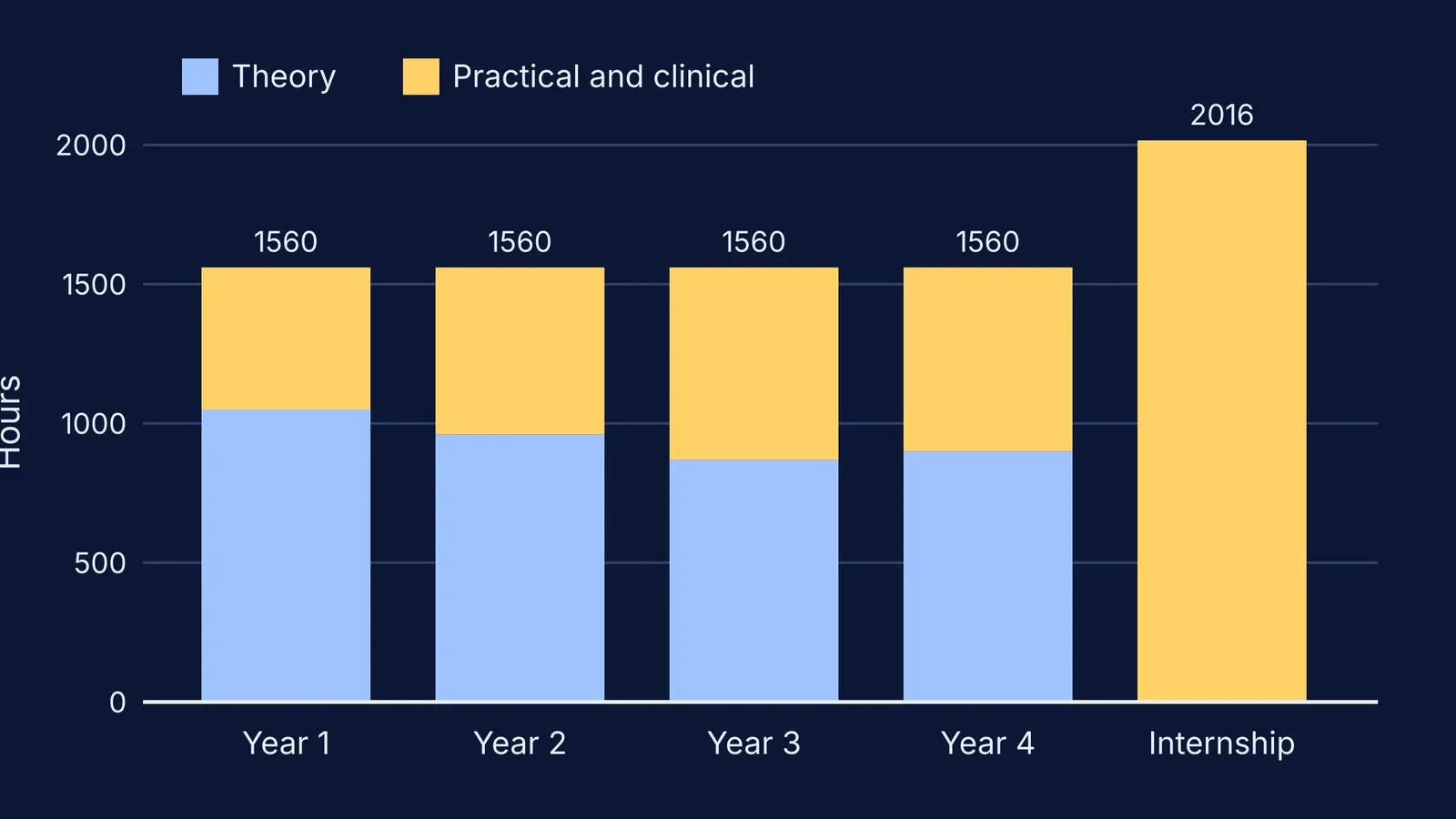
The NCAHP curriculum sets four academic years of at least 1,560 teaching hours each, followed by a one-year internship. To be admitted, you need to have passed 10+2 with at least 50% aggregate in physics, chemistry and biology, and you must have appeared in NEET. You also need to be 17 by the date of admission.
Year 1: anatomy, physiology, biochemistry, fundamentals of exercise and electro-physical agents, psychology and sociology, and India's healthcare system, plus 150 hours of clinic orientation.
Year 2: pathology and microbiology, pharmacology, public health, emergency care, exercise therapy, electrotherapy, biomechanics and kinesiology, and yoga, plus 210 hours of clinical observation.
Year 3: general medicine and paediatrics, general surgery, orthopaedics, physiotherapy for medical, surgical and orthopaedic conditions, functional diagnosis, and research methods, plus 300 hours of clinical education.
Year 4: neurology, cardiothoracic conditions, sports physiotherapy, ethics and law, community rehabilitation and a project, plus a 300-hour clinical rotation.
Practical and clinical hours rise from 510 in year 1 to 690 in year 3. To sit the final exam, you need 75% attendance in theory and 85% in practicals, and you must pass theory and practical separately.
If muscles, joints or levers from Class 11-12 feel shaky, the Fermi Concept Library has a lesson for every concept in biology and physics, so you can fill a gap before biomechanics builds on it.
How does the BPT internship work?
Under the NCAHP rules, the internship is a compulsory, full-time rotatory posting of 12 months, starting only after you pass every subject from all four years. That adds up to at least 2,016 hours (7 hours a day, 6 days a week, for 48 weeks). The college pays a stipend at the rate the State Council prescribes, and every intern completes Basic Life Support training.
The postings are:
musculoskeletal and orthopaedic physiotherapy, 45 days
neurological physiotherapy, 45 days
community physiotherapy or a rural posting, 2 months
one month each in cardiology ICU/NICU, pulmonology or medicine, sports physiotherapy, obstetrics and gynaecology, paediatrics, surgery or oncology, and burns and plastic surgery
Up to 4 months can be done as an externship at an institute approved by the State Council. You keep a log book and present at least twelve cases, and the degree is awarded only after the college certifies that you completed the internship satisfactorily.
Where do BPT graduates work in clinical and sports roles?
The curriculum names hospitals, nursing homes, sports teams, fitness centres, community rehabilitation, health promotion services and independent physiotherapy clinics, private and public, as places where graduates can work. Its list of practice settings adds home-based care, special schools, senior citizen centres, workplaces, women's health centres and research centres.
Clinical roles follow the internship postings, from orthopaedic and neuro to paediatric and women's health work, while sports roles build on the year 4 sports paper and posting. The commission recommends the professional title Physiotherapist, with the prefix Dr and the suffix PT. If training interests you more than treatment, compare a sports science degree.
What further study comes after BPT?
The Master of Physiotherapy (MPT) is a two-year course of at least 3,240 hours. You need a recognised BPT with pass marks (50%), and you get in through a state or university entrance test and an interview. Specialities include musculoskeletal, neuroscience, cardiopulmonary, sports, paediatrics, obstetrics and gynaecology, oncology and community physiotherapy. You need a master's degree to teach as a lecturer or assistant professor, and the handbook also sets out a PhD route.
Is BPT the right course for you?
Will you enjoy anatomy and physiology for a whole year? They take up the most hours in year 1.
Are you comfortable with hands-on work: touching patients, guiding their limbs, and standing through long sessions?
Can you explain an exercise patiently, many times over, to someone in pain?
Are you ready for five years in total, including a 12-month internship with a 2-month rural or community posting?
Have you looked at the courses next door? Read occupational therapy vs physiotherapy and the wider list of allied health courses after 12th PCB.
If you said yes to the first four, ask each college: does it run its own physiotherapy clinic, which hospitals host its interns, and what stipend does it pay? The curriculum requires all three.
Not sure where to start revising Class 12 biology? Fermi's AI tutor works out what you already know and builds a plan for the session, so you start with your weakest topic instead of a blank page.