On this page
Water seeds with salty water and fewer of them sprout, and the ones that do sprout later. That is also a real problem for Indian farmers: the ICAR-Central Soil Salinity Research Institute puts India's salt-affected land at 6.73 million hectares.
What happens to seeds in salt water?
A seed has to soak up water before it can start growing. Water moves by osmosis from where water potential is higher to where it is lower, and dissolved salt lowers water potential.
The College Board's AP Biology equations sheet gives solute potential as ψs = −iCRT. Here i is the ionisation constant, C the molar concentration, R = 0.0831 litre bar per mole kelvin and T the temperature in kelvin. In an open dish, water potential equals solute potential. Sodium chloride splits into two ions, Na⁺ and Cl⁻, so we take i as about 2.
The saltier the solution, the more negative its water potential. That shrinks the difference that pulls water into the seed, so germination is both slower and lower.
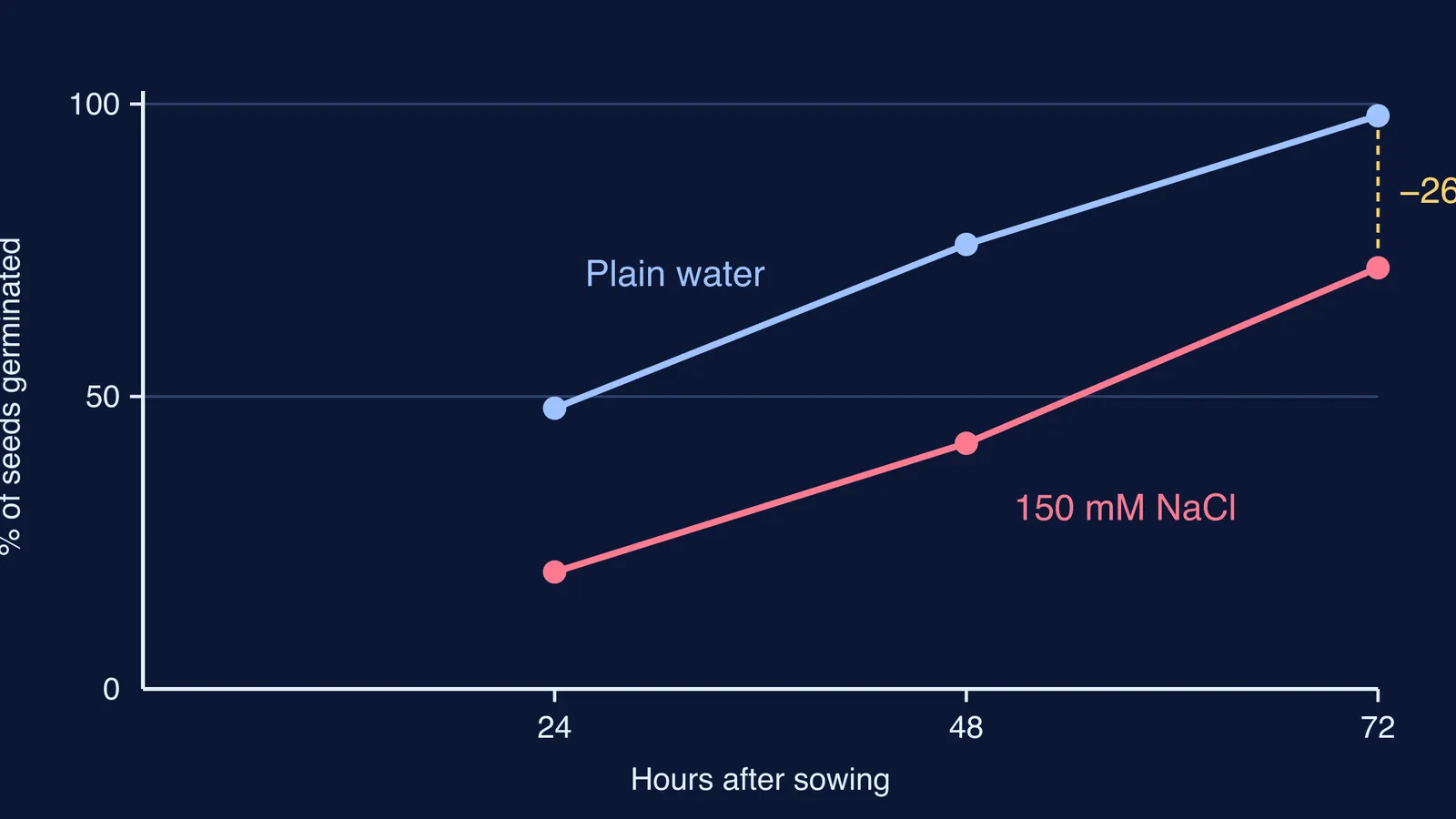
In a cotton study in Genes (2026), 48% of seeds in water had germinated at 24 hours, against 20% in 150 mM NaCl. At 72 hours the figures were 98% and 72%.
How much salt seeds can take depends on the species and on the salt. In a canola study in Frontiers in Plant Science (2022), more than 90% of seeds germinated in anything from 0 to 200 mM NaCl. That fell to 60% at 250 mM and almost zero at 300 mM. Alkaline baking soda (NaHCO₃) cut germination to 23% at only 100 mM.
How do you set up the salt water seed germination experiment?
Use five concentrations: 0, 50, 100, 150 and 200 mM NaCl, the range used in a wheat study in ISRN Botany (2012). Sodium chloride has a molar mass of 58.44 g/mol (PubChem), so 200 mM means 11.7 g of salt per litre.
Make a 200 mM stock: dissolve 11.7 g of plain salt and top it up to 1 litre with water.
Dilute for the others, 100 mL each: 150 mM is 75 mL stock + 25 mL water, 100 mM is 50 + 50, and 50 mM is 25 + 75. Use plain water for 0 mM.
Line five labelled boxes with tissue or filter paper. Place 30 seeds in each, as the canola study did, and add the same volume of solution to each (that study used 10 mL).
Use one kind of seed; moong or mustard works. Keep the dishes side by side, out of direct sun.
Keep the lids on. Evaporation leaves the salt more concentrated.
Count at the same time every day for 7 days. Use the canola study's rule: a seed counts once its shoot or root is as long as the seed.
Ideally, repeat each dish three times, so one bad batch of seeds will not decide your result.
How do you calculate germination percentage and water potential?
Germination percentage = (seeds germinated ÷ seeds sown) × 100. If 21 of your 30 seeds sprout, that is 70%.
Now work out the solute potential of each dish at 25 °C (T = 298 K), using the formula from the AP Biology sheet. For 100 mM: ψs = −2 × 0.1 × 0.0831 × 298 = −4.95 bar, about −0.5 MPa. The 50, 150 and 200 mM dishes come out at −2.48, −7.43 and −9.91 bar. Plain water is 0 bar.
For comparison, NOAA gives the average salinity of seawater as about 35 parts per thousand. Dissolve 35 g of table salt in a litre and you get about 600 mM, roughly −29.7 bar. That is three times as negative as your strongest dish.
Plot germination against day, one line per concentration, then final germination against ψs. If the ψs working is where you get stuck, the Fermi Problem Library has worked problems with a step-by-step solver that explains the reasoning rather than printing an answer.
What does this experiment tell us about saline soils?
Your dishes are a small version of a seedbed in salty soil. CSSRI says its 6.73 million hectare estimate is almost the same as its 1970 figure: over four decades, land reclaimed and land degraded roughly balanced out.
For your write-up, check that you have:
a hypothesis naming what you changed and what you measured
a table of daily counts for each dish
the two graphs above
an explanation in terms of water potential and osmosis
limitations: one seed type, one temperature, a small sample, additives in table salt
one extension, such as two seed types, or NaCl against baking soda
If osmosis or water potential still feels shaky, the Fermi Concept Library covers every concept in physics, chemistry, biology, mathematics and computing, each with its own lesson.
Set up the five dishes this weekend and count on day one.