On this page
If you are in Class 11 or 12 and like the idea of protecting people from fire, you will see plenty of adverts for “fire and safety” courses. They are not the same thing. An engineering degree, a government safety diploma and a short private certificate lead to different jobs, at different ages.
What is the difference between a fire engineering degree and a safety diploma?
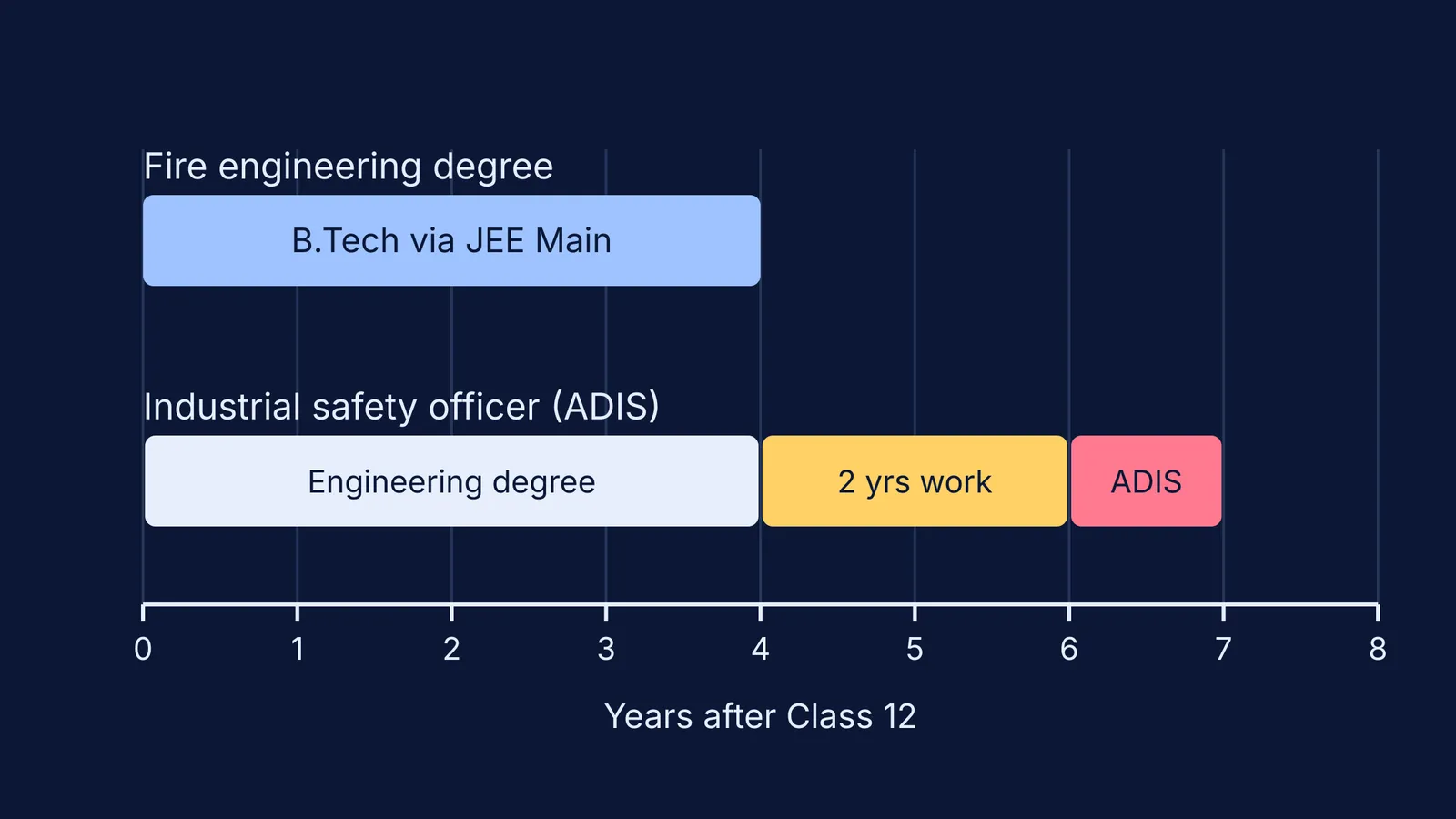
A fire engineering degree is a four-year engineering programme you join straight after Class 12. The NFSC admission brochure for 2026-27 says the National Fire Service College, Nagpur, runs under the Ministry of Home Affairs and calls itself the only institute in India offering a B.Tech in Fire Engineering. Its course is affiliated to Rashtrasant Tukadoji Maharaj Nagpur University and approved by AICTE. It has an intake of 60 students, admitted on JEE Main rank.
An industrial safety diploma is a different route. The Directorate General Factory Advice Service and Labour Institutes (DGFASLI), under the Ministry of Labour and Employment, runs a one-year Advanced Diploma in Industrial Safety (ADIS) at the Central Labour Institute, Mumbai, and at Regional Labour Institutes in Chennai, Faridabad, Kanpur and Kolkata. DGFASLI describes these diplomas as “the only recognized statutory qualification all over India for appointment as Safety Officers as per The Factories Act, 1948”.
You cannot join it straight after Class 12. The 2024-25 prospectus from CLI Mumbai asks for a degree or diploma in engineering, or a science degree with chemistry or physics as a major. It also lists experience, preferably in a supervisory role: 2 years for engineering graduates and 5 years for diploma or science graduates.
The law is changing too: a PIB backgrounder on the OSH Code, 2020 says the code replaces 13 central labour laws, including the Factories Act, 1948. Check the current rules when you reach that stage.
What does a fire engineer actually do?
The NFSC brochure says its degree adds “fire dynamics, industrial safety, risk assessment and fire protection system design” to standard engineering. The brochure names oil and gas, power, steel, infrastructure, aviation, manufacturing and government services as sectors where it says its graduates are in demand. For a first taste of the science, read our explainer on how fire extinguishers work.
The NFSC course is also physical. The same NFSC brochure says the course involves “rigorous physical training”, and sets standards before admission. These include a minimum height of 165 cm for men and 157 cm for women, 6/6 vision in the better eye without glasses, and no colour blindness. Hostel is compulsory, with a 9:30 pm roll call. Listed fees for 2026-27 are ₹42,000 a year including hostel, before mess, medical insurance and university charges, and the brochure notes they may be revised.
Which fire and safety courses are recognised in India?
Start your shortlist with programmes whose status you can confirm on an official page:
B.Tech (Fire Engineering), NFSC Nagpur: JEE Main Paper 1, physics and maths compulsory in Class 12, according to the NFSC brochure.
B.Tech Safety and Fire Engineering, CUSAT, Kochi: the CUSAT School of Engineering lists it as 8 semesters, 60 seats and NBA accredited.
ADIS from DGFASLI institutes: after a degree or diploma and work experience.
Other colleges run fire and safety programmes too. Judge each one with the checklist below.
How do you spot a weak fire and safety institute?
Ask these questions before you pay anything:
Who awards the certificate: a university, a state technical board, or the institute itself? The ADIS at CLI Mumbai, for example, is awarded by the Maharashtra State Board of Technical Education, according to the CLI prospectus.
Is the course approved? For an engineering degree or diploma, look the institute up on AICTE's official website for the current academic year. For a “university”, check it is not on the UGC list of fake universities.
Does it promise you a “safety officer” job straight after Class 12? The statutory route DGFASLI describes needs a degree or diploma first, then work experience.
Where does the practical training happen? Ask to see the labs and the drill ground.
Who hired last year's batch? Ask for company names, and talk to two former students yourself.
Is the refund rule in writing? NFSC's brochure, for instance, states its cancellation refund.
How should you plan from Class 11?
Keep physics and maths. The NFSC brochure asks for both as compulsory subjects, plus English, with at least 50% in physics, maths and one listed optional subject taken together.
Prepare for JEE Main, since NFSC admits on JEE Main rank.
Read the medical and physical standards now, not after your results.
Shortlist three to five programmes and run each through the checklist.
If you keep losing marks on mechanics or heat numericals, the Fermi Problem Library has worked problems with a step-by-step solver that explains the reasoning rather than printing an answer.
Parents can read next: when your child is unsure about a career in Class 12 and when a child wants ITI or polytechnic.