On this page
If you want to cook for a living, the end of Class 12 is a good point to start, and no particular stream is required for the main routes. The real choice is between three kinds of training: a short craft course or diploma that gets you into a kitchen fast, a hotel management degree that covers hotel administration more broadly, and a culinary arts degree built around the kitchen and its business side. All three usually end the same way, with you starting near the bottom of a kitchen team and working up.
What are the ways to become a chef after 12th?
The National Council for Hotel Management and Catering Technology (NCHMCT) publishes the eligibility and duration of the courses its institutes run. Three of them lead straight to a kitchen:
Craftsmanship Certificate Course in Food Production: 1.5 years, open after Class 10. Its course structure ends with a third semester of 20 weeks of industrial training in a hotel or restaurant.
Diploma in Food Production: 1.5 years, open after a 12th pass. Its course structure gives the whole third semester, 24 weeks, to industrial training in hotels.
B.Sc. in Hospitality and Hotel Administration (HHA): 3 years, open after 12th with English as a subject. Its admission page says seats go by All India Rank in NCHM JEE, which the National Testing Agency conducts, and graduates receive a Jawaharlal Nehru University degree. Our guide to NCHM JEE and hotel management explains the exam.
The craft course syllabus, according to NCHMCT's admission page, covers cookery and larder, bakery and patisserie, hygiene, equipment maintenance and costing, and its graduates usually start as cooks, commis or kitchen assistants.
Culinary arts degrees are run by universities and private institutes, and the details vary. As one example, Gurugram University's BA (Hons) in Culinary Arts regulations, adopted from 2019, set a three-year, six-semester course, ask for 10+2 with at least 50% marks, and describe it as preparation for a career in management in the culinary industry.
Degree or diploma: which one suits you?
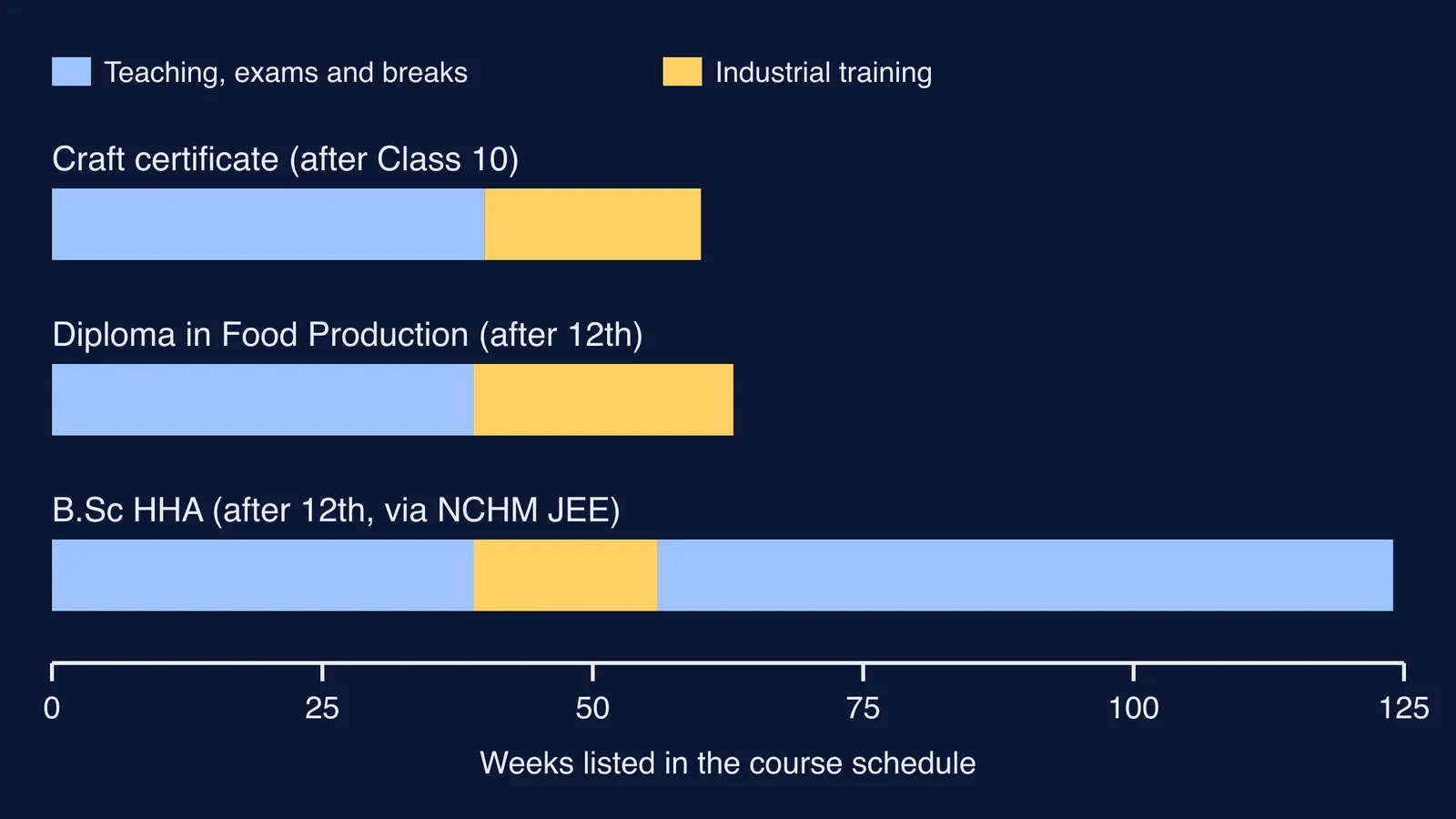
Here is a worked comparison. Add up the weeks each NCHMCT course structure lists for teaching, exams, breaks and training, then see how many are spent in a hotel:
Diploma in Food Production: 24 of 63 listed weeks, roughly 38% (NCHMCT).
Craft certificate: 20 of 60 listed weeks, about a third (NCHMCT).
B.Sc. HHA: one 17-week industrial training block, in the third or fourth semester depending on the student's group, out of about 124 listed weeks, roughly 14% (course structure).
That does not make one route better. It tells you what you are paying for. Use it like this:
Pick a diploma or craft course if you want to be cooking within two years and learn best by doing. You can study further later.
Pick the B.Sc. HHA if you want a degree, might move into hotel operations or management, and are ready to prepare for an entrance exam.
Pick a culinary arts degree if you are sure about food, want a degree, and the institute can show you its kitchens and where its graduates work.
What do kitchen hours actually look like?
The Tourism and Hospitality Skill Council's qualification pack for a commis chef (2021 version), an entry-level kitchen job, describes the work as setting up the kitchen, preparing sauces, salads, cold starters and other base items, monitoring stock, and closing the kitchen at the end of the shift. It lists "the stamina to work for long hours" as a required personal attribute and sets 18 years as the minimum job entry age.
Kitchens are busiest when everyone else is eating, so expect evenings, weekends and festival days at work, and long stretches on your feet. Industrial training is where most students find out whether they enjoy that rhythm.
What should you ask before paying fees?
Who awards the certificate or degree, and is that body recognised? Check the name against our guide to the fake universities list.
How many weeks of industrial training are there, in which hotels, and who arranges them?
How many hours a week do students cook in the training kitchen, and how many students share one station?
What is the total cost for the whole course, including uniforms, knife kits, hostel and exam fees, and what is the refund policy in writing?
Where did last year's batch start work, and in what role? Read our placement data red flags before trusting a brochure.
If you feel awkward asking, use this script on your visit: "Before we pay, could you show us the training kitchen during a practical class, last year's list of industrial training hotels, and the refund policy in writing?" A good institute will say yes without fuss.
Cooking is also applied science: heat moving through a pan, proteins setting, sugars browning. If you want to understand what is happening on your stove, the Fermi Concept Library has a lesson for every concept in physics, chemistry and biology.
Decide how soon you want to be in a kitchen, shortlist two or three institutes, and visit each before you pay.