

On this page
When you are choosing an engineering or science college, the placement brochure is often the first thing you check. Seeing claims of "100% placement" and a "₹1.2 Crore highest package" can make a college seem like a guaranteed ticket to a great career.
However, there is often a vast gap between these glossy marketing figures and the official data colleges must submit to the government. Before paying the admission fee, you need to know how to read beyond the marketing to find out what actually happens to the graduating batch. Here are the red flags to watch out for, and how to find the truth.
How do colleges calculate 100% placement?
It seems mathematically impossible for a college to guarantee a job for every single student, yet many claim exactly that. They achieve this using the "vanishing denominator" trick.
Instead of calculating the placement percentage based on the total number of students in a batch, the college only counts "eligible" students (College and Fees). A college can artificially shrink this eligible pool by excluding students with backlogs, low attendance, or a CGPA below a strict threshold (such as 7.0). They may also ask students who have not secured a job to sign a form stating they are "opting out" to pursue higher studies or entrepreneurship.
Through these filters, a batch of 500 students might be reduced to an "eligible" pool of just 200. If those 200 students get jobs, the college claims a 100% placement rate, completely ignoring the 300 students who graduated without an offer.
If you are navigating your first semester at science or engineering college and find yourself struggling with foundational subjects, this eligibility threshold can be a major stressor. If you are not sure where to start studying to catch up, Fermi's AI tutor works out what you already know and builds a plan for the session, so you sit down to a clear next step. For specific topic gaps, the Fermi Concept Library contains every concept in physics, chemistry, biology, mathematics and computing, each with its own lesson and its place in the map.
What is the difference between median and average packages?
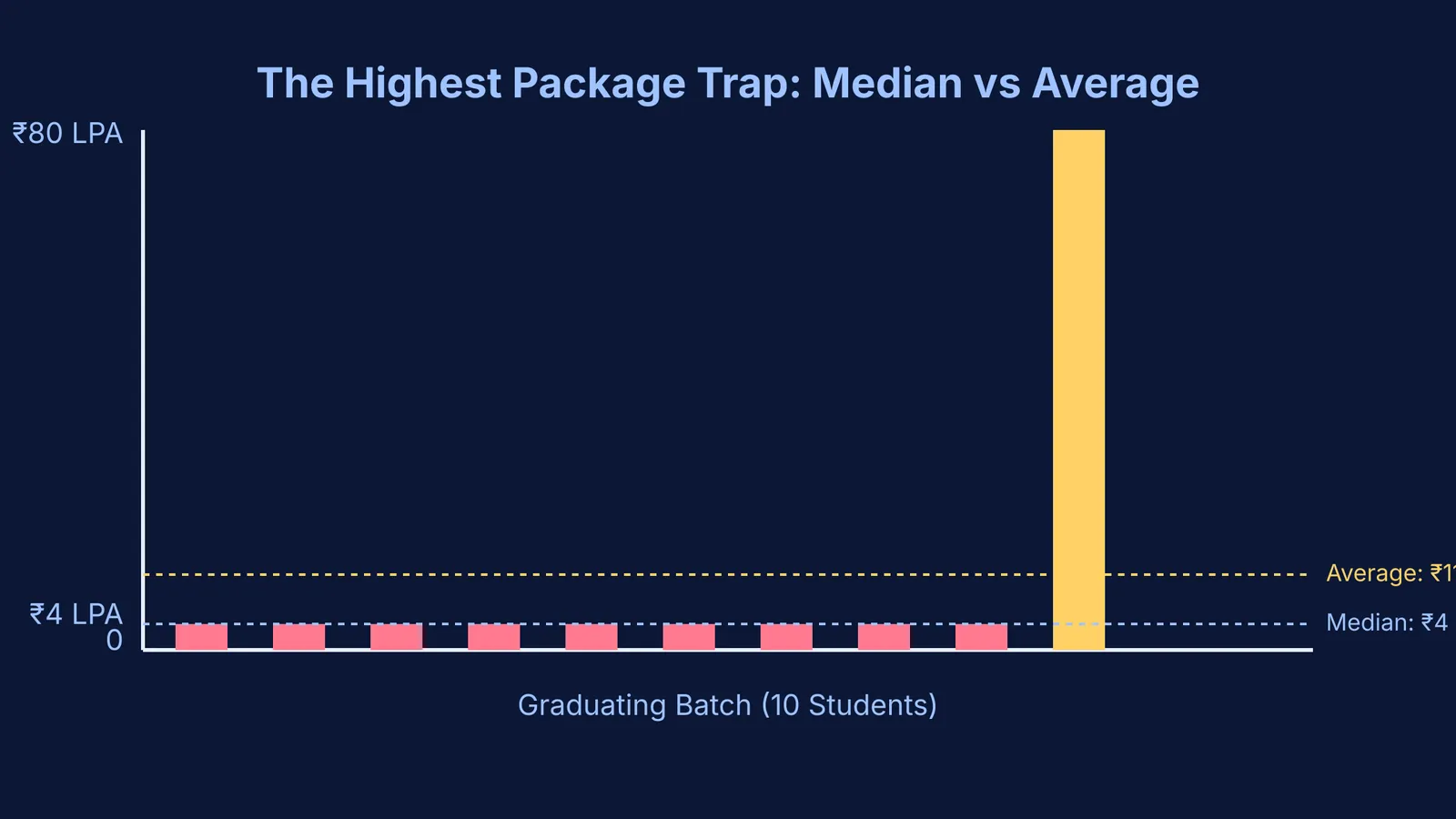
The second most common red flag is the "Highest Package" trap. The National Institutional Ranking Framework (NIRF) requires colleges to report median salaries precisely to prevent exceptionally high outliers from skewing the data. A brochure might boldly advertise a highest package of ₹80 Lakhs Per Annum (LPA). Often, this represents a single international offer, or an off-campus placement where the student applied independently and the college had little involvement.
When a college highlights the "Average Package," that single massive offer pulls the entire average up. For example, if nine students earn ₹4 LPA and one student earns ₹80 LPA, the mathematical average is ₹11.6 LPA. A prospective student might expect to earn around ₹11 LPA, when the reality for 90% of the class is ₹4 LPA.
The honest figure is the median salary. The median is the exact middle value of all offers. If the median is ₹6 LPA, it means exactly half the students earned that amount or more, and half earned less. Because the median represents the typical outcome, it is the standard required by NIRF.
How to check college placement claims are real?
Do not rely solely on the college website's banner images. Instead, use this practical framework to find the real numbers:
Check the NIRF Report: Every participating institution must host its NIRF data on its website, or you can search for it directly on the NIRF portal. Look for the "Graduation Outcomes" section. Here you will find the official "Median Salary" for undergraduate and postgraduate batches.
Look at Placed vs Graduated: In that same NIRF table, compare the "Total Number of Students Graduating" against the "Number of Students Placed". Dividing these two numbers gives you the true, unfiltered placement percentage.
Distinguish CTC from take-home pay: "Cost to Company" (CTC) often includes one-time signing bonuses, the cost of employee meals, and stock options that take years to vest. The actual take-home salary is often significantly lower.
Check branch-wise data: A college might boast a high overall placement rate driven entirely by its Computer Science department, while core branches like Mechanical or Civil Engineering struggle. Always ask for data specific to your intended degree.
It is entirely normal to improve your CGPA as you settle into college life, but you want to ensure the institution you choose will actually support you when it comes time to find a job. If you have questions about whether a particular path is right for you, read our guide on talking about STEM careers beyond engineering and medicine. When evaluating any college, remember: the median salary tells the truth that the highest package hides.


