

On this page
For students exploring undergraduate degrees outside conventional engineering and medicine, the National Council for Hotel Management Joint Entrance Examination (NCHM JEE) offers an established gateway into the global hospitality industry. Administered as a nationwide computer-based test by the National Testing Agency, NCHM JEE provides entry into three-year undergraduate hospitality degrees across government and private hotel management institutes in India.
What does the NCHM JEE exam pattern cover?
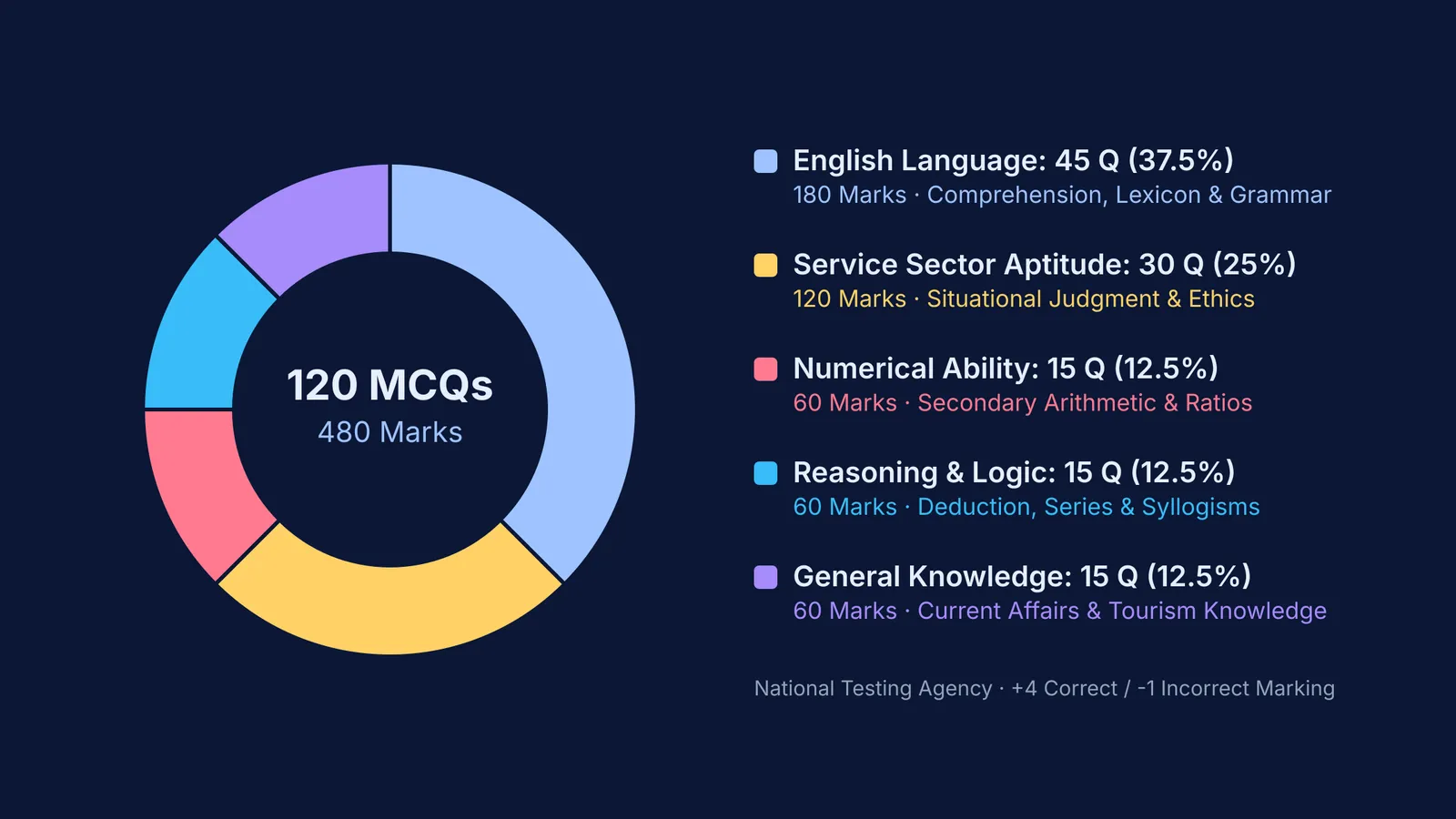
As outlined in the official NCHMCT guidelines, the National Testing Agency administers the entrance test as a 120-minute computer-based session comprising 120 multiple-choice questions for a maximum score of 480 marks. Earlier test cycles through 2025 followed a longer 200-question format conducted over 180 minutes for 800 marks. Under the current structure, every question awards 4 marks for a correct response and imposes a negative marking deduction of 1 mark for an incorrect answer, with no penalty for unattempted questions.
The examination evaluates candidates across five sections:
English Language: 45 questions (180 marks), testing reading comprehension, vocabulary, and grammar.
Aptitude for Service Sector: 30 questions (120 marks), evaluating interpersonal empathy, customer-handling judgment, and ethical decision-making.
Numerical Ability and Analytical Aptitude: 15 questions (60 marks), assessing arithmetic including percentages, ratios, and time-speed-distance.
Reasoning and Logical Deduction: 15 questions (60 marks), examining syllogisms, series, and blood relations.
General Knowledge and Current Affairs: 15 questions (60 marks), covering national events, tourism geography, and cultural honours.
English Language and Service Sector Aptitude make up 75 of the 120 questions, representing 62.5% of the overall score. Candidates must have passed Class 12 or equivalent with English as a compulsory subject; under current council policy, there is no upper age limit.
Which institutes participate and how does counselling work?
NCHM JEE ranks govern admission across hospitality institutes nationwide, as catalogued by the NCHMCT counselling portal. This network includes 21 Central Institutes of Hotel Management (IHMs) funded by the Ministry of Tourism, over 25 State IHMs, 1 Public Sector Undertaking institute, and affiliated private colleges, offering over 10,000 undergraduate seats annually.
Top central colleges—such as IHM Pusa in New Delhi, IHM Mumbai, IHM Bengaluru, IHM Chennai, and IHM Kolkata—command the most competitive closing ranks in online counselling. Under a Memorandum of Understanding between NCHMCT and Jawaharlal Nehru University (PIB release), students enrolled in the three-year B.Sc. in Hospitality and Hotel Administration receive their degrees from JNU, with an optional fourth year for an Honours degree under National Education Policy guidelines.
What do students study during the B.Sc. in hospitality?
The curriculum structured by NCHMCT combines operational technique with managerial foundations across six semesters. Core practical training centres on four operational pillars known as the Big Four:
Food Production: Culinary skills, knife work, regional Indian cooking, international cuisine, volume catering, and bakery.
Food and Beverage Service: Restaurant service styles, banquet operations, beverage service, and dining room management.
Front Office Operations: Guest reservations, registration logistics, concierge services, and hotel property management software.
Accommodation Operations: Housekeeping standards, laundry operations, fabric care, interior aesthetics, and room upkeep.
Students also study hotel accountancy, facility engineering, hospitality marketing, and human resources. During the second year, all undergraduates complete a mandatory 17-week industrial training semester in classified star hotels, rotating across all four operational departments.
What career paths open after graduating from an IHM?
Graduating from a top IHM opens paths well beyond traditional hotel kitchens or reception desks:
Luxury Hospitality Management: Management Trainee programs with brands like Taj (IHCL), Oberoi, Marriott, and ITC Hotels, fast-tracking graduates toward departmental leadership and General Manager roles.
Aviation and Cruise Lines: International cabin crew, VIP airport lounge management, and luxury cruise liners that offer global travel alongside tax-free earnings.
Quick Service Restaurants and Retail: Managerial positions in high-volume food brands and multinational retail chains.
Luxury Brand Experience: Client relationship roles with premium fashion and timepiece houses, where customer service etiquette is paramount.
For families evaluating vocational tracks against standard academic expectations, when a student's career choice differs from family expectations offers a structured framework for weighing non-traditional degrees.
How should you prepare for the service aptitude and numerical sections?
Because verbal ability and service aptitude account for 62.5% of the total marks under the NCHMCT examination pattern, a balanced weekly strategy is essential:
Master Service Scenarios: Service aptitude questions assess situational judgment. The most effective responses consistently prioritize guest safety, calm conflict resolution, and courteous problem solving over defensive reasoning.
Build Daily Reading Habits: Regular reading of news editorials strengthens comprehension speed and vocabulary for the 45 English questions.
Review Secondary Arithmetic: For the 15 numerical questions, review arithmetic formulas covering percentages, profit and loss, and ratios. The Fermi Problem Library provides worked problems with a step-by-step solver that explains the reasoning rather than printing an answer, helping you verify your problem-solving steps.
Balancing exam preparation with Class 12 board exams works best with structured scheduling. Techniques like weekly time blocking for students and setting clear study goals help candidates allocate focused time for each subject. To build consistency across unfamiliar sections, Fermi's AI tutor can work out what you already know and build a plan for the session, keeping your preparation organized across all five sections.


