On this page
CMA stands for Cost and Management Accountant, a qualification awarded by the Institute of Cost Accountants of India (ICMAI). ICMAI is a statutory body set up on 28 May 1959 under the Cost and Works Accountants Act, 1959, and it works under the Ministry of Corporate Affairs, according to the institute's history page.
What are the stages of the CMA course after 12th?
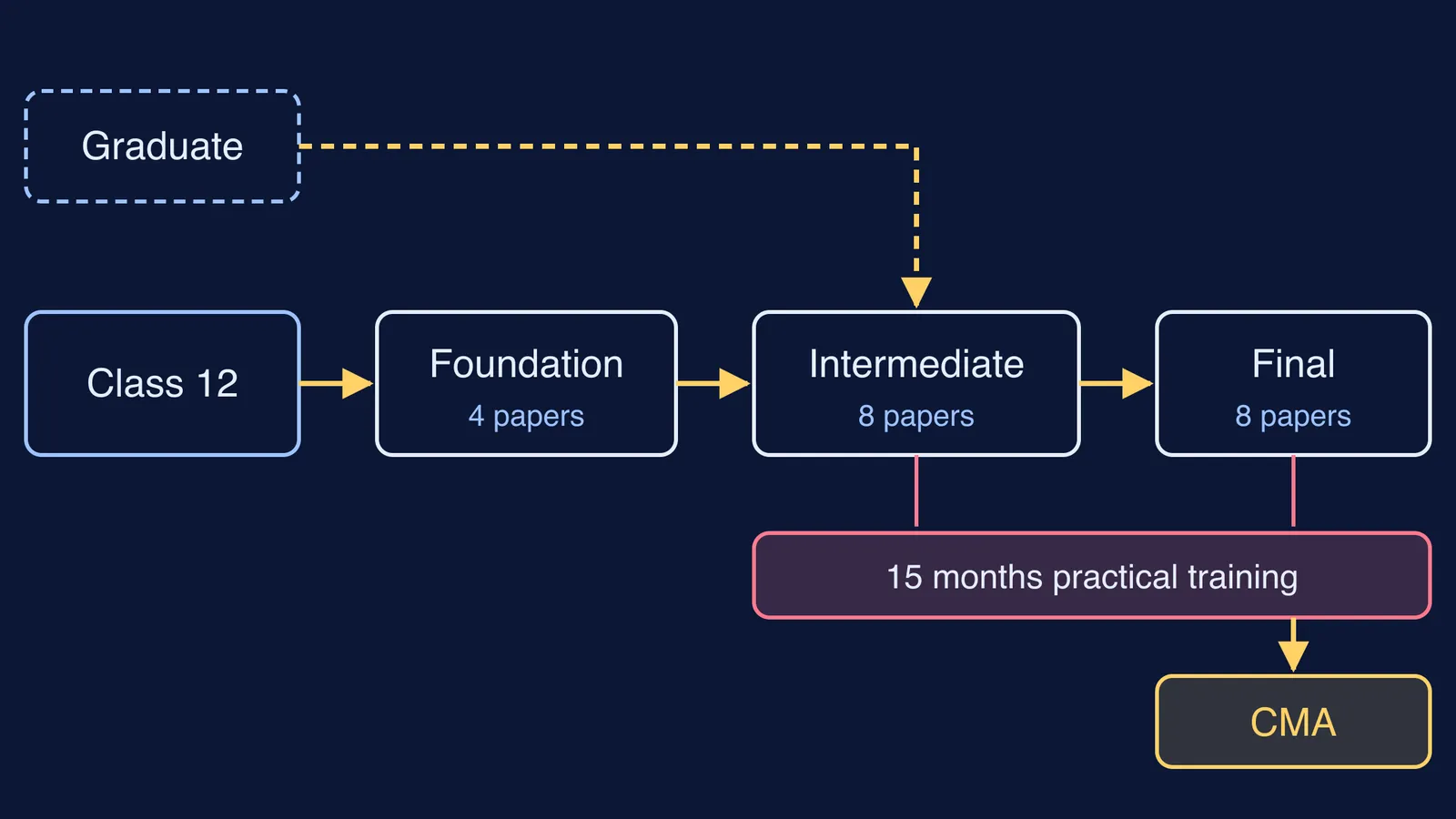
There are three exam levels plus training. The paper lists come from ICMAI's Syllabus 2022 pages.
Foundation: four papers covering business laws and communication, financial and cost accounting, business mathematics and statistics, and business economics and management (ICMAI Foundation papers).
Intermediate: eight papers in two groups of four, running from financial accounting and taxation to cost accounting and management accounting (ICMAI Intermediate curriculum).
Final: seven compulsory papers, including strategic cost management and cost and management audit, plus one elective chosen from three (ICMAI Final papers).
Practical training: students who registered for Intermediate on or after 11 February 2020 must complete 15 months of practical training before their Final result is declared (ICMAI training scheme).
The same training scheme says you need at least 10 months of training done by 31 August to sit the December Final, or by 28/29 February to sit the June Final. You can train with a practising cost accountant, a bank, a public sector undertaking or a company above a set turnover, among others.
Who is eligible for CMA Foundation and Intermediate?
Under ICMAI's eligibility rules, you can join Foundation once you have passed Class 10, so a Class 12 student can start early. Intermediate needs Class 12 plus Foundation, or a degree in most subjects. Engineering students who have finished their second year also qualify. If you have passed ICSI's Foundation or ICAI's Intermediate, you are exempt from CMA Foundation.
You can register at any time of year, but ICMAI's admission page sets two cut-offs: 31 January for the June exam term and 31 July for the December term. Fees change, so check the current fee schedule on that page before you pay.
How is CMA different from CA and CS?
CMA (ICMAI) is about cost: what it really costs to make a product or run a service, and how managers use those numbers. When the government requires certain companies to have a cost audit, Section 148(3) of the Companies Act, 2013 says it shall be conducted by a cost accountant.
CA (ICAI) is built around financial reporting, audit and tax. ICAI's education and training chart has the same three levels, but it asks for 2 years of practical training, and you sit the Final six months after that training ends.
CS (ICSI) is about company law, compliance and governance. Its exams run in three levels (CSEET, Executive and Professional) alongside practical training, and company secretaries count as key managerial personnel under the Companies Act (overview of ICSI).
The routes connect: ICAI's chart lists passing the ICMAI Intermediate exam as a direct-entry route into CA Intermediate. For more, read our explainers on chartered accountancy for PCM students and the company secretary route through CSEET.
Should you do CMA with a BCom?
A degree gets you straight into Intermediate, so a BCom graduate skips Foundation. Class 12 plus Foundation also opens Intermediate, so you can work through the levels while you are at college. ICMAI's eligibility page offers provisional Intermediate registration to students still waiting on their degree results, with 18 months to convert it to a regular one.
Before you choose, ask yourself:
Do I want a degree to fall back on if a level takes several attempts? Then take the BCom alongside.
Will my college timetable leave room for June and December exams?
Am I sure about cost accounting? If not, try a year of BCom first; direct entry stays open.
Where will I do 15 months of training? Plan it around college, not after it.
A sample plan for someone finishing Class 12 in 2027
By 31 July 2027: register for Foundation for the December 2027 term, and start your BCom.
December 2027: sit the four Foundation papers.
Once your Foundation result is out: register for Intermediate before the next cut-off (31 January or 31 July).
During Intermediate: check when the training scheme lets you start, then find a placement, so you have 10 months done by the Final cut-off.
Final year of BCom: sit the CMA Final in a term that fits your training dates.
This plan assumes you pass every level at the first attempt. Before you fix any dates, check ICMAI's current prospectus for minimum gaps between levels.
Business mathematics and statistics turns up early in the course. If those chapters still feel shaky after Class 12, the Fermi Concept Library has a lesson for every concept in mathematics, so you can close a gap before it costs you a paper. If your family wants the bigger picture, our guide on explaining commerce careers to your family is a good next read.