On this page
Can a PCM student become a Chartered Accountant?
Yes. The Institute of Chartered Accountants of India (ICAI) does not restrict entry to the commerce stream. You can register for the CA Foundation course after passing your Class 12 board exams, regardless of whether you studied PCM (Physics, Chemistry, Mathematics), PCB, or arts. There is no minimum Class 12 percentage required to register for the foundation level.
While commerce students have a head start in basic accounting, science students bring strong analytical skills that help with the quantitative papers. Many students with a background in science choose chartered accountancy to enter niche, high-growth fields like forensic accounting, financial modelling, and data analytics, where logical reasoning and mathematical fluency are highly valued.
What is the CA path after Class 12 Science?
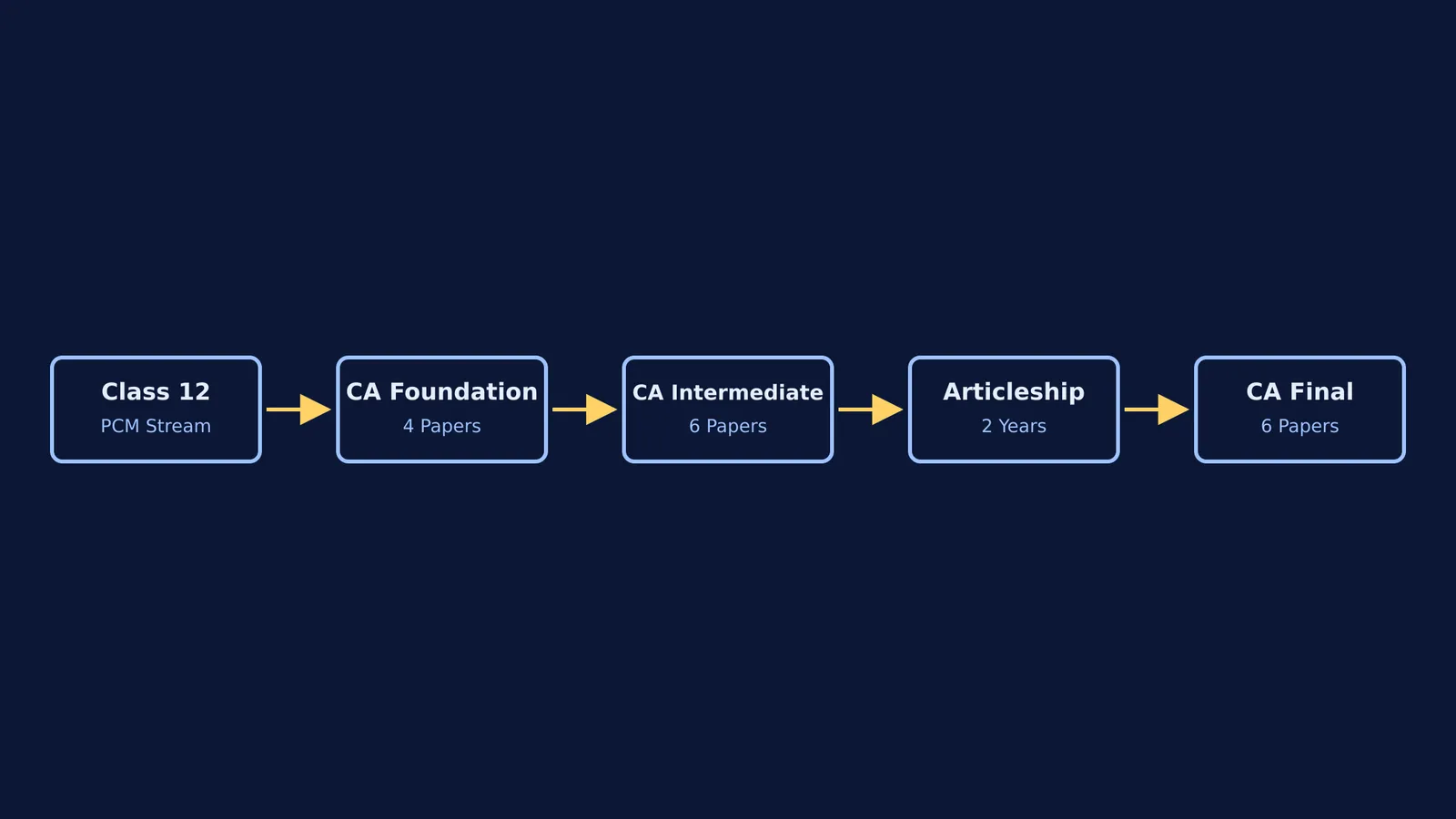
Under the new ICAI Scheme of Education and Training implemented in 2023, the path to becoming a CA takes about four and a half years:
CA Foundation: A four-paper entry-level exam. You need a mandatory four-month study period after registering before you can sit for the exam.
CA Intermediate: Two groups of exams covering advanced subjects. The new scheme reduced the total papers at this level from eight to six.
Articleship (Practical Training): Once you pass both groups of Intermediate, you must complete exactly two years of practical training in a CA firm. This is a reduction from the three years required under the old scheme.
CA Final: After a six-month study period post-articleship, you take the final exams, which also consist of six papers.
It is a long road requiring a durable schedule. If you are setting up your schedule, read our guide on how to build a study routine that lasts.
What are the CA Foundation subjects?
The first hurdle is the CA Foundation exam, which consists of four 100-mark papers. To pass, you must score at least 40% in each paper and an aggregate of 50% across all four.
Accounting: A subjective paper on financial statements, bank reconciliations and company accounts. This paper is purely practical and tests your ability to prepare and interpret financial records.
Business Laws: A subjective paper covering the Contract Act, Companies Act and other regulatory frameworks. It requires drafting precise legal answers based on case studies.
Quantitative Aptitude: An objective paper divided into Business Mathematics (40 marks), Logical Reasoning (20 marks) and Statistics (40 marks).
Business Economics: An objective paper on demand and supply, markets and national income, which now includes concepts previously covered at the Intermediate level.
How does PCM help in the CA Foundation?
If you studied maths in Class 11 and 12, Paper 3 (Quantitative Aptitude) will play to your strengths. Topics like calculus, permutations, combinations and sequences are already familiar to you. In the September 2024 CA Foundation exams, the overall pass rate was 19.67%, meaning strong performance in maths can significantly boost your aggregate score to help clear the 50% threshold.
However, Accounting and Business Laws will be entirely new. You will have to learn the language of debit and credit from scratch. This is where a clear plan matters. AI study plans can help pace your initial reading, but understanding the core concepts requires active learning. The leap from physics problems to accounting ledgers is significant, but the problem-solving mindset you developed in science will help you break down complex financial scenarios.
How do science students bridge the gap?
You do not need to attend a commerce coaching centre to catch up, though many students choose to take focused classes for the accounting papers. ICAI provides comprehensive study material designed for beginners. Whether you are deciding between coaching, online classes or self-study, focus on learning the reasoning behind accounting rules rather than memorising entries. Understand why a liability is credited and an asset is debited before you try to balance a balance sheet.
If you are reviewing the calculus and statistics needed for Paper 3, the Fermi Problem Library has worked problems with a step-by-step solver that explains the reasoning rather than printing an answer. If you get stuck on a new topic, Fermi's AI tutor can work out what you already know and build a plan for the session, writing on a board and checking your understanding as it goes.
Taking on chartered accountancy as a science student is challenging but entirely possible. By leveraging your strengths in quantitative aptitude and dedicating focused time to mastering the basics of accounting and law, you can build a successful career in finance.