On this page
A BSc in Electronics and a BTech in Electronics and Communication Engineering (ECE) look similar on paper. The difference shows up later: how long the degree takes, which master's programmes accept you, and how you prove your skills to an employer. Here are the routes, the official rules, and a year-by-year skill plan.
How is BSc Electronics different from a BTech in ECE?
The length is different. The GATE 2027 eligibility rules describe a BE or BTech as “4 years after 10+2” and a BSc as a “3-year program”. A UGC expert committee has also recommended that a three-year degree be called BSc, and a four-year degree BSc (Hons), an Honours degree with research, or BS, so ask your college whether its BSc runs for three years or four.
The focus is different too. A BTech in ECE is an engineering degree built around design: communication systems, signal processing, VLSI and a large final project. Our guide to electronics and telecommunication engineering covers that branch in detail. A BSc Electronics usually teaches electronics alongside physics and mathematics, with more theory and less design work.
What can you do after BSc Electronics?
There are three main routes.
MSc first. JAM (Joint Admission Test for Masters) opens postgraduate science programmes at premier institutes. JAM 2027 is on 14 February 2027 and is organised by IIT Kharagpur. Another entrance test is CUET (PG), run by the National Testing Agency.
MTech through GATE. GATE 2027, organised by IIT Madras, has 30 test papers, including Electronics and Communication Engineering (EC), Instrumentation Engineering (IN) and Physics (PH), and a score stays valid for 3 years. BSc students can take it once they are in their third year.
A job straight away. Embedded firmware, testing, electronics manufacturing and semiconductor work reward people who can show what they have built; see our embedded systems career guide. In March 2026 the Ministry of Electronics and IT said the Chips to Startup (C2S) programme has a 10-year target of training 85,000 engineers in semiconductor design, with design software available in 315 academic institutions. Ask whether your college is one of them.
Can you do an MTech after BSc Electronics?
Yes, but usually not straight after a three-year BSc. Clearing GATE alone is not enough. Each institute also sets a minimum degree.
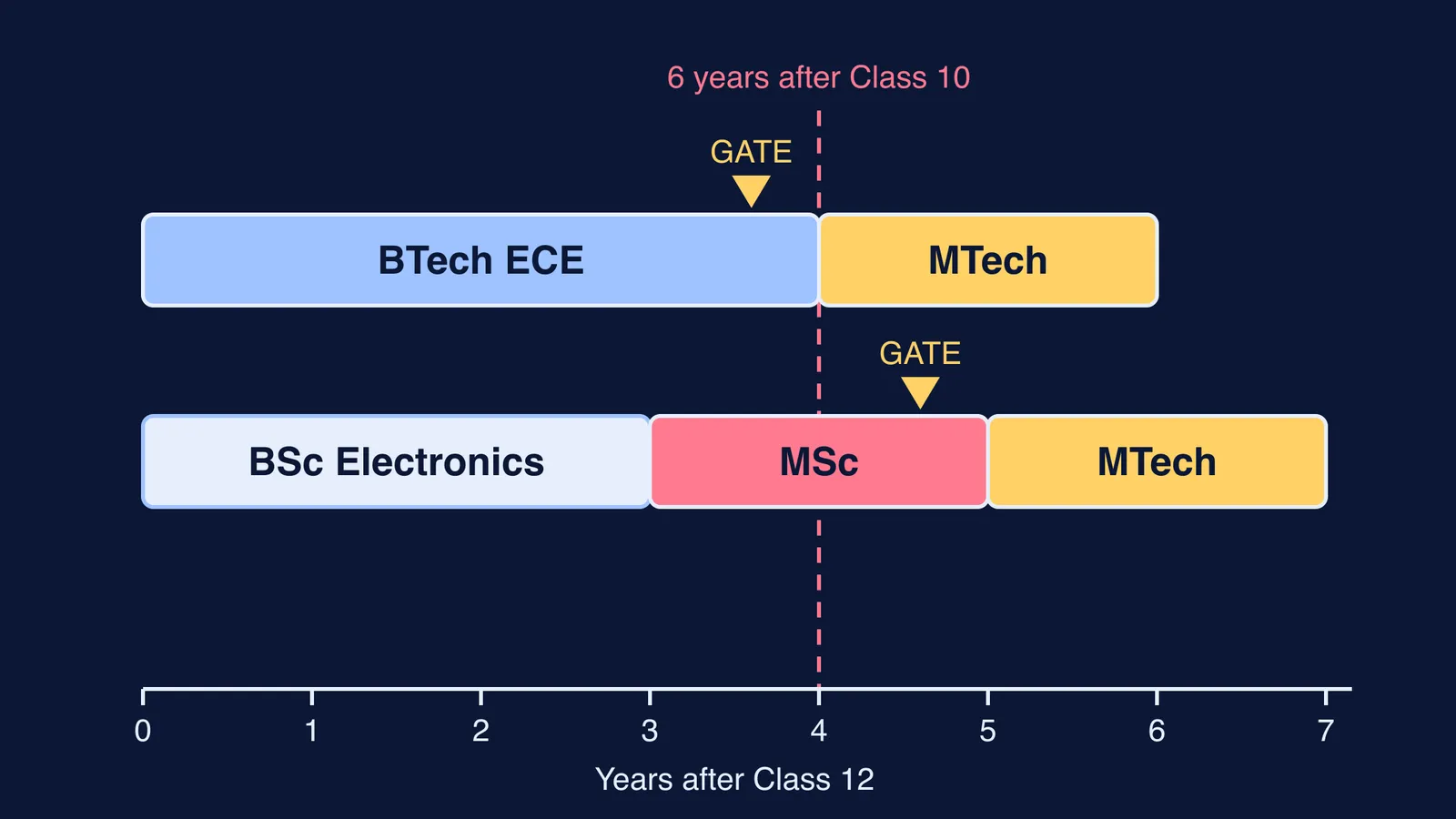
IIT Guwahati asks for a degree “obtained through a study of at least 6 years duration” after Class 10. Class 11 and 12 plus a three-year BSc adds up to five years, so you fall short.
IIT Jammu's 2026-27 MTech in VLSI Design accepts a BE, BTech, four-year BS or an MSc in Electronics or related branches, with 60% marks, 60% in Class 10 and 12, and a GATE EC score of at least 300 (200 for SC, ST and PwD candidates).
A worked example. Say you pass Class 12 in 2026. You finish a three-year BSc Electronics in 2029 and an MSc Electronics in 2031. That is seven years after Class 10, which clears the six-year rule. You take GATE EC in February 2031, in your final MSc year, and start an MTech later that year: one year after a BTech classmate could. Weighing a research degree instead? Read our comparison of MS by research and MTech.
Which skills should you start in your first year?
A portfolio sets you apart. Here is a three-year plan.
Year 1
Learn C programming, one small exercise a day.
Build simple circuits on a breadboard and measure them with a multimeter.
Get a basic microcontroller board. Make an LED blink, then read a sensor.
Read one datasheet a week, start to finish.
Year 2
Learn digital logic, then write and simulate small designs in Verilog.
Learn how chips talk to each other over UART, I2C and SPI.
Design one printed circuit board in KiCad, which is free, and get it made.
Use Python to log and plot data from your circuits.
Year 3
Start GATE EC practice early in the year.
Finish one complete project and put the code and photos online.
Look for an internship at a lab, a startup or an electronics manufacturer.
If semiconductor physics or complex numbers stop making sense, the Fermi Concept Library has a lesson on every concept in physics, mathematics and computing. For ideas that are easier to see than to read, try the Fermi Simulation Lab.
Should you pick BSc Electronics or BTech ECE?
Pick BSc Electronics if you enjoy physics and theory, or if research or teaching appeals to you. Plan on doing an MSc.
Pick BTech ECE if you want design-heavy engineering and the shortest route to an MTech.
Either can work for embedded and electronics jobs if you build real projects; check each listing's degree requirement.
Start one Year 1 skill this week, and add the next when it feels routine.