

On this page
If you are filling a counselling choice list, you will often see Electronics and Telecommunication Engineering (shortened to E&TC or EXTC) close to Electronics and Communication Engineering (ECE). The short answer is that the two names describe nearly the same subject. What matters more is the syllabus of the college you are choosing and the kind of work you want to do afterwards.
What does an electronics and telecommunication branch cover?
E&TC is the study of how electronic circuits are built and how they carry information from one place to another. The electronics half covers semiconductor devices, analog circuits such as amplifiers and filters, and digital circuits such as counters and memories. The telecommunication half covers signals, modulation, networks, and the antennas and cables that carry information.
In the second-year curriculum of Cummins College of Engineering for Women, Pune, an autonomous institute affiliated to Savitribai Phule Pune University, Semester III of the B.Tech in Electronics and Telecommunication Engineering includes Electronic Circuits and Applications, Signals and Systems, Digital Electronics, and Data Structures and Algorithms, with labs for three of them.
For a map of the whole degree, look at the GATE 2027 syllabus for Electronics and Communication Engineering published by IIT Madras, the organising institute. It has eight sections:
Engineering mathematics
Networks, signals and systems
Electronic devices
Analog circuits
Digital circuits
Control systems
Communications
Electromagnetics
Notice how much of it is physics. The electronic devices section starts with energy bands in solids and semiconductors, and the electromagnetics section starts with Maxwell's equations. If you liked semiconductors and electromagnetic waves in Class 12, you have already met the foundations of this branch.
Is electronics and telecommunication the same as ECE?
For most practical purposes, yes, and the national exams treat them as one field. GATE has a single EC paper covering the eight sections above. UPSC's Engineering Services Examination calls its fourth category Electronics and Telecommunication Engineering, and the ESE 2027 notification listed about 480 vacancies across its four disciplines: civil, mechanical, electrical, and electronics and telecommunication.
The real differences sit inside colleges, not in the name. One department may offer more electives in wireless and networks, another more in VLSI or embedded systems. Compare the third- and fourth-year electives of the programmes on your list. If your actual choice is between ECE and electrical, our guide to choosing between ECE and EEE walks through that comparison.
What is the scope of electronics and telecommunication engineering?
Most E&TC careers fall into three areas.
Networks. Operators, equipment makers and internet providers need engineers to plan, run and secure networks. TRAI reported 1,114.17 million internet subscribers at the end of June 2026, of whom 1,066.43 million used wireless connections (TRAI Press Release No. 135/2026). Our post on careers in telecom and networking after ECE covers the roles.
Devices. Chip design, embedded systems and hardware testing draw on the devices, analog and digital sections of the syllabus. Students often build towards this through VLSI or embedded electives, and some go on to a master's degree.
Signal processing. Audio, images, radar, medical scans and wireless receivers all depend on filtering and transforming signals. The maths is heavy: Fourier transforms, z-transforms and probability. Our guide to signal processing careers for ECE students explains the paths.
Software jobs are also open to E&TC graduates, since the course includes programming, but treat that as an open door, not the reason to pick this branch.
How do you decide if E&TC suits you?
Try this four-week test before counselling. Spend about three hours a week on it.
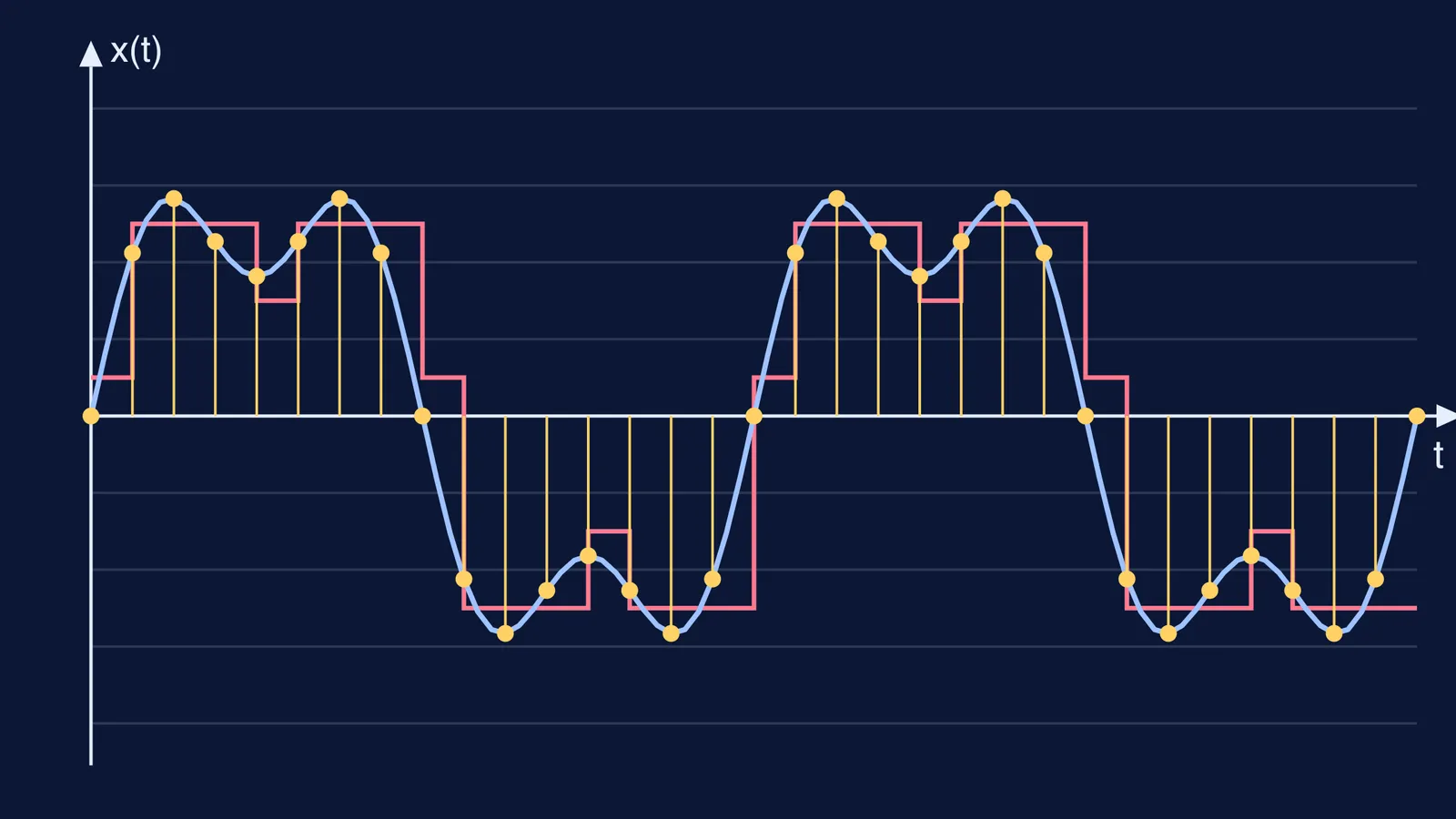
Week 1, signals. Draw a wave and mark points on it at equal time gaps, like the image at the top of this page. Ask yourself what goes wrong if the points are too far apart. If that question pulls you in, signal processing may suit you.
Week 2, devices. Revise the Class 12 chapter on semiconductors: p-n junctions, diodes and logic gates. Notice whether you enjoy the physics or only tolerate it.
Week 3, circuits. Build one small LED, resistor and switch circuit with an adult nearby, or try a free online circuit simulator.
Week 4, syllabus. Download the curriculum PDFs of the two programmes you are weighing and list the electives in years three and four side by side.
Here is a worked example of week 4. Say College A offers E&TC with electives in wireless communication and antennas, and College B offers ECE with electives in VLSI and embedded systems. If week 1 excited you most, College A's list fits better, whatever the branch is called. If weeks 2 and 3 did, College B's list does.
If a Class 12 topic such as p-n junctions or electromagnetic waves feels shaky during the test, the Fermi Concept Library has a lesson for every physics concept. For ideas that are easier to see than to read, such as waves and fields, the Fermi Simulation Lab has interactive simulations.
Start with week 1 this weekend, and download the syllabi before your counselling round opens.


