On this page
Signal processing turns messy, real-world measurements into clear, actionable information. Whether capturing speech from a phone microphone, receiving radio signals from an orbital satellite, or measuring electrical pulses from a human heart, engineers design mathematical algorithms that filter noise, compress bandwidth, and detect hidden features. For students in Electronics and Communication Engineering (ECE), signal processing provides the algorithmic foundation that bridges raw physical hardware with modern software and machine learning.
What industries hire signal processing engineers?
The global professional home for this discipline is the IEEE Signal Processing Society, founded in 1948 and now numbering approximately 25,000 members across 120 countries. In consumer hardware, audio engineers design active noise cancellation (ANC), beamforming microphone arrays, and spatial audio codecs. In telecommunications, wireless teams build the physical layer (PHY) of 5G and emerging 6G networks, using orthogonal frequency-division multiplexing (OFDM) and massive MIMO beamforming to prevent signal fading.
Demand also extends deep into healthcare, aerospace, and defense. Biomedical engineers process electrocardiograms (ECG) and magnetic resonance imaging (MRI) scans at medical device makers such as GE Healthcare and Siemens Healthineers, filtering baseline drift and reconstructing cross-sectional tissue slices. According to the U.S. Bureau of Labor Statistics, employment for electrical and electronics engineers is projected to grow 8% from 2025 to 2035, with about 16,300 annual openings driven by semiconductor manufacturing, robotics, and wireless systems. In India, organisations like ISRO, DRDO, and automotive radar suppliers recruit engineers who understand synthetic aperture radar (SAR) and frequency-modulated continuous-wave (FMCW) radar signal pipelines.
Which core mathematics do you need in signal processing?
Many students first encounter signal processing as an abstract hurdle in college. Under the AICTE Model Curriculum for undergraduate ECE, students complete 160 credits, with foundational courses like Signals and Systems in the third semester followed by Digital Signal Processing in the fifth or sixth semester. The subject relies on three mathematical pillars:
Linear Time-Invariant (LTI) systems and convolution: Any linear system is characterised by its impulse response h[n]. The output y[n] equals the discrete convolution sum y[n] = Σ x[k] h[n − k], mirroring the continuous convolution integral y(t) = ∫ x(τ) h(t − τ) dτ.
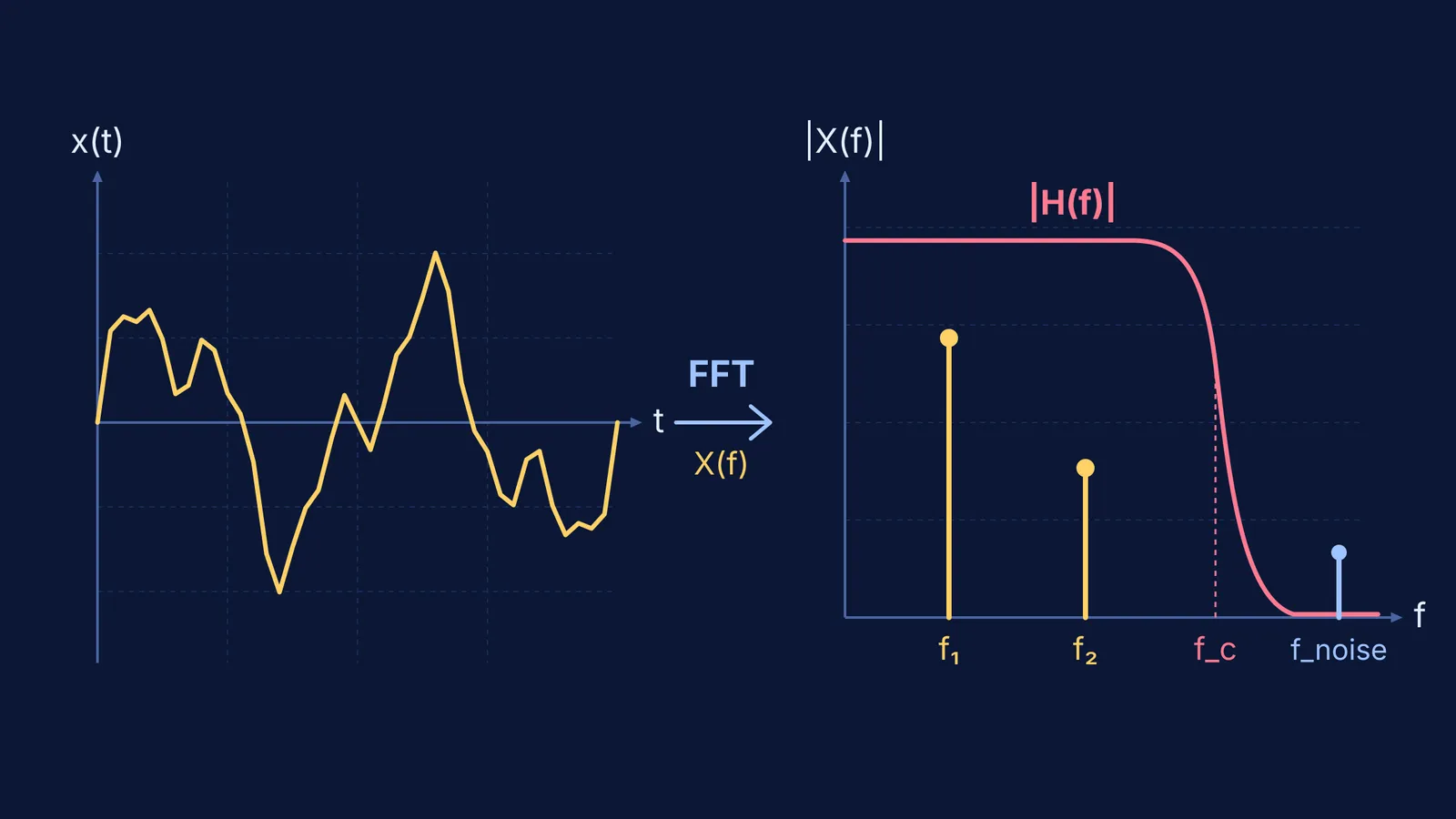
Sampling and Fourier analysis: The Fourier transform converts a time signal x(t) into its frequency spectrum X(f). To capture an analog signal without distortion, the sampling rate fs must exceed twice the highest frequency present (fs > 2 fmax) to prevent aliasing. The Cooley-Tukey Fast Fourier Transform (FFT) reduces discrete spectral computation from O(N²) operations to O(N log N).
Z-transforms and linear algebra: Evaluating transfer functions H(z) in the complex plane allows engineers to place poles and zeros to guarantee filter stability. Matrix decompositions such as singular value decomposition (SVD) underpin multi-antenna beamforming.
If you struggle to visualise how sinusoidal waves combine into complex signals or how cutoff frequencies isolate harmonics, the Fermi Simulation Lab provides interactive simulations for ideas that are easier to see than to read. When solving filter transfer functions or checking pole-zero stability for exams, the Fermi Problem Library offers worked problems with a step-by-step solver that explains the reasoning rather than simply printing an answer.
How can ECE students build practical signal processing projects?
You do not need expensive bench instruments to start practicing signal engineering. With a laptop and Python, you can process real sensor data using the open-source SciPy signal processing package. A reliable four-step project framework includes:
Capture and load raw time-domain data: Record audio through your computer microphone or download public physiological data, such as cardiac rhythms from PhysioNet. Store the signal as a one-dimensional array sampled at a known rate fs.
Compute the power spectrum: Run an FFT using numpy.fft.rfft to identify dominant frequencies, harmonics, and background noise floors.
Design an appropriate filter: Select an analog prototype such as a Butterworth or Chebyshev filter using scipy.signal.butter. For digital stability, convert the filter coefficients into second-order sections (SOS).
Filter the signal and compare: Pass the signal through scipy.signal.sosfiltfilt to eliminate phase distortion. Plot the before-and-after waveforms and play the audio to hear the noise disappear.
Concrete beginner projects include building a 50 Hz power-line hum remover for voice recordings, an automated ECG heart-rate detector that flags irregular intervals, or an image edge-detection script using 2D spatial convolution kernels.
How can you turn coursework into an engineering career?
Academic theory becomes valuable to employers when backed by tangible code, hardware experiments, and clear communication. If your university offers academic flexibility, consider pursuing a minor degree in another branch such as computer science or data science to strengthen your software foundations in C++ and algorithmic complexity.
Next, publish your code repositories with clean documentation, sample audio files, and frequency plots. Following best practices for building a student GitHub profile demonstrates to interviewers that you can write production-ready signal processing code, not just solve textbook derivations.
Finally, when completing semester capstones or lab assignments, practice writing a college project report that details filter design tradeoffs, word-length effects, and empirical signal-to-noise ratios.
Start by downloading a noisy audio track today, plot its Fourier spectrum in Python, and listen to the transformation as your first filter isolates the signal.