

On this page
When counselling starts, many students stare at the list of branches and wonder about the difference between Electronics and Communication Engineering (ECE) and Electrical and Electronics Engineering (EEE). If you are preparing for your first semester at science or engineering college, understanding what these degrees actually entail is the first step.
On paper, they look like twins. Both are four-year B.Tech degrees requiring 160 credits under the AICTE model curriculum, and both share a common first-year foundation in physics, mathematics and basic programming. But from the third semester onwards, their paths split.
What is the difference in course content?
The difference comes down to scale: what you are transmitting.
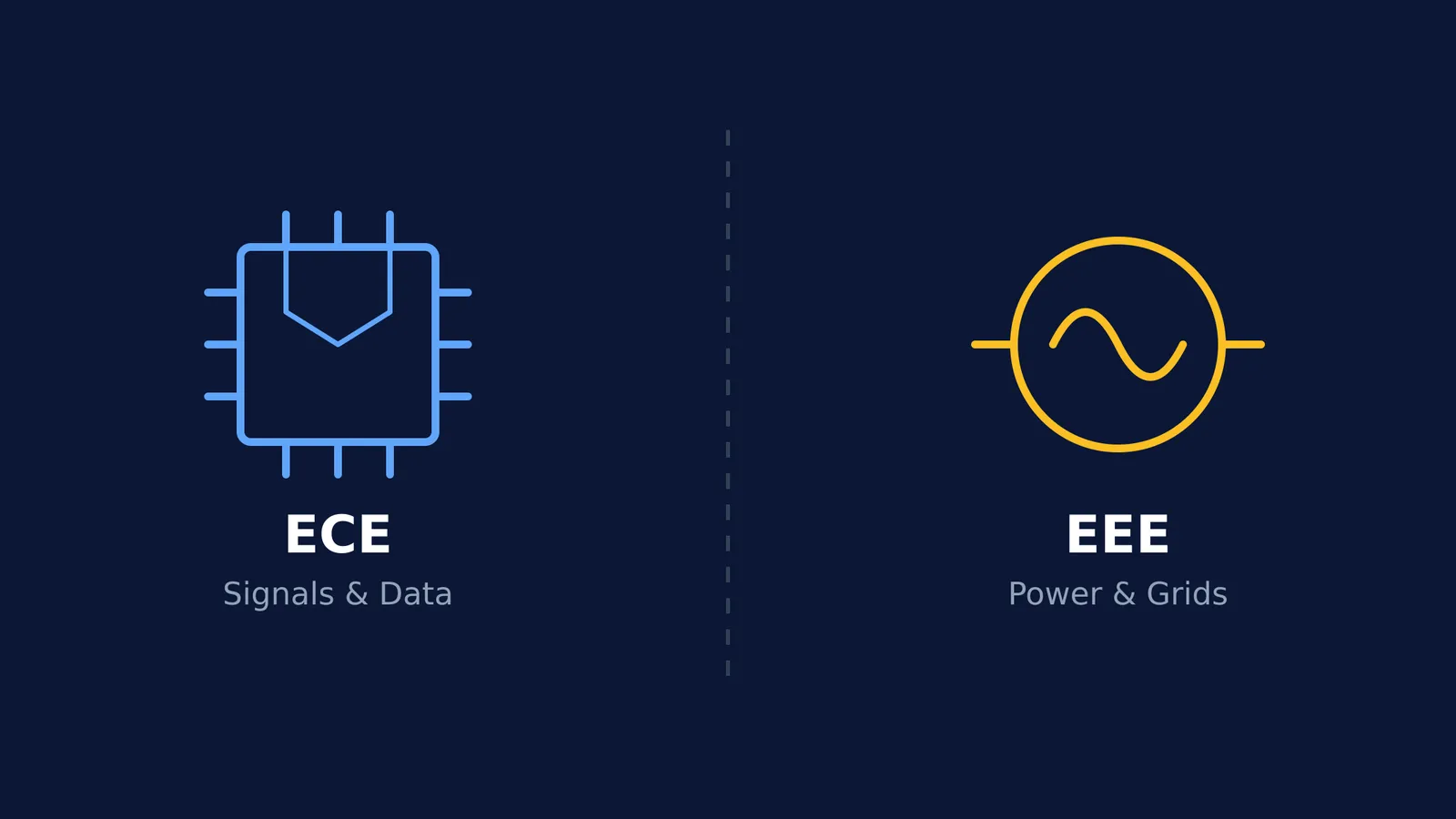
In an ECE degree, you focus on the transmission of information. You study how to process, send and receive data using low-voltage, high-frequency systems. The core subjects include digital signal processing, microprocessors, embedded systems and VLSI design (the science of making integrated circuits and microchips). If you are fascinated by 5G networks, smartphones or the sensors in a robot, this is your domain.
In an EEE degree, you focus on the transmission of power. You study how to generate, distribute and control electricity on a macro scale. The curriculum is heavy on electrical machines (transformers, motors, generators), power systems, high-voltage engineering and control systems. It is mathematically rigorous, requiring a solid grasp of electromagnetic field theory and calculus. If you want to understand how a city's power grid works or design the drivetrain of an electric vehicle, EEE is the path.
Which branch is better for software placements?
The short answer is ECE.
While computer science is the most direct route to a software engineering job, ECE is widely treated by software recruiters as the next best thing. ECE students often have an easier time pivoting to software because their coursework already involves a fair amount of digital logic, microcontrollers and programming (such as C or C++ for embedded systems). When software companies visit campuses, they typically allow ECE students to sit for the same placement tests as their CS peers.
EEE students are also eligible for most IT placements, but the transition takes more personal effort. The EEE curriculum is dense with physics and heavy electrical theory, leaving less free time to build a portfolio of data structures, algorithms and coding projects. However, EEE graduates hold a unique advantage in specialised software roles, such as writing control software for industrial automation or electric vehicles.
ECE or EEE: which branch is better for me?
There is no universally "better" branch—only the one that fits your aptitudes and career plans.
If you enjoy logic and want maximum flexibility, choose ECE. It is the smoother bridge if you are unsure whether you want a core engineering job or an IT career. It also places you directly in the path of the booming semiconductor industry, where VLSI engineers are in high demand.
If you prefer physics and want a highly stable core engineering career, choose EEE. It is a traditional "evergreen" branch with strong prospects in renewable energy, manufacturing and electric vehicles. It also offers excellent opportunities in the public sector, as government companies and state electricity boards regularly hire electrical engineers.
Before you make your final choice on the counselling form, review the exact syllabus of the colleges you are considering. If you find yourself struggling with the underlying physics and mathematics required for either branch, the Fermi Concept Library maps out every core idea in electricity and magnetism, so you can build your foundation before the semester begins. And even if you decide neither of these is right for you, there are many ways of talking about STEM careers beyond engineering and medicine.


