

On this page
If you are finishing a BTech, or your child is, two masters routes look alike on paper and work very differently. One is a coursework masters, usually called an MTech. The other is a research masters: an MS by Research at many IITs, an MTech (Research) at IISc. Here is how they compare, using the institutes' own rules.
What is the difference between MS by research and MTech?
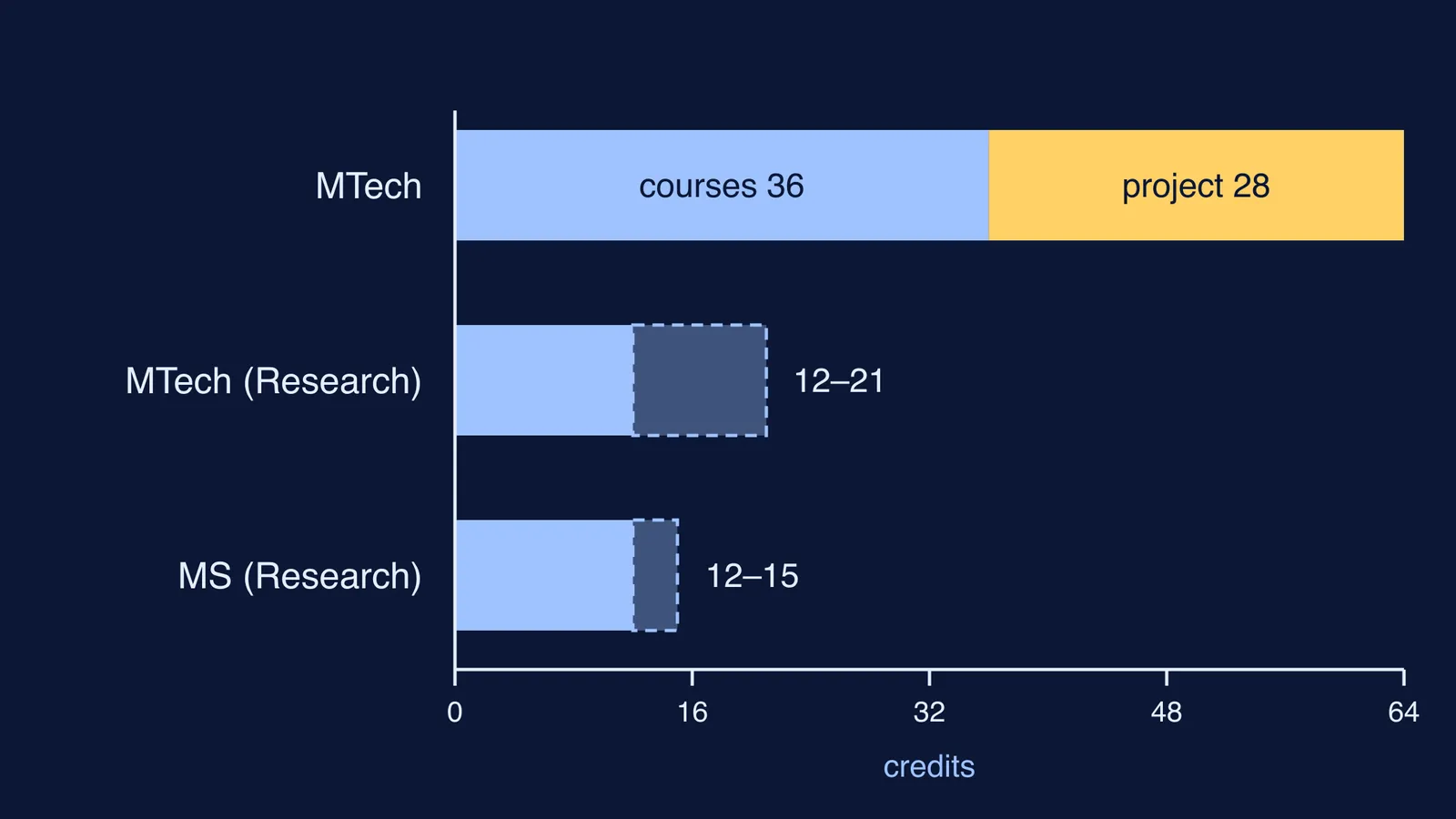
A coursework MTech is mostly classes, followed by a project. The IISc Department of Electrical Communication Engineering describes its MTech as "a two-year course-based programme" of 64 credits: 36 from courses and 28 from the project.
A research masters is mostly one research problem, written up as a thesis. The same department's MTech (Research) page asks for 12 to 21 course credits over about 2 to 2.5 years, and students must "complete a dissertation based on original research". In the department's own words, "MTech (Research) is a research program while MTech is a course based program."
IIT Bhubaneswar's MS (by Research) regulations set coursework at 12 to 15 credits, to be finished within the first year, with the thesis due within two and a half years of registration.
How do admissions differ for MS by research and MTech?
Both usually start with a GATE score. The selection step after that is where they part ways.
MTech: IISc ECE holds an in-person technical interview of about 10 to 15 minutes, with no written test. Offers arrive through the Common Offers Acceptance Portal (COAP), which, as its official FAQ says, is not an application portal: you still apply to each institute separately.
Research masters: IIT Bhubaneswar's regulations shortlist on GATE (or CSIR-UGC NET for science postgraduates), then weight a written test at 40% and an interview at 60%, and admit twice a year. At IIT Madras, shortlisted candidates face a "test and interview" or an interview alone.
Without GATE: both IISc's MTech (Research) and IIT Bhubaneswar's MS (by Research) let BTech graduates of centrally funded technical institutes with a CGPA of 8.0 or above apply without GATE.
Funding routes: IIT Madras admits MS scholars under categories that include a Half-Time Research Assistantship, outside fellowships and project funding, plus external and part-time routes for people with at least two years of relevant work experience.
What is the workload like in each?
In an MTech, the timetable sets your pace: lectures, assignments and exams for most of the first year, then a project that grows to fill the second.
In a research masters, the courses are front-loaded and light, and most of your time goes into one problem with a supervisor. IIT Bhubaneswar's regulations have an advisory committee review thesis progress every semester, and two unsatisfactory semesters in a row end the enrolment.
Neither is the easy option. MTech pressure comes from fixed deadlines; research pressure comes from experiments that fail and a finish date that partly depends on you. If that starts to weigh on you, talk to your supervisor or campus counsellor, or call Tele MANAS on 14416.
Which is better for a PhD or a job?
A research masters works as a trial run of a PhD. At IISc ECE, masters students can convert to the PhD programme after the second semester if they meet a minimum performance criterion in their first year.
An MTech gives you a broad base of advanced courses and a fixed two-year end date, which can make campus placements easier to plan around. Placement records differ by department, so ask each one for recent figures.
How do you choose? A five-question check
Is there a problem area you would happily read about for two years?
Is a PhD, here or abroad, likely within the next five years?
Are you comfortable with a finish date that can stretch by a semester?
Do you learn better by building one thing deeply than by taking many courses?
Can you name two faculty members whose recent papers you have read?
Three or more yeses point towards a research masters. Mostly noes point towards an MTech.
Worked example: you have an NIT BTech with a CGPA of 8.3, a decent GATE score, and yeses to questions 1, 2 and 4. Apply to both routes, rank research seats first, and read two papers from each lab you list before the interviews.
Before accepting any offer, ask a current student in the lab how long recent MS students took to submit, how often they meet the supervisor and how the funding is arranged. Their answers tell you more than any brochure.
If GATE preparation exposes old gaps in mathematics or computing, the Fermi Concept Library gives each concept its own lesson, and the Fermi Problem Library has worked problems with a step-by-step solver that explains the reasoning rather than printing an answer.
Start with the current admission brochure of the two departments you most want, and compare their credits and funding line by line.


