On this page
The short version: the "Honours" in B.Com (Hons) usually means depth, with more of your timetable spent on commerce itself. We use Delhi University (DU) as the worked example; rules differ elsewhere, so check your own university's bulletin.
What is the difference between B.Com and B.Com Honours?
Under DU's Undergraduate Curriculum Framework 2022, B.Com (Hons) is a single-discipline programme: in the four-year version, a major in commerce needs at least 88 of 176 credits, from 20 discipline-specific core papers and at least two electives. The same framework lists B.Com among programmes with more than one discipline as core, where a major needs 80 of 176 credits in that discipline. In plain words, all of an Honours student's core papers are commerce, while B.Com students share core time with other subjects.
There is a second meaning to watch for. Under the UGC's Curriculum and Credit Framework for Undergraduate Programmes, a three-year degree needs at least 120 credits and a four-year honours degree needs 160, including a 12-credit research project or, for students not doing research, three courses worth 12 credits. So "honours" can name the subject-heavy course, the fourth year, or both. Our explainer on the four-year UG honours degree under NEP covers that second meaning.
B.Com vs B.Com (Hons): the side-by-side view
The first three points use DU's rules; the CA and MBA points apply across India.
Core subject: B.Com (Hons) has commerce as its single core discipline; B.Com has commerce alongside other core disciplines.
Depth: Honours goes further into commerce papers; B.Com gives you more breadth.
CUET subjects for DU: Honours needs Mathematics/Applied Mathematics or Accountancy/Book Keeping; B.Com needs neither.
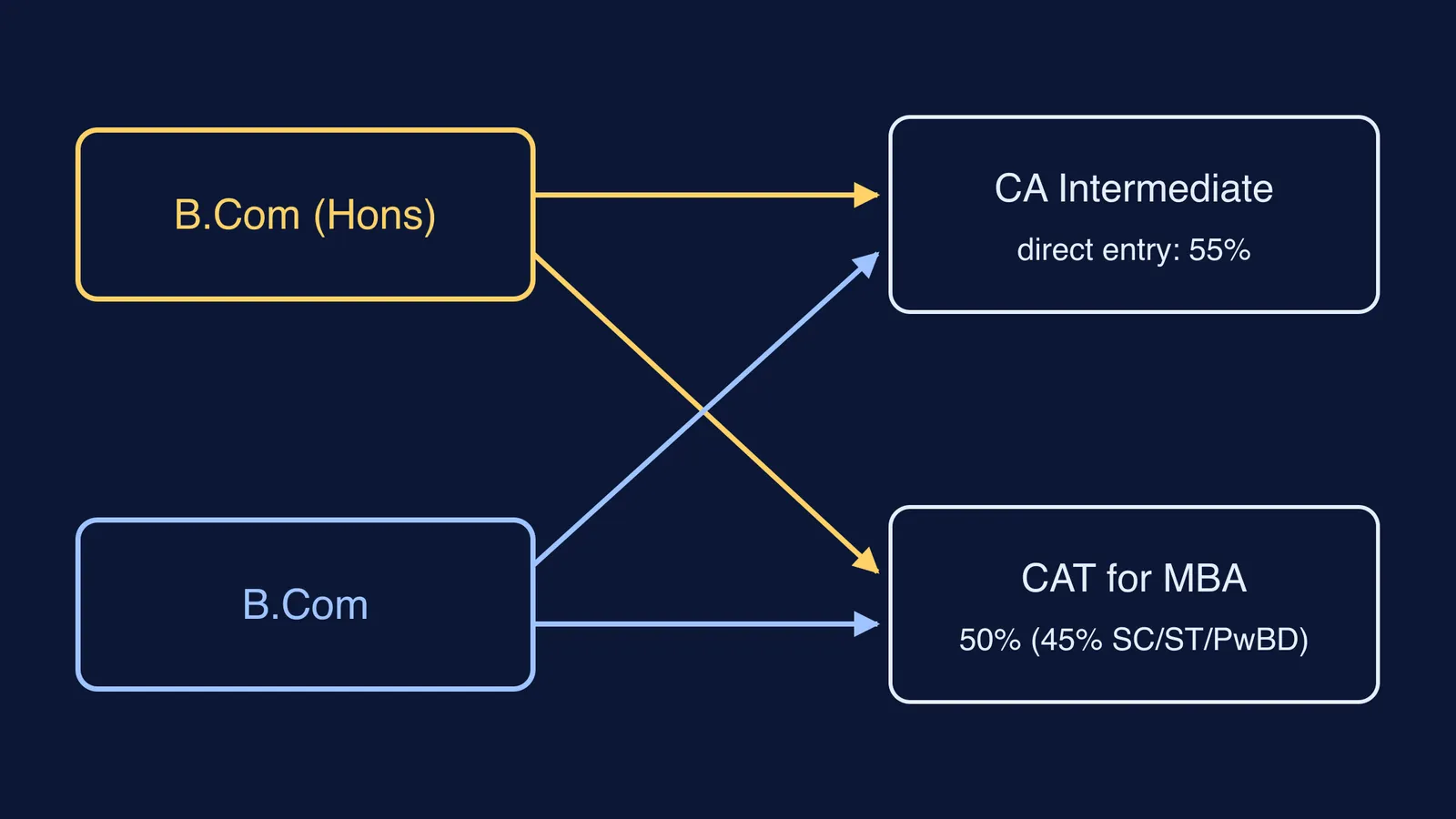
CA direct entry: the same 55% rule for both, because both are commerce degrees (ICAI chart).
CAT for an MBA: the same 50% rule for both, because both are bachelor's degrees (CAT 2026 eligibility).
Suits you if: Honours, you enjoy accounts, tax and finance and want to go deep; B.Com, you want commerce with room for other subjects.
What are the admission requirements for B.Com Honours?
DU's Bulletin of Information for UG admissions 2026-27 sets two CUET routes into B.Com (Hons):
One language from List A, plus Mathematics or Applied Mathematics, plus any two subjects from List B.
One language from List A, plus Accountancy or Book Keeping, plus any two subjects from List B.
For B.Com at DU, the same bulletin asks for one language from List A plus any three List B subjects, or one language, one List B subject and the General Aptitude Test. It also says you must take CUET in the subjects you are studying or have passed in Class XII.
A worked example: Meera took Accountancy, Business Studies and Economics in Class 12, without maths. She can still reach B.Com (Hons) through the Accountancy route. Kabir studied humanities with no maths or accountancy, so at DU his subjects fit the B.Com combinations, not the Honours ones. Our guide to choosing CUET subjects for DU courses walks through the subject lists.
If maths is your weak CUET paper, the Fermi Problem Library has worked problems with a step-by-step solver that explains the reasoning rather than printing an answer.
Is B.Com or B.Com Honours better for CA?
Neither label decides it. ICAI's education and training chart lets commerce graduates with 55% marks, and other graduates with 60%, register directly for CA Intermediate without the Foundation exam. Students in the last year of graduation can register provisionally; the registration is confirmed once their final marksheet shows the minimum marks. The Foundation route stays open whichever degree you pick.
Which is better for an MBA or a job?
For an MBA through CAT, the CAT 2026 eligibility notice asks for a bachelor's degree with at least 50% marks, or 45% for SC, ST and PwBD candidates. It does not ask whether the degree was Honours. The notice adds that meeting the minimum does not ensure shortlisting, so your CAT score and academic record matter more than the label.
For jobs, read the eligibility line in each advert or recruitment notice: it names the degree and the marks it wants. If you are drawn to accounts, audit or tax roles, or to an M.Com later, Honours-level depth can give you more practice in those papers. Our guide to careers after commerce: CA, CS, economics and management lays out the wider map.
A five-minute check before you fill preferences
Open the university's admission bulletin and copy the exact CUET combination for each course.
Tick your Class 12 subjects against it, since you must take CUET in them.
Read the semester-wise list of papers for both courses on the college or university website.
Write down your next goal (CA, CAT, M.Com or a job) and the marks it needs.
Check whether the course runs three years or four, and what the fourth year adds.
If you answer only one question tonight, make it step 4: the marks your next goal needs decide more than the word Honours.