

On this page
The National Education Policy (NEP) 2020 has fundamentally changed how college degrees work in India. For decades, students enrolled in rigid three-year Bachelor's programmes locked into a single stream. The new Curriculum and Credit Framework for Undergraduate Programmes (CCFUP) introduces a flexible four-year system with multiple entry and exit points, cross-disciplinary subjects, and a direct runway into academic research.
If your child is applying to university, understanding this structure is the first step in planning their academic journey.
How does the four-year UG honours degree work?
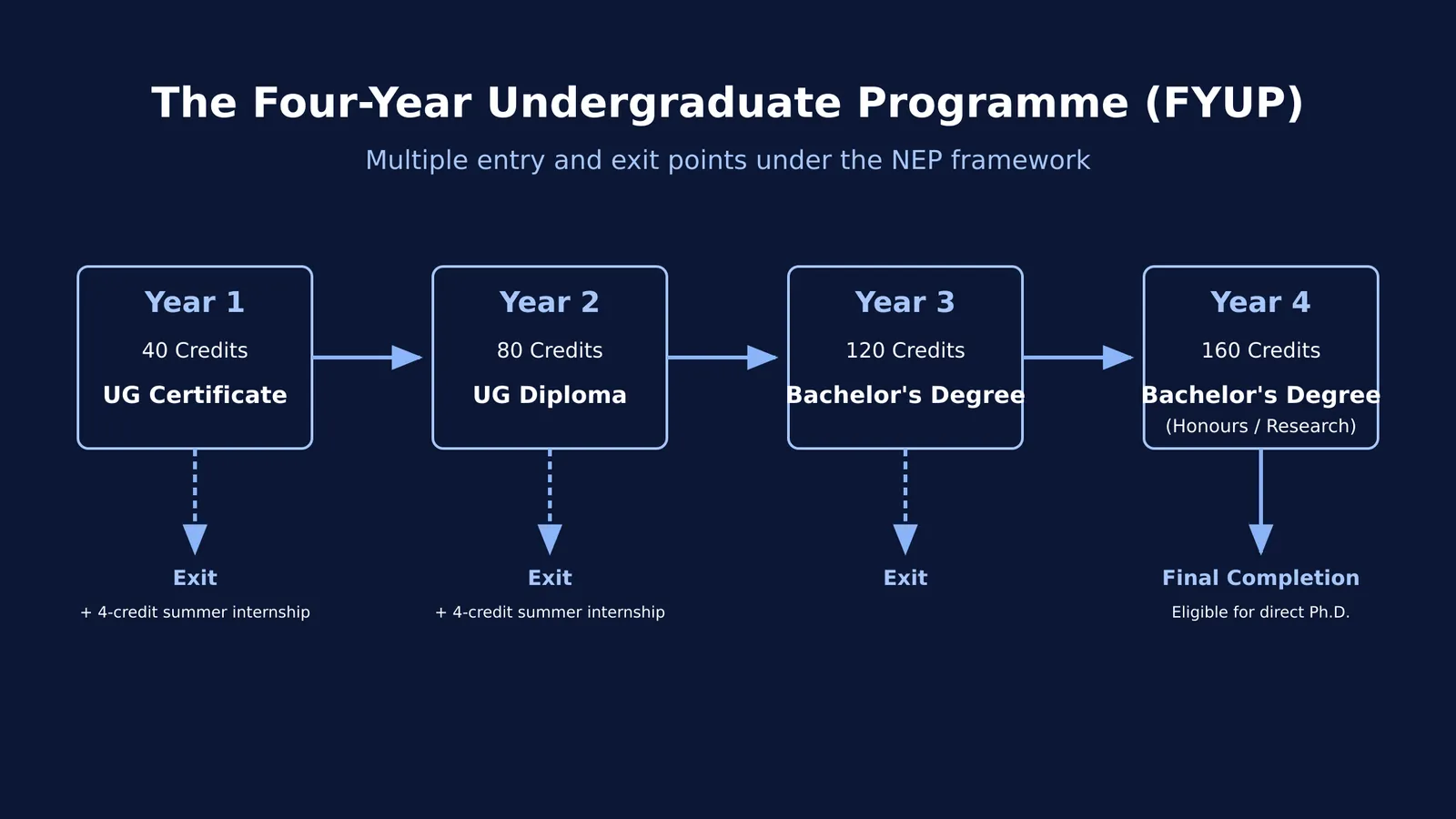
The new framework operates on an Academic Bank of Credits (ABC), where students earn and store credits digitally. According to the University Grants Commission (UGC) framework, a full four-year degree requires a minimum of 160 credits, usually taken as approximately 40 credits per year.
One of the biggest shifts is the multiple entry and exit system. Instead of losing all progress if they drop out, students earn recognized qualifications at each stage:
1 Year (2 Semesters): Exiting here with 40 credits awards a UG Certificate (plus a 4-credit summer internship).
2 Years (4 Semesters): Exiting with 80 credits awards a UG Diploma (plus a 4-credit summer internship).
3 Years (6 Semesters): Exiting with 120 credits awards a standard Bachelor's Degree.
4 Years (8 Semesters): Completing the full 160 credits awards a Bachelor's Degree (Honours) or Bachelor's Degree (Honours with Research).
This flexibility reduces the pressure on students who may need to pause their studies, allowing them to return later and pick up where they left off.
What is the "Honours with Research" option?
For students aiming for a career in academia or advanced science, the fourth year offers a specialized track.
The UGC framework states that students who secure a 7.5 CGPA or above in the first six semesters can opt for the "Honours with Research" stream in their fourth year. This track requires them to complete a 12-credit research project or dissertation under the guidance of a faculty member.
Crucially, completing this research track makes a student eligible for direct admission into a Ph.D. programme, potentially bypassing a Master's degree. If you are having conversations about the future, our guide on talking about STEM careers beyond engineering and medicine can help you and your teen explore how these research paths lead to roles in biotechnology, data science, and environmental research.
How does the multidisciplinary approach change learning?
The NEP framework breaks down the hard walls between Science, Arts, and Commerce. A student majoring in Physics can now take a minor in Economics, or a Biology major can study Data Analytics. The curriculum mandates specific credit blocks for Multidisciplinary Courses, Skill Enhancement Courses, and Value-Added Courses.
While this breadth is excellent for a well-rounded education, it can be intimidating to tackle university-level concepts outside of your core strengths. If a student finds themselves struggling with the mathematics required for an economics minor, the Fermi Concept Library holds every concept across maths and the sciences, placing each lesson in a clear map so they can trace back to the exact foundational idea they missed.
Similarly, when tackling difficult multidisciplinary assignments, Fermi's AI tutor can work out what a student already knows, build a plan for the session, and teach through the problem step-by-step rather than just printing an answer.
What does this mean for later study and careers?
The shift to a four-year structure aligns Indian higher education with global standards, particularly those in the United States and Canada, where a four-year bachelor's degree is often the minimum requirement for graduate admissions.
Parents should recognize that the first three semesters are designed to be exploratory. Students are encouraged to take diverse subjects before firmly committing to their major. It is perfectly normal for a teenager to change their mind after taking a few introductory courses. If this happens in your family, reading about when your child's career choice differs from yours can provide a helpful framework for supportive conversations.


