On this page
If you are in mechanical, civil, electrical or chemical engineering, you may feel a quiet pressure to drop your branch and chase software jobs. You do not need to choose. The useful question is narrower: which bits of coding make you better at the branch you already study?
Should mechanical students learn coding?
Yes, because your own syllabus already leans on it. The GATE 2026 Mechanical Engineering syllabus, published by IIT Guwahati, lists numerical methods: solving linear and non-linear equations, integration by the trapezoidal and Simpson's rules, and single and multi-step methods for differential equations. The same document lists NC/CNC machines and CNC programming under manufacturing.
In practice, numerical methods are done in code. An NPTEL course on Applied Numerical Methods, taught by Prof. Malay K. Das of IIT Kanpur's mechanical engineering department and aimed at students in any branch of engineering, states its objective as solving algebra and calculus problems “using repetitive calculations, implemented in a computer”. Its course plan gives week 2 to an introduction to programming, then moves through differential equations, case studies and regression.
So the goal is not to become a software engineer. It is to make the computer do the tedious arithmetic, so you can spend your thinking on the physics.
Which programming language should a core branch student learn first?
For most core students, start with Python. In the Stack Overflow 2025 Developer Survey, 57.9% of the 31,771 people who answered the language question said they had done extensive work in Python over the past year. For engineering work the bigger reason is its scientific libraries: SciPy, described in Nature Methods in 2020 as “a de facto standard for leveraging scientific algorithms in Python”, includes routines for integration and differential equations.
Python: your first language for numerical methods, lab data and plots.
MATLAB: learn it if your department's labs use it. GNU Octave is free and its syntax is largely compatible with MATLAB, so you can practise at home.
C: worth keeping if your first-year course taught it, and useful later for microcontrollers in electrical and electronics work.
CNC part programs (G-code): for mechanical students, these come with your manufacturing lab, not as a separate hobby.
Pick one language and stay with it for a full semester. Switching every month is the commonest way to learn the first chapter of four languages.
What does coding add to a heat transfer problem?
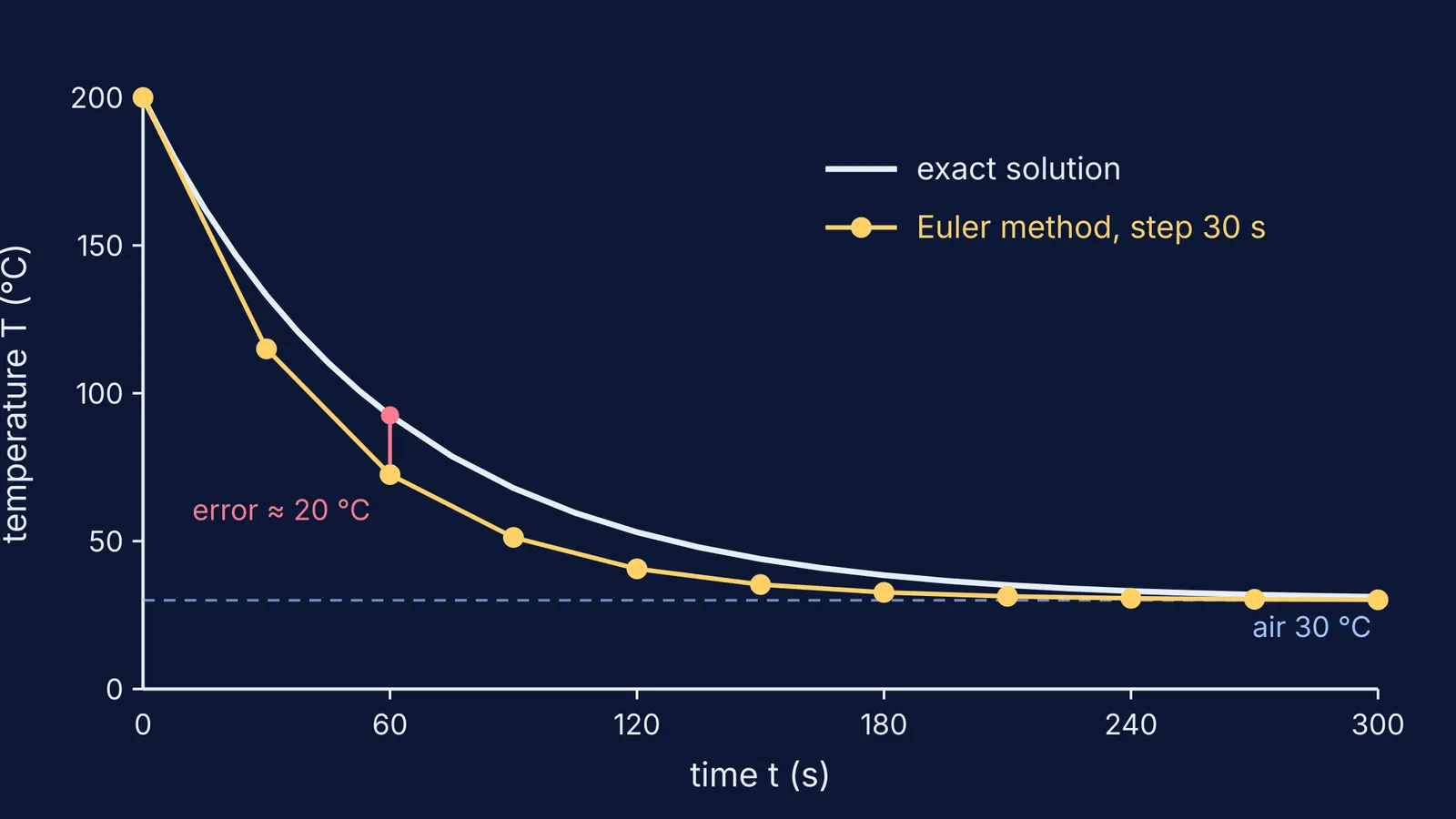
Here is a problem from the “lumped parameter system” topic in the same GATE syllabus. A small steel part at 200 °C cools in air at 30 °C, with a time constant of 60 seconds. The exact answer is T = 30 + 170 e^(−t/60), which gives about 92.5 °C after 60 seconds.
Now solve it the way a computer would, with Euler's method:
Start with T = 200 and t = 0, and choose a step h.
Work out the cooling rate: −(T − 30) ÷ 60.
Update T to T + h × rate, and t to t + h.
Repeat until t = 60, then compare with the exact answer.
With h = 30 seconds, each step halves the gap to 30 °C, so you get 115 °C and then 72.5 °C: 20 degrees too cold. With h = 6 seconds, ten steps give about 89.3 °C, much closer. That one experiment teaches you more about step size and error than a page of theory, and it is the same idea behind the “single and multi-step methods” GATE asks about.
How do you balance coding with branch subjects?
Treat coding as a tool for your subjects, not a second degree. A weekly plan that fits around a full timetable:
Monday, 45 minutes: redo one problem from this week's maths or thermodynamics tutorial in code.
Wednesday, 45 minutes: learn one new idea in your language (loops, arrays, plotting).
Saturday, 90 minutes: a small project linked to a lab, such as plotting your own experiment readings.
Sunday, 15 minutes: write down what broke and what you learned.
Around internals and end-semester exams, stop learning new syntax and only use code to check answers. If you are still finding hours, our guide to a daily routine for engineering college students shows where the free blocks usually sit.
A rough four-year arc: basics in the first year, numerical methods in code in the second, one branch project in the third (lab data, a CNC toolpath, a beam calculation), and then a portfolio you can show. If you want credits for it, read how a minor degree in BTech works before you sign up. For a sense of where computing meets core jobs, see the piping design engineer role for mechanical students.
Often the code is not the hard part; the maths underneath is. If Simpson's rule or a differential equation feels shaky, the Fermi Concept Library has a lesson for every concept in physics, mathematics and computing. And if you do not know where to start, Fermi's AI tutor can work out what you already know and build a plan for the session.
This week, pick one tutorial problem you have already solved by hand and solve it again in code.