On this page
If you would rather take an engine apart than write equations, you do not have to choose between a workshop and an engineering degree. India's rules let you start with your hands and move up to a B.Tech later through lateral entry. Each step has its own eligibility rule, though.
What are the routes from Class 10 to automobile engineering?
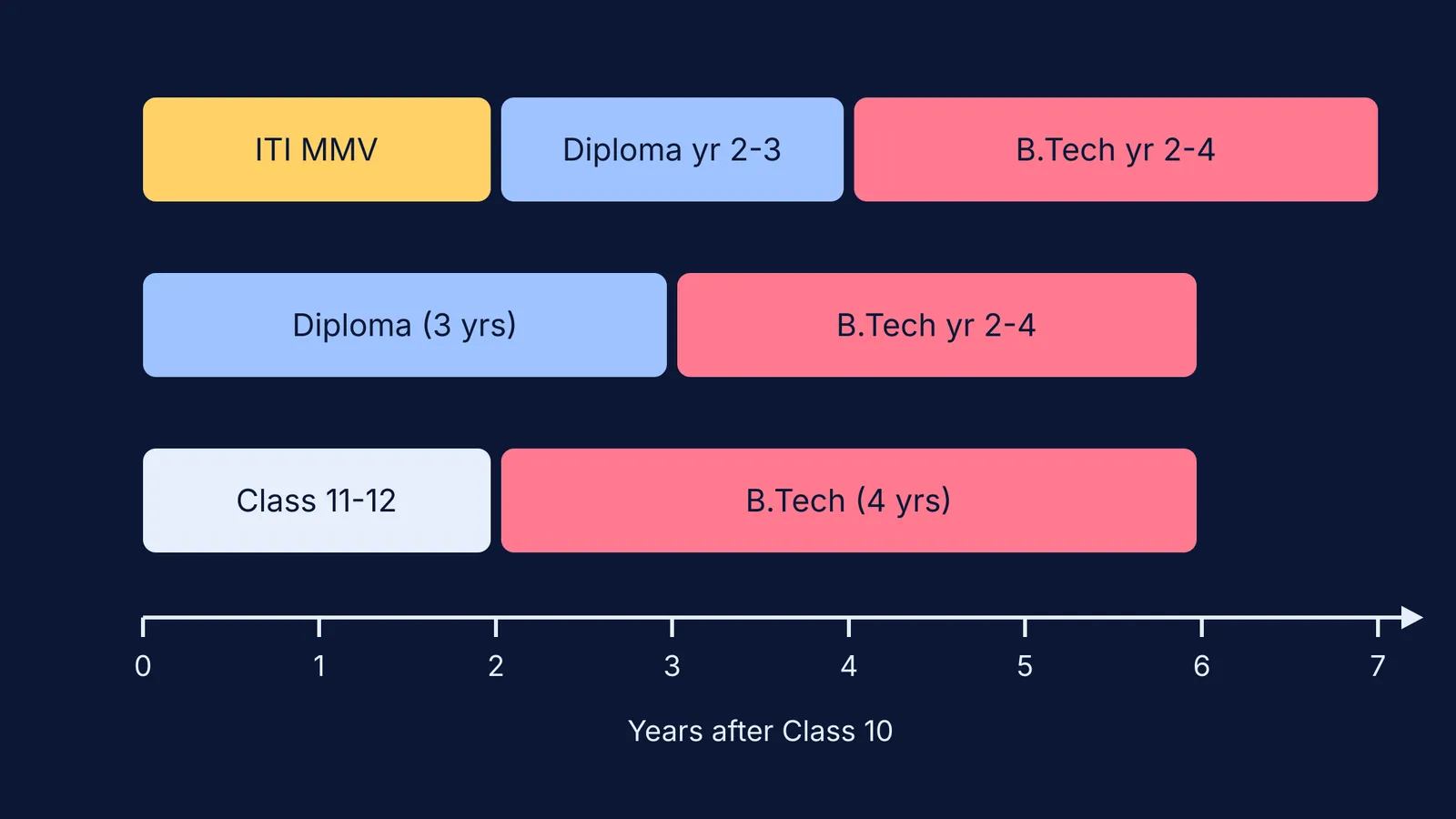
There are three common routes. The diagram above shows how many years each takes.
Workshop first (ITI). According to the DGT curriculum for the Mechanic Motor Vehicle trade, the ITI course lasts two years and is open to students who passed Class 10 with science and mathematics (or an equivalent). It covers 2,400 hours of training plus 300 hours of on-the-job training or a group project, and ends with a National Trade Certificate.
Polytechnic diploma. A diploma in engineering is a three-year course after Class 10, according to Annexure-8 of AICTE's Approval Process Handbook 2024-25 to 2026-27. Automobile Engineering is on the handbook's list of approved course names.
Class 12, then a B.Tech. The standard four-year engineering degree, from the same handbook.
If you are still deciding between the first two, our guide to choosing ITI or polytechnic after Class 10 compares them side by side.
Can an ITI student join a diploma in the second year?
Yes. AICTE's handbook states that "10th + 2 year ITI shall be eligible for admission to Second Year Diploma Course(s) in Any branch of Engineering and Technology."
The DGT curriculum lists lateral entry to a diploma among its progression pathways, alongside apprenticeship and joining industry as a technician who can rise to senior technician, supervisor and manager. That last path, into service management, has no degree step.
How does lateral entry from a diploma to a B.Tech work?
The rules are in clause 6.13 and Annexure-8 of AICTE's Approval Process Handbook:
Who is eligible: you need a diploma passed with at least 45% marks (40% for reserved categories), in any branch of engineering and technology. B.Sc graduates with the same marks who had mathematics in Class 12, and B.Voc or three-year D.Voc holders in the same or an allied sector, are also eligible.
Where you join: the second year of a B.Tech, which leaves three years to finish.
How many seats: lateral entry is allowed up to 10% of a course's approved intake, as extra (supernumerary) seats, plus any first-year seats left unfilled.
Who runs admission: your state or UT admission authority, so entrance tests, counselling and dates differ by state.
Can you study while working in a service workshop?
Clause 6.5 of the AICTE handbook lets working professionals with ITI or diploma qualifications who are enrolled in regular courses attend theory and practical classes at flexible times, even beyond office hours. It counts this as regular study, not part-time.
Apprenticeship is the other bridge. The Ministry of Education's National Apprenticeship Training Scheme places graduate and diploma apprentices with industry and pays a stipend. When the Cabinet approved its continuation in November 2021, for 2021-22 to 2025-26, the automobile sector was one of the areas it named. That approval ran to March 2026, so ask your placement cell whether it is still open.
A worked example: Class 10 in 2026 to a B.Tech in 2033
Arjun (an example, not a real student) passes Class 10 in 2026 and loves fixing two-wheelers. Using the durations in the DGT curriculum and the AICTE handbook, his plan is:
2026 to 2028: ITI Mechanic Motor Vehicle. The syllabus covers engines, gearboxes, brakes, steering, electricals and the basic parts of electric vehicles.
2028 to 2030: second-year entry into a diploma in automobile or mechanical engineering, staying well above 45% every semester.
2030 to 2033: second-year entry into a B.Tech, through his state's admission process.
That is seven years from Class 10, one more than the other routes. In return, Arjun has two certificates and real workshop hours, and he can stop at any stage and start working.
How do you close the maths gap before lateral entry?
The AICTE handbook says universities will offer bridge courses, such as mathematics, physics and engineering drawing, for students from diverse backgrounds. Here is a plan for your final diploma year:
Download the first-year B.Tech maths and physics syllabus of the university you are targeting.
Mark each topic: done in diploma, seen once, or never seen.
Work through the never-seen topics in a short daily slot, starting with differentiation and integration.
Link each topic to the workshop: rate of change to acceleration, integration to the work done by a brake.
If integration feels unfamiliar, the Fermi Concept Library gives every concept in mathematics and physics its own lesson and its place in the map, so you can see what to learn first. For numericals, the Fermi Problem Library has worked problems with a step-by-step solver that explains the reasoning rather than just printing an answer.
To see where an engineering degree can take you beyond the service bay, read our guides to mechatronics and robotics engineering and production and industrial engineering.