On this page
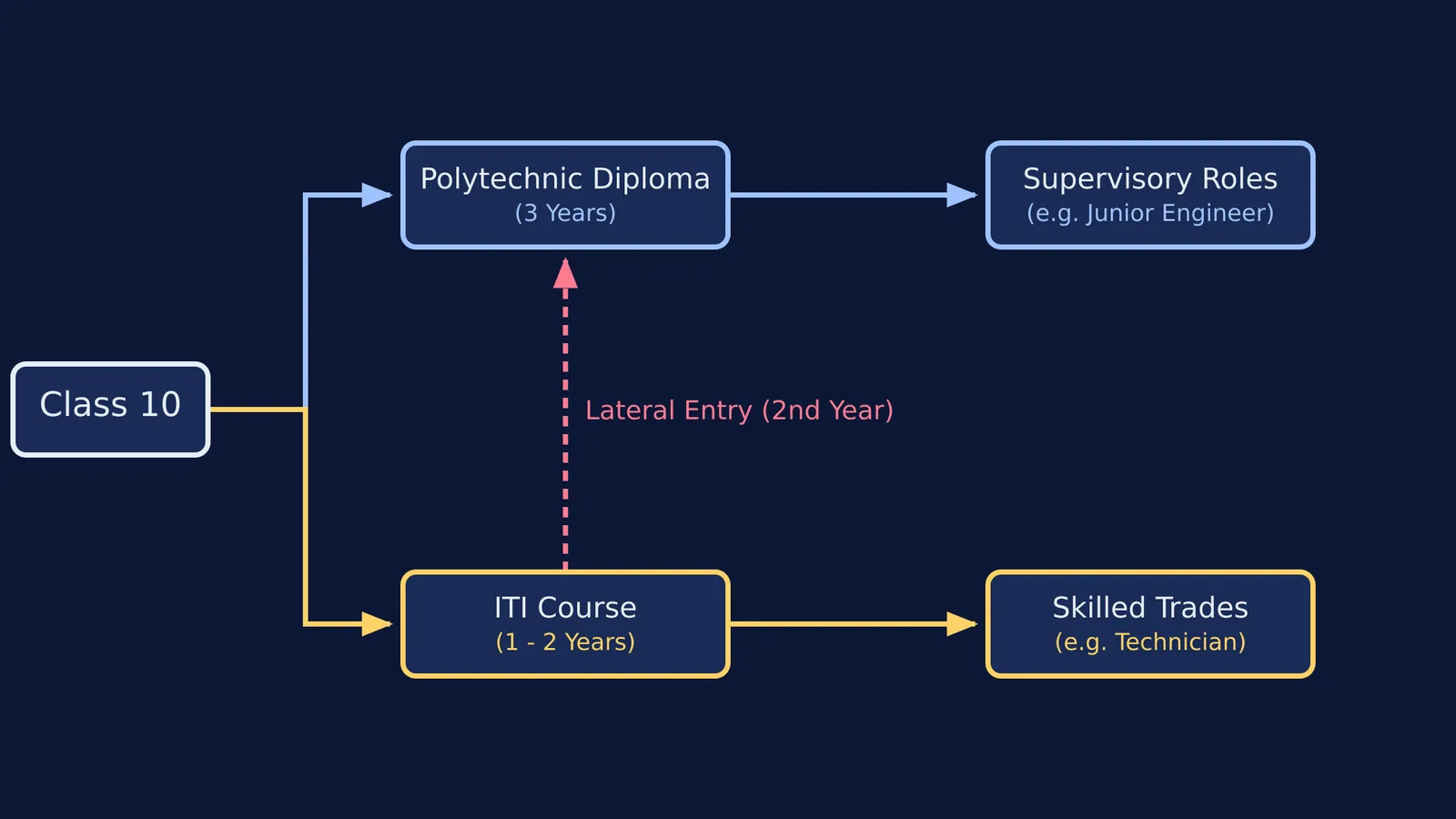
Choosing your path after Class 10 is about your career timeline and how you prefer to learn. Many students look for alternatives to the traditional Class 11 and 12 route. Taking a technical path early allows you to build specialized skills, enter the workforce sooner, and gain practical experience that classroom-only learning might miss. India has over 13,800 Industrial Training Institutes (ITIs) and more than 3,900 AICTE-approved polytechnics. Both offer routes to employment without doing Class 11 and 12, but they lead to different types of jobs.
Duration and depth: How long do they take?
The primary difference lies in what and how they teach:
ITI focuses on vocational skills. It takes 6 months to 2 years, depending on the trade (for example, 2 years for an electrician, but 1 year for a welder). You learn exactly how to do a specific job with your hands. The learning environment is primarily workshop-based. If you are learning to be an electrician, you will spend your days wiring panels, troubleshooting circuits, and handling real tools. Assessment is heavily based on your practical ability to complete tasks safely.
A polytechnic diploma in engineering takes 3 years. It covers the theory behind the work, teaching you why the systems operate the way they do. A polytechnic student spends a significant amount of time in classrooms alongside lab work. The focus includes engineering mathematics, physics, and applied sciences. You learn how to calculate loads, design basic systems, and understand the core engineering principles that drive the machinery.
Jobs: What can you become?
The two qualifications target different levels of the workforce, and their long-term career trajectories diverge over time.
ITI graduates work as skilled workers. You can become a fitter, machinist, electrician or welder. These certificates from the National Council for Vocational Training (NCVT) are the standard requirement for technical ground-level jobs, such as the Assistant Loco Pilot (ALP) in the railways. An ITI graduate often starts on the shop floor or in a maintenance team. Over the years, you can move up to a master technician or shift supervisor role, but reaching engineering management usually requires further formal education.
Polytechnic graduates take on supervisory or mid-level technical roles. For example, the Staff Selection Commission (SSC) Junior Engineer (JE) exam strictly requires a 3-year diploma or an engineering degree; ITI candidates are not eligible. Polytechnic graduates typically enter as junior engineers or technical assistants. Because they have a stronger theoretical foundation, they often handle project planning, quality control, and team management. They act as the bridge between senior engineers and skilled technicians.
When preparing for competitive or lateral entry exams, Fermi's AI tutor teaches rather than answers. It notices where you are stuck, checks your understanding as it goes, and builds a plan for your study session.
Further study: What are the lateral entry paths?
The education system allows you to build on your qualifications step by step without losing time:
ITI to Polytechnic: If you complete a 2-year ITI course, you can take a lateral entry exam for direct admission into the second year of a polytechnic diploma.
Polytechnic to B.Tech: If you complete a 3-year diploma, you can sit for exams like LEET to enter directly into the second year (third semester) of a B.Tech engineering degree.
When you use the lateral entry option to join a B.Tech program, you graduate at the same time as students who took the standard Class 11 and 12 route. However, the transition can require extra focus. Diploma holders are usually very strong in practical engineering subjects but may need to spend more time mastering the advanced calculus and theoretical physics required in a degree program.
If you are learning technical subjects in these courses and want to see how circuits or machines work before a practical, the Fermi Simulation Lab has interactive simulations for ideas that are easier to see than read. You can also explore options like Mechatronics and Robotics Engineering: Career Scope or read about What is the environmental engineering branch?.
ITI or polytechnic: Which should you choose?
Use this simple framework to decide which path aligns with your goals:
Choose ITI if: You want to start earning quickly (within 1 to 2 years), prefer working with tools instead of textbooks, and want to enter trades like manufacturing, construction, or basic electrical work.
Choose polytechnic if: You want to be an engineer, plan to write government JE exams, enjoy learning the mathematics and physics behind technology, or intend to study further for a full B.Tech degree.
Whatever you choose, planning ahead helps. If you are ever unsure what to do in the gap before higher studies begin, a structured routine like What to do after Class 12 before college starts: an 8-week plan can keep you on track.