

On this page
If you have ever watched a modern assembly line, a surgical robot, or even a self-parking car, you have seen mechatronics in action. It is the engineering discipline that bridges physical machines and intelligent code.
As industries rush to adopt automation and smart manufacturing, the demand for engineers who understand both hardware and software is surging. India is rapidly modernising its production floors; the International Federation of Robotics reports that India is the world's 7th largest market for industrial robots in terms of operational stock, having reached a milestone of 5,911 annual installations.
What is the career scope of mechatronics engineering?
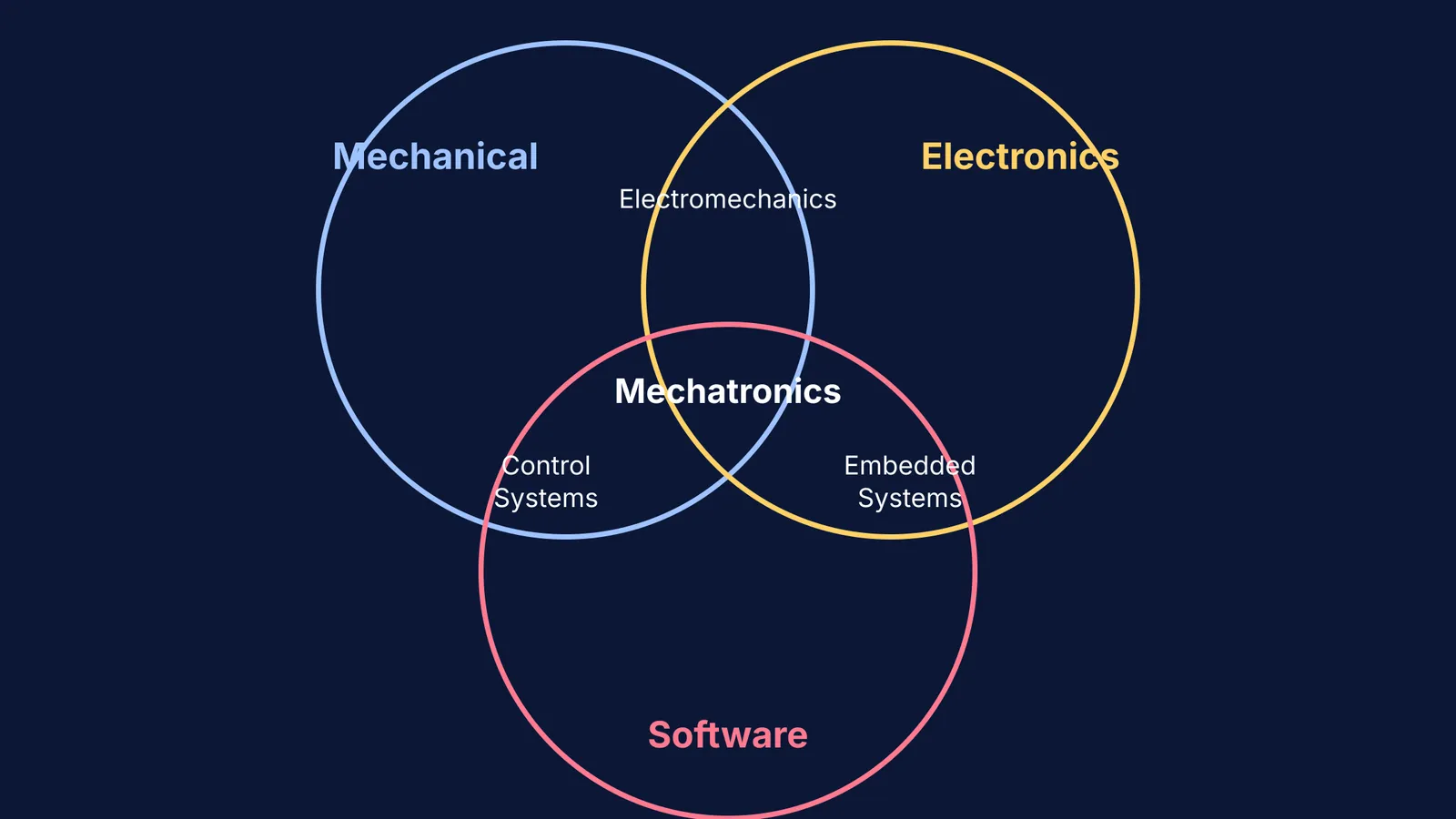
Mechatronics engineers do not sit in silos. While a pure software engineer writes code and a pure mechanical engineer designs gears, a mechatronics engineer ensures the code correctly tells the gears when to turn.
The career scope is expanding because automation is no longer confined to car factories. E-commerce warehouses, agricultural technology, renewable energy systems and healthcare all rely on smart, connected machines. The U.S. Bureau of Labor Statistics projects that mechanical engineering fields—which encompass robotics and mechatronics—will grow by 11% between 2025 and 2035, creating 33,500 new jobs.
To succeed in this scope, a mechatronics degree trains you in a three-layer stack:
The Body (Mechanical): The physical structures, actuators and motors. You will study kinematics and dynamics, applying rules like Torque as r × F: finding torque about a point with vectors to calculate how much force a robotic joint needs to lift a payload.
The Nervous System (Electronics): The sensors and circuits that gather data and deliver power. You will design circuit boards and learn techniques like the Node potential method: solving circuits by assigning voltages.
The Brain (Software): The microcontrollers and programmable logic controllers (PLCs) that process data and make decisions, often using languages like C++ and Python.
What jobs can you get with a mechatronics degree?
Because the skill set is multidisciplinary, graduates are highly adaptable. Some of the most common job titles include:
Robotics Engineer: Designing and testing robotic systems for manufacturing or research.
Automation Engineer: Upgrading factory production lines to run efficiently with minimal human intervention.
Control Systems Engineer: Writing the mathematical algorithms (like PID controllers) that keep drones stable in the air or ensure a surgical robot moves with sub-millimetre precision.
Electromechanical Technician: Building, maintaining and troubleshooting smart machinery on the factory floor.
Is mechatronics right for you?
Choosing mechatronics over a traditional computer science or mechanical engineering degree depends on how you like to work. Ask yourself:
Do you want to see your code move? If you prefer your programming to have physical consequences in the real world rather than just running on a screen, mechatronics is a strong fit.
Can you handle context-switching? You will need to debug a software error in the morning and a loose wire or a jammed gear in the afternoon.
Are you comfortable with advanced mathematics? Control theory and kinematics are mathematically heavy. You will spend a lot of time working with differential equations, matrices and vectors.
If you struggle to picture how changing a gear ratio affects speed or how a control loop responds to feedback, the Fermi Simulation Lab provides interactive simulations for the ideas that are easier to see than to read.
For students preparing for university, mastering the underlying mathematics and physics is crucial. The Fermi Concept Library contains every concept in physics, chemistry, biology, mathematics and computing, each with its own lesson and its place in the map, so you can build the fundamentals required to engineer the automated systems of the future.


