On this page
The Auxiliary Nurse Midwife (ANM) course is the shortest of the three main Indian Nursing Council (INC) nursing routes after Class 12, and it is built around community health work. Here is what the official rules say, and how it compares with GNM and B.Sc Nursing.
Who can join the ANM course after 12th?
The INC's guidelines for ANM schools set out the admission rules:
You must have passed Class 12 (10+2) from CBSE, ICSE, a state board or a recognised equivalent.
You must be at least 17 on or before 31 December of the admission year, and no older than 35.
The upper age limit rises to 42 for Anganwadi workers, ASHAs and trained dais joining government ANM schools.
Admission depends on a satisfactory medical examination report.
Admission to ANM is restricted to female candidates.
Science is not compulsory. The INC's eligibility page accepts Class 12 in Arts subjects such as history, economics or home science, with English Core or English Elective, or in Science.
What is taught in the ANM syllabus?
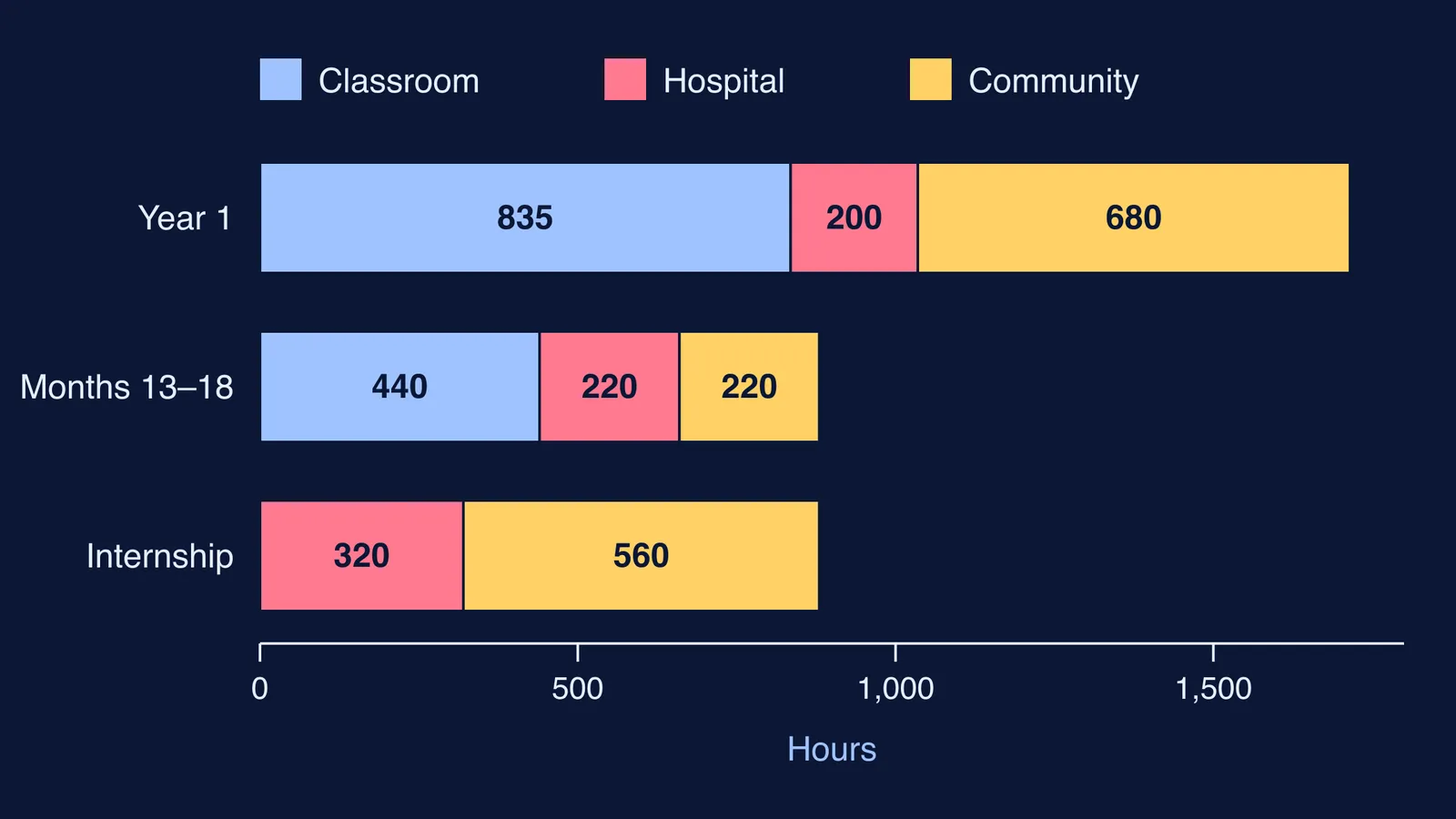
The course lasts two years, 18 months of teaching plus a six-month internship, according to the INC's amended ANM syllabus and regulations. The first year has four subjects:
Community health nursing
Health promotion: nutrition, the human body and hygiene, environmental sanitation and mental health
Primary health care nursing: infection and immunisation, communicable diseases, community health problems, primary medical care, and first aid and referral
Child health nursing
Months 13 to 18 cover midwifery and health centre management. Exams are worth 800 marks after year one and 600 after year two. Across the second year, each student is expected to examine 35 antenatal women and conduct 20 safe deliveries in hospital and community, the same document says. In the internship, groups of 4 to 5 students live at a sub-centre or primary health centre (PHC) for four weeks alongside a regular ANM.
Add up the hours in those INC tables: about 1,460 in the community, 740 in hospital and 1,275 in the classroom. The chart above shows the split by phase.
What does an ANM do at a sub-centre or PHC?
In rural public health care, the ANM's base is the sub-centre, which the Indian Public Health Standards 2022 call a Health and Wellness Centre–Sub Health Centre. The norm is one for every 5,000 people in the plains and every 3,000 in hilly, tribal or desert areas. The standard team is a Community Health Officer, an ANM and a male multipurpose worker, or a Community Health Officer and two ANMs.
The same standards list the ANM's duties under the Community Health Officer, including:
Registering pregnancies early, antenatal check-ups and spotting high-risk pregnancies
Tracking children's immunisation and following up missed doses
Simple tests such as haemoglobin, urine and blood sugar
First aid in obstetric emergencies and prompt referral
Home visits to new mothers, sick newborns and patients who missed follow-ups
Supporting ASHAs and teaching families about nutrition and family planning
If that field work appeals to you, our guide to public health careers in India shows where it can lead.
ANM vs GNM vs B.Sc Nursing: which one fits you?
The INC's list of nursing programmes and its eligibility page give the basics:
ANM: 2 years, exams by a Nursing Examination Board, registered as an ANM (R.ANM). Women only; Arts or Science.
GNM: 3 years, exams by a Nursing Examination Board, registered as a Registered Nurse and Registered Midwife (RN and RM). Needs 40% in Class 12 with English; registered ANMs are also eligible.
B.Sc Nursing: 4 years, university exams, also RN and RM. Needs PCB with English and 45% aggregate.
The INC prescribes no gender ratio for GNM or B.Sc Nursing admission, its B.Sc Nursing FAQ says, and neither carries ANM's women-only rule, so these are the routes to look at if you are a man. An M.Sc in Nursing needs a B.Sc, B.Sc Hons or Post Basic B.Sc Nursing with at least 55%, plus a year of work experience, under the INC's M.Sc regulations. In November 2024 the INC published a draft ANM to GNM bridge programme for comment; check with your State Nursing Council whether it is in force before planning around it.
A simple way to decide:
ANM if you want to qualify in two years, enjoy village health work and did not take PCB.
GNM if you want RN status without a university degree.
B.Sc Nursing if you have PCB, want a degree and may aim for an M.Sc later.
Our comparison of GNM and B.Sc Nursing goes deeper, and this guide explains which B.Sc Nursing and allied health courses accept NEET. If B.Sc Nursing is the goal but some PCB topics feel shaky, the Fermi Concept Library has a lesson for every concept in biology, chemistry and physics.
Five checks before you pay an ANM school
The first four questions below come from rules in the INC's ANM school guidelines; the fifth is our own:
Can I see this year's State Nursing Registration Council recognition? It is mandatory for every ANM programme.
Has the INC inspected the school for suitability under Section 13 of the INC Act?
How many seats are sanctioned? The INC allows at most 60 for an ANM programme.
Will you ask for a service bond or keep my original certificates? The INC calls bonds and forcibly kept originals unethical.
Which sub-centre or PHC will I be posted to for community work and the internship?
Ask for both documents before you pay any fee.