On this page
When a plane crosses cloud at night, the pilot is trusting electronics to say where the aircraft is, which way it points and what the controls are doing. That work is avionics, and it uses almost every subject in an electronics degree at once.
In its licensing rules for maintenance engineers, the Directorate General of Civil Aviation (DGCA) CAR-66 defines an avionics system as an aircraft system that “transfers, processes, displays or stores analogue or digital data”. Its listed examples include autoflight; communication, radar and navigation; instruments; and fly-by-wire systems.
What does avionics actually do in an aircraft?
Most of it falls into four jobs:
Navigation: working out position and heading from satellite signals, radio aids and inertial sensors.
Communication and radar: radios, transponders and radar, which are RF and signal-processing problems.
Control: autopilots and fly-by-wire, where sensors feed a computer that moves the control surfaces.
Displays and data: the screens, data buses and recorders that tie everything together.
Here is why navigation needs careful electronics. An inertial navigation system uses accelerometers and gyroscopes, and as Andrey Soloviev explains in Inside GNSS, a constant accelerometer bias makes position error grow with the square of time.
Try the numbers. Take a small bias, b = 0.01 m/s², roughly one-thousandth of g. Position error is x = ½bt². After 60 seconds, x = 0.5 × 0.01 × 60² = 18 m. After 10 minutes (600 s), x = 0.5 × 0.01 × 600² = 1,800 m. This simple formula works for short stretches; over longer ones, the same article notes that the Schuler effect stabilises the growth of horizontal error. A tiny sensor error becomes a large navigation error, which is why inertial estimates are corrected with outside fixes such as satellite navigation. Our explainer on NavIC, India's own satellite navigation system covers that side.
Which avionics course can you do after electronics engineering?
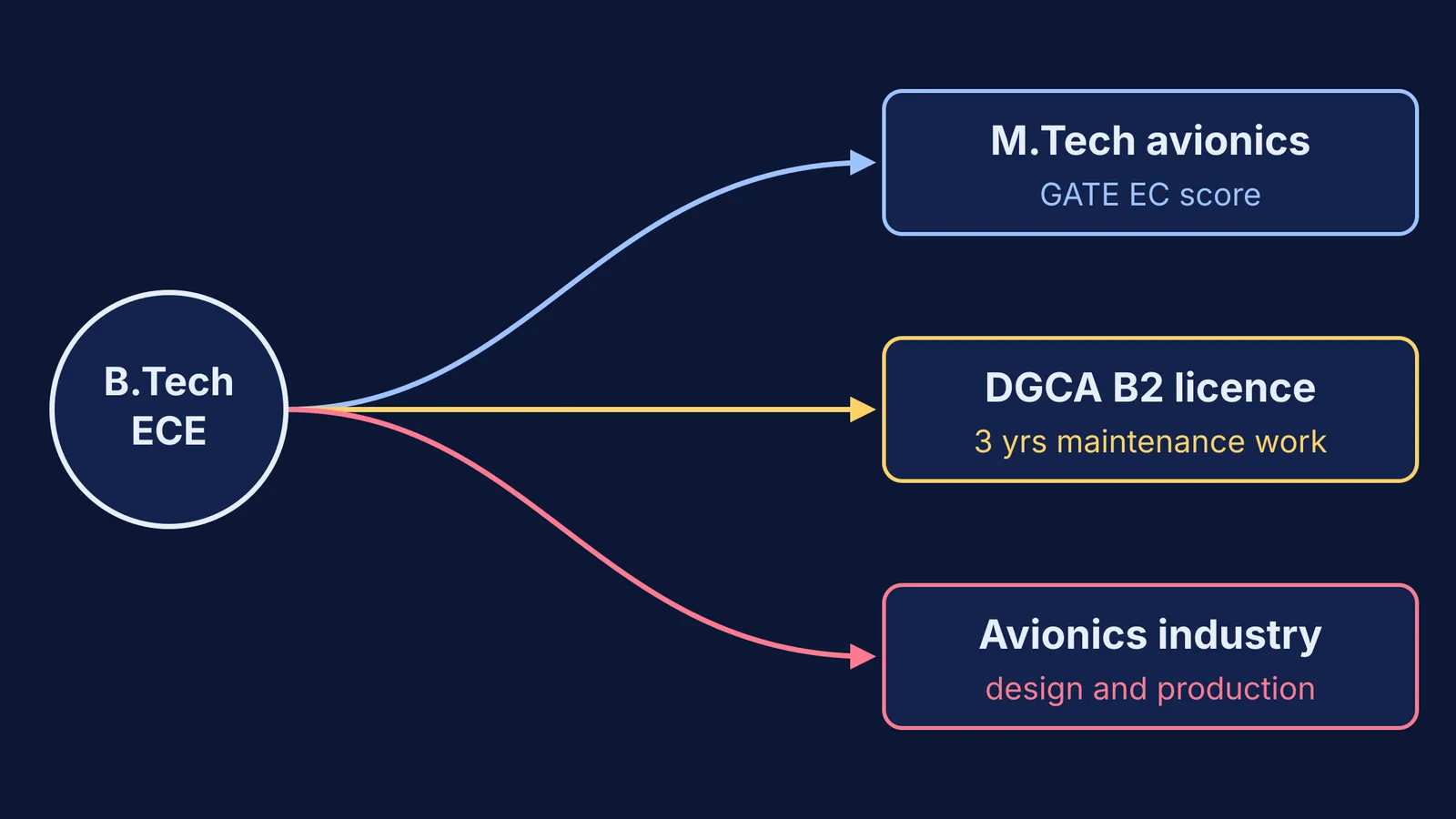
There are three common routes after a B.Tech in ECE.
Route 1: an M.Tech in avionics. The Indian Institute of Space Science and Technology (IIST), under the Department of Space, runs an Avionics department with five M.Tech branches for 2026-27: RF and Microwave Engineering, Digital Signal Processing, VLSI and Microsystems, Control Systems, and Power Electronics, according to its 2026-27 admission notification. Admission is through CCMT and needs a valid GATE score; every avionics branch accepts the Electronics and Communication Engineering paper. The same notice sets a minimum of 60% or CGPA 6.5 for General, EWS and OBC candidates, and 55% or CGPA 6.0 for SC, ST and PwD candidates. Check the next year's notice before applying.
GATE 2027 is organised by IIT Madras, with exams on 6, 7, 13, 14, 20 and 21 February 2027, according to the official GATE 2027 site. If you are weighing a job against further study, read our guide on choosing between a job, GATE or an MS after B.Tech.
Route 2: a DGCA aircraft maintenance licence. CAR-66 sets out several licence categories. A Category B2 holder certifies maintenance on avionic and electrical systems. For B2, an applicant with an engineering degree needs three years of practical maintenance experience on operating aircraft, against five years with no degree and no approved training. You also have to pass DGCA's basic knowledge module exams.
Route 3: an avionics design or production job. HAL's Avionics Division at Korwa was set up in 1983 to produce the Display Attack Ranging and Inertial Navigation system for the Jaguar aircraft. Its product list today includes inertial navigation systems, flight data recorders and cockpit displays. Watch employer career pages for graduate engineer notices.
Which route fits you?
Ask yourself four questions, in order:
Do you enjoy designing circuits, algorithms or control loops more than handling hardware? Lean towards the M.Tech.
Do you want hands-on work on aircraft, with a licence that lets you certify the work? Look at DGCA B2, and accept that it takes years of logged experience.
Do you need to earn soon? Apply for industry jobs and keep GATE as a later option.
Which of your subjects is strongest: signals, RF, VLSI or control? Match that to the IIST branch list above.
What should you study now to get ready?
If you are still choosing a branch, our comparison of ECE and EEE shows where each one leads. In ECE, the subjects closest to avionics are signals and systems, control systems, electromagnetics, communication and digital electronics.
Weak spots in these subjects can trace back to maths: Laplace transforms, complex numbers or differential equations. The Fermi Concept Library covers every concept in physics, chemistry, biology, mathematics and computing, each with its own lesson, so you can fix a gap before it slows down your GATE preparation. For ideas that are easier to see than to read, the Fermi Simulation Lab has interactive simulations.
This week, pick one route, open its official document, and list what you still need.