

On this page
As your final year of engineering approaches, the pressure to choose a path intensifies. Should you sit for placements, prepare for competitive exams, or apply to foreign universities? The sheer volume of advice from peers and family can make this process feel overwhelming, but breaking down the practical realities of each option can bring clarity.
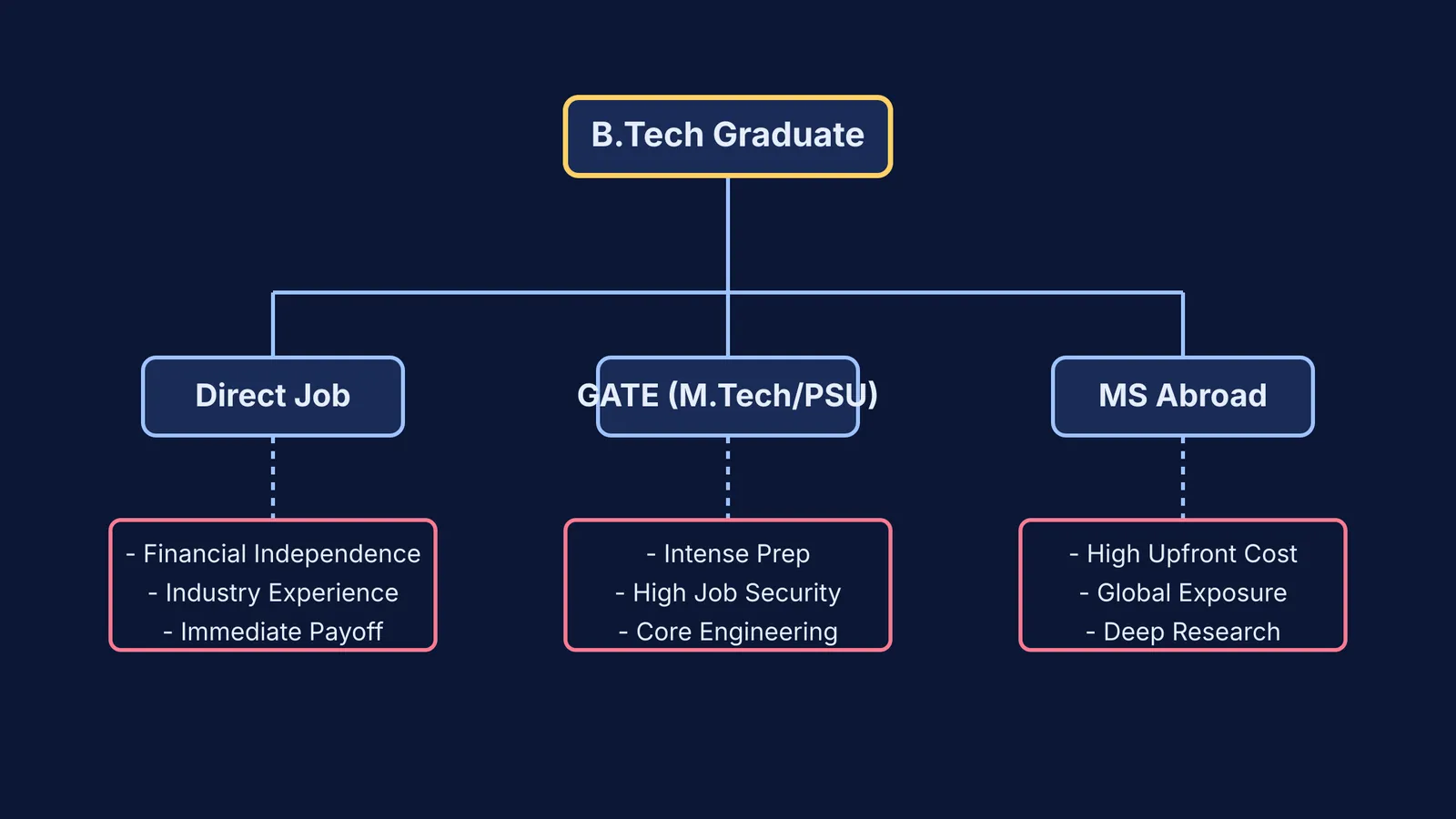
Choosing between a direct job, the Graduate Aptitude Test in Engineering (GATE), and a Master of Science (MS) abroad is one of the biggest decisions of your academic life. Each path demands a different investment of time, money, and effort.
Should you take a job immediately after B.Tech?
Entering the workforce immediately is the most common route. A direct job offers immediate financial independence and early professional experience.
If you secure a role through campus placements, you can start building a professional network and understanding corporate expectations right away. Industry experience helps you identify what you actually enjoy doing, which can make a future master's degree much more focused. Many students work for a few years before pursuing higher education.
As the technology landscape changes, staying adaptable is crucial. For insights into what employers look for, you can read our guide on which skills matter more as AI spreads.
Is GATE worth it for higher studies and PSU jobs?
The Graduate Aptitude Test in Engineering (GATE) is conducted jointly by the Indian Institute of Science and seven Indian Institutes of Technology on behalf of the Ministry of Education.
A high GATE score serves two primary purposes in India. First, it is the gateway to Master of Technology (M.Tech) and PhD programmes at premier institutes like the IITs and NITs, which often come with a government stipend. Second, GATE scores are used by several Indian public sector undertakings (PSUs) for recruiting graduate engineers into entry-level positions, offering high job security and excellent benefits. You can find more details in our post on GATE for science graduates.
If you are preparing for GATE, revising core mathematics and physics is essential. When you get stuck on difficult previous-year questions, the Fermi Problem Library has worked problems with a step-by-step solver that explains the reasoning rather than printing an answer.
When does an MS abroad make sense?
An MS abroad offers global exposure, access to massive research funding, and international career opportunities. However, it requires a significant financial investment and months of preparation for exams like the GRE, TOEFL, or IELTS.
This path is increasingly popular. As of January 2021, more than 1 million Indian students were studying in 85 countries outside India, with over 50% choosing North America.
If your interest lies in specialized fields like artificial intelligence, aerospace, or advanced materials, foreign universities often provide better laboratory infrastructure. While the upfront cost is high, many students secure teaching or research assistantships to offset tuition fees. If you need to strengthen fundamental concepts before applying, the Fermi Concept Library contains every concept in physics, chemistry, biology, mathematics and computing, each with its own lesson and its place in the map.
How to decide: A four-step framework
Instead of following the crowd, use this simple framework to narrow down your options:
Assess your financial runway: Can your family support a couple of years of education without strain? If not, a direct job or a stipend-supported M.Tech through GATE is the safer choice. An MS abroad usually requires taking on an education loan.
Define your timeline for returns: A job pays immediately. GATE requires months of intense preparation for a delayed payoff. An MS takes years and considerable capital before you see a return on investment.
Test your academic interest: Do you enjoy reading research papers and diving deep into technical subjects, or do you prefer building products and managing teams? Higher education demands academic rigor; industry rewards execution.
Talk to alumni: Reach out to seniors who chose each of these three paths. Ask them what their typical Tuesday looks like. If you need help broadening the discussion with your family, read our advice on talking about STEM careers beyond engineering and medicine.
There is no objectively correct choice—only the choice that best aligns with your current resources and future ambitions. Take the time to evaluate your personal circumstances, talk to professionals who have walked these paths, and trust your ability to adapt.


