On this page
A zip-lock bag, a little water and a sunny window are enough to show a child the loop that brings every monsoon: water rises as invisible vapour, turns back into droplets and falls. It costs almost nothing and keeps working for days, so your child can check it before and after school.
What do you need for a water cycle in a bag?
A clear zip-lock bag that seals well
Tap water, enough to cover the bottom of the bag when it hangs
A few drops of blue food colouring (optional, but useful later)
A permanent marker and strong tape
A window that gets direct sun for part of the day
First, let your child draw a sun and a cloud near the top of the bag and waves near the bottom.
How do you set up the water cycle in a bag, step by step?
Pour in the water and add the colouring.
Seal the bag and run a finger along the seal twice.
Tape the bag flat to the sunny pane, water at the bottom, seal at the top.
Ask for a prediction: "What will the bag look like tonight?" Write it on a paper stuck beside the window.
Leave it alone. Shaking the bag splashes water up the sides and hides the droplets you want to see.
Use cool tap water, not hot, and hang the bag out of toddlers' reach.
What will your child see over the week?
The timing depends on your sun and weather, but changes usually come in this order:
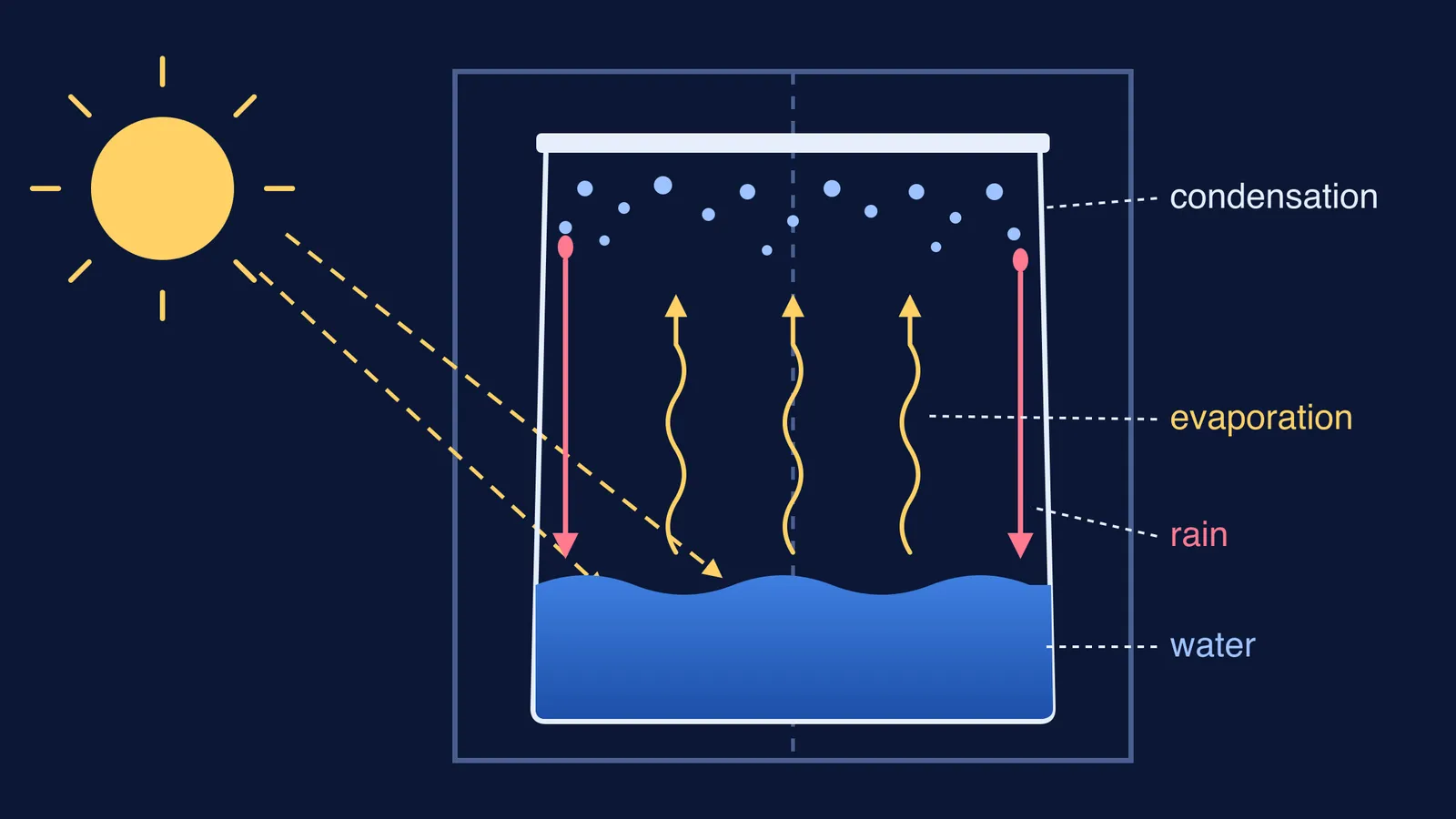
The plastic above the water line turns misty.
The mist gathers into separate droplets, mostly near the top.
Droplets join, grow heavy and slide down the plastic into the "sea" at the bottom.
On a cloudy day there is less new mist. That is a clue worth writing down.
The colour gives a second clue. Ask where the blue goes. The droplets at the top are clear, because the dye stays behind in the liquid when water evaporates.
Our guide to starting a science journal with your child turns that log into a habit.
Why do droplets form at the top of the bag?
Three words carry the whole activity, and NOAA's water cycle resource page defines them plainly. Evaporation happens when water absorbs energy from the sun, the atmosphere or even our own body heat. Condensation is water vapour turning back into liquid droplets, which is how clouds form. Precipitation is that condensed water falling back to Earth as rain, snow or other forms.
In the bag, sunlight warms the water and some of it escapes as vapour into the trapped air. When that vapour meets plastic that is a little cooler, some of it turns back into liquid. It is the same thing that makes a glass of cold nimbu pani sweat on a humid afternoon, and the reason an air conditioner drips, which we explain in why AC units drip water.
The bag is a model: it leaves out plants, wind, rivers and groundwater. NOAA's JetStream page on the water cycle says a water molecule spends about nine days in the atmosphere, on average, before returning to Earth. A 2017 study in Hydrology and Earth System Sciences by Ruud van der Ent and Obbe Tuinenburg put the global average at 8.9 days, give or take 0.4.
If your child would rather see an idea than read about it, the Fermi Simulation Lab has interactive simulations for the ideas that are easier to see than to read.
How can you turn it into a fair test?
Make a second bag and change only one thing. Decide in advance what you will compare, such as which bag mists first.
Sun or shade: one bag on a sunny window, an identical one on a shady window.
Salty sea: stir a spoon of salt into one bag. After a few days, dab a droplet from the top and a drop from the bottom onto a dark plate and let both dry. The bottom drop should leave a white ring of salt; the top drop should leave little or none.
The salt test answers a real question. NOAA notes that most of Earth's water is salt water and that 97% of it is stored in the ocean. Yet rain is fresh, because the salt stays behind when water evaporates. For another slow experiment that needs the same patience, try the plant maze in a shoebox.
What should you ask while you watch?
Ask one question, then wait:
"Nothing splashed up there. So how did water get to the top?"
"Why is the water at the top clear when the bottom is blue?"
"What would happen if we moved the bag into a cupboard?"
"Where is this happening outside right now?" Think of clothes drying on the balcony, puddles shrinking after rain, or the lid of a pot of dal.
Let wrong guesses stand until the bag tests them.
Tape up the bag tonight, write down one prediction, and check it with your child at breakfast.