

On this page
A science journal is a plain notebook where your child records what they notice, measure, draw and still wonder about. It needs no kit and suits a curious six-year-old as well as a Class 9 student. Here is how to start one this week and keep it going for a year.
What is a science journal, and why does it help?
Drawing can be part of how science is learned, not just decoration. In a 2011 article in Science, Shaaron Ainsworth, Vaughan Prain and Russell Tytler pointed to emerging research suggesting that drawing should be explicitly recognised as a key element in science education (Ainsworth, Prain and Tytler, Science).
Writing helps too, with a caveat. A meta-analysis of 48 school-based writing-to-learn programmes found a small, positive effect on achievement (Bangert-Drowns, Hurley and Wilkinson, Review of Educational Research). Effects were larger with metacognitive prompts (questions about one’s own thinking) and longer programmes, and smaller with longer writing assignments and in Grades 6 to 8. For home, that suggests short entries, a closing question, and months rather than days.
How do I start a science journal with my child?
You need very little:
A notebook your child chooses; blank pages make sketching easier.
A pencil, colour pencils and a small ruler kept with it.
A fixed weekly slot of 10 to 15 minutes, tied to something you already do, such as Sunday breakfast.
Every entry follows the same five lines, copied onto the first page:
Date, time and place (and the weather, if outside).
I noticed: one or two sentences.
Sketch: drawn from the real thing, labelled, with arrows.
Number: something counted, measured or timed.
I wonder: one question, and how we might find out.
A worked example
An illustrative entry a nine-year-old might write after soaking moong overnight: “Sunday, 8 am, kitchen. I noticed: the moong got fatter and some skins split. Sketch: a dry seed next to a soaked one, arrow to the white tip. Number: 14 of my 20 seeds split. I wonder: will the split ones sprout first in the dark?”
What should a child write about each week?
Twelve prompts from most Indian homes and gardens:
Ants: put sugar and salt near an ant trail. Which gets visitors first?
Shadows: mark a stick’s shadow tip at 9 am, noon and 3 pm.
The Moon: sketch it at the same time every few nights. The cycle of phases repeats about every 29.5 days, so a month of sketches shows one full cycle (NASA).
Sprouts: soak chana and draw one seed daily for a week.
Ice: time a cube melting on a steel plate and on a wooden board.
One tree: record its leaves, flowers and fruits weekly. SeasonWatch, an India-wide programme, monitors the flowering, fruiting and leaf flush of 130+ common trees and asks observers to upload every week (SeasonWatch).
Rain: measure a puddle every hour after a shower.
Birds: tally window visitors for ten minutes, same time each week.
Kitchen colours: what happens to haldi water when baking soda goes in?
Sound: tap glasses filled to different levels and draw the heights in order of pitch.
Leaves: trace three leaves and compare their veins.
Your own question: pick one “I wonder” line and test it.
For prompts 1 and 8, see our guide to observing birds and insects with your child at home. Park extra questions in a weekly science question jar for family dinners.
How do you keep a science journal going for a year?
Expect the habit to take a while. In a study of 96 volunteers repeating a daily behaviour in the same context, the time to reach near-peak automaticity ranged from 18 to 254 days, and missing one opportunity did not materially affect habit formation (Lally and colleagues, European Journal of Social Psychology). That study tracked daily actions, not weekly ones, so treat it as a rough guide: keep a fixed moment and shrug off a missed week.
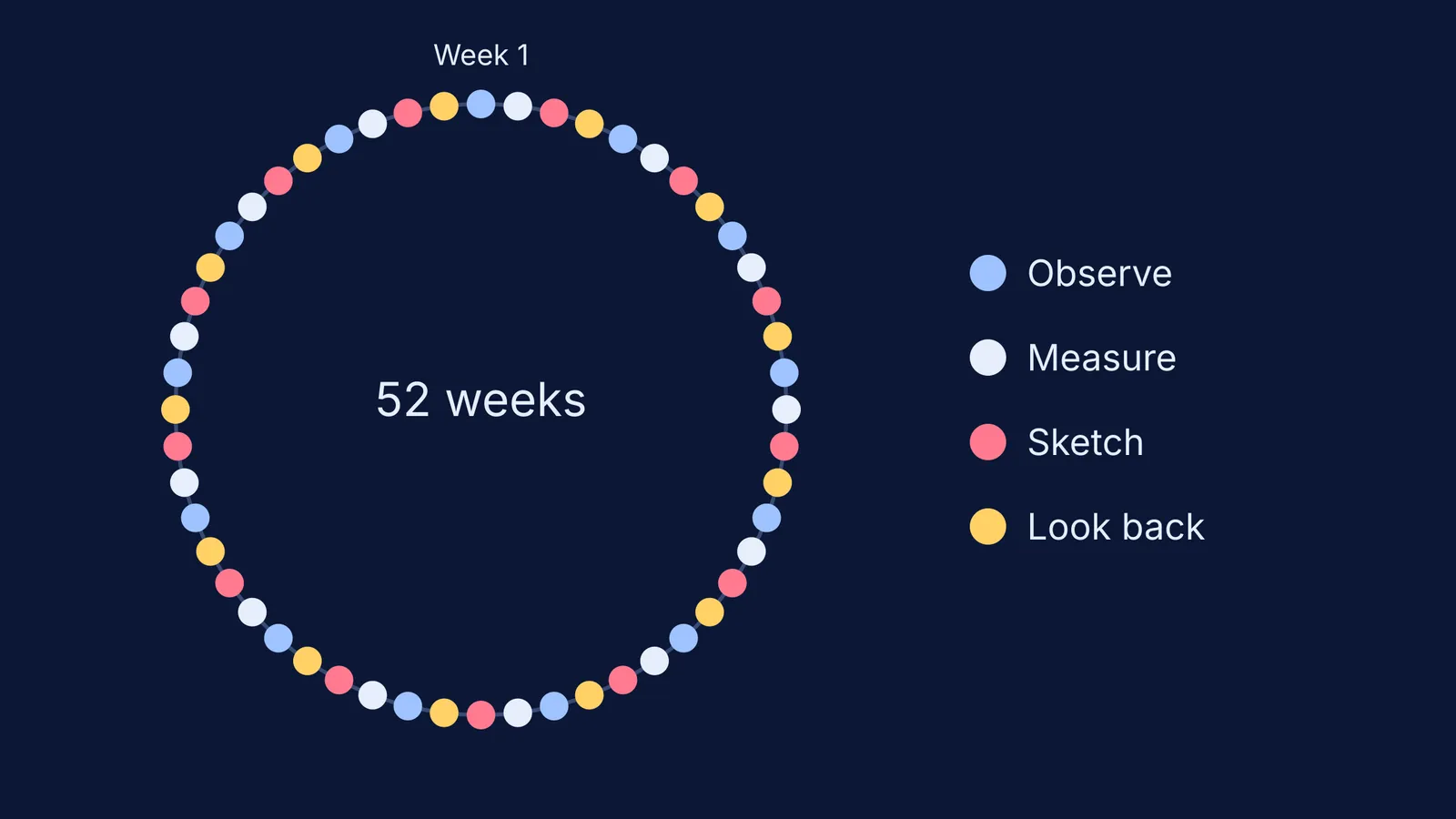
A four-week rotation keeps it fresh and gives you 13 rounds a year:
Week 1, observe: describe one thing closely.
Week 2, measure: count, time or measure something.
Week 3, sketch: one careful, labelled drawing.
Week 4, look back: reread the month and choose one question to test.
Questions to ask together:
“What did you notice this week that you did not expect?”
“How could we measure that?”
“Which question do you want to chase next?”
Older children can share tree or bird records through citizen science projects in India. When a question needs an explanation neither of you has, the Fermi Concept Library has a lesson for every concept in physics, chemistry, biology, mathematics and computing, so you can look things up together.
Find a notebook today, write the five lines on page one, and let your child choose what to look at first.


