

On this page
On a humid summer afternoon, you have probably noticed water trickling from a thin plastic pipe outside your home. If you place a bucket beneath the drain pipe of a running split air conditioner, it can fill in a few hours.
Where does this water come from? An air conditioner has no connection to a municipal water line, nor is it leaking refrigerant. Every drop dripping outside was floating invisibly in your room minutes earlier.
Where does the water dripping from an AC come from?
Air contains invisible water vapour. According to the U.S. Geological Survey, condensation occurs when water vapour cools and turns into liquid water, releasing latent heat as molecules organise. Inside a split air conditioner, refrigerant evaporates through copper tubes lined with aluminum fins, chilling the coil to between 4 °C and 7 °C.
As the blower pulls warm room air across these cold fins, the air cools rapidly. Just like why a cold glass sweats in summer, warm air hitting a chilled surface sheds moisture. Droplets condense on the fins, collect in a drain pan, and flow through an external pipe outdoors.
What is the dew point in an air conditioner?
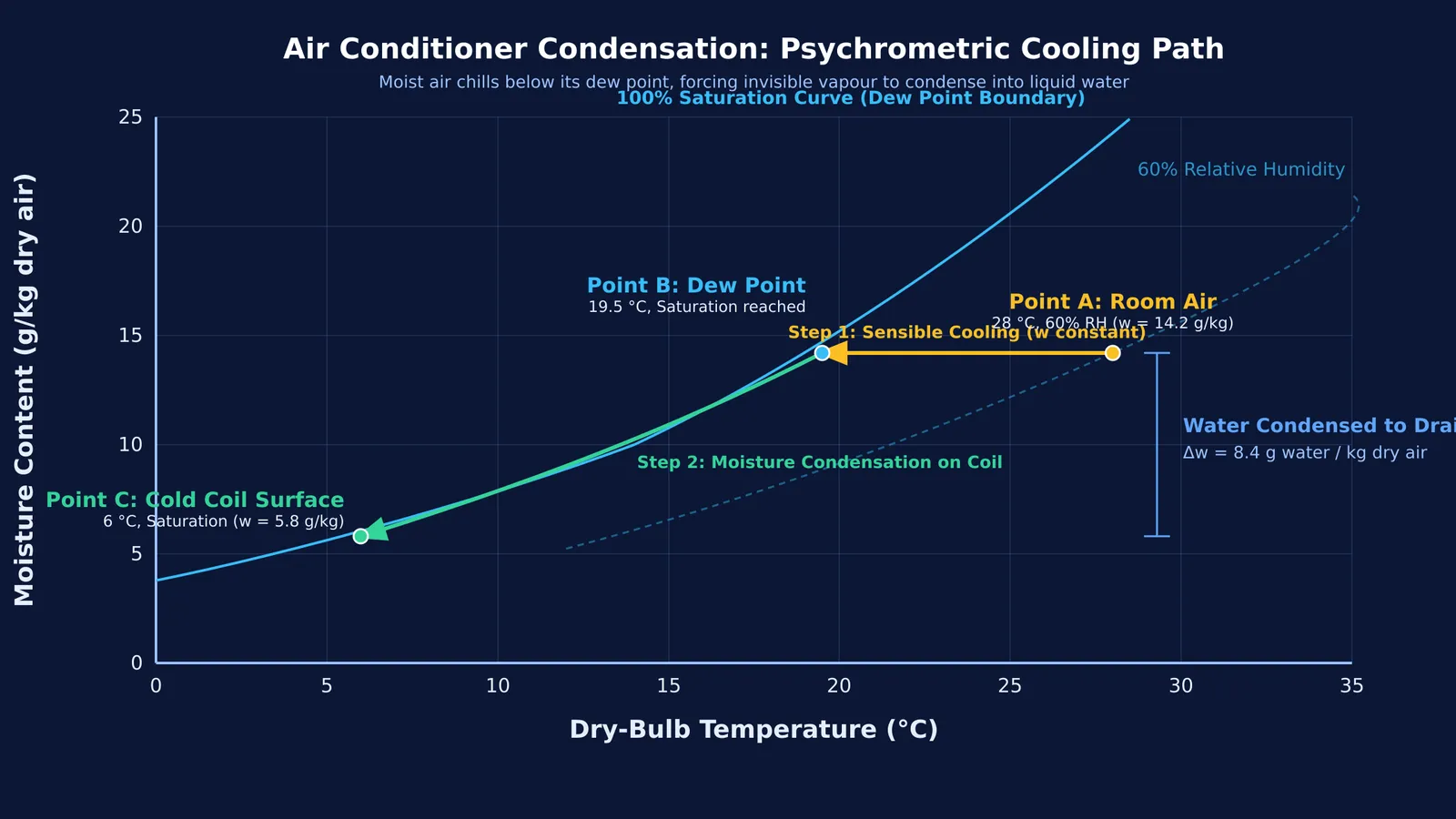
To understand why condensation occurs, consider the dew point. The National Weather Service glossary defines the dew point as the temperature to which air must be cooled at constant pressure and moisture content to reach saturation (100% relative humidity). If air cools below this threshold, excess moisture condenses into liquid.
In humid weather, room air at 28 °C with 60% relative humidity has a dew point of roughly 19.5 °C. Because the evaporator coil runs at 5 °C to 7 °C, incoming air cools well below this dew point.
As explained in NCERT Class 11 Physics, condensing vapour releases its latent heat of vaporisation (around 2,450 kJ/kg at room temperature). This principle explains why clothes dry slowly in the monsoon: when ambient air is near saturation, liquid cannot readily evaporate into it. By chilling air below its dew point, the unit removes moisture so your sweat can evaporate and cool you.
At the Fermi Simulation Lab, you can explore interactive simulations for ideas that are easier to see than to read, such as observing how temperature changes the saturation boundary.
How much water does an AC produce per hour?
The water volume an air conditioner extracts depends on room temperature, humidity, and system capacity.
In a review in *Sustainable Cities and Society*, researchers Salem Algarni, C.A. Saleel, and M. Abdul Mujeebu found that residential air conditioners produce between 0.38 and 1.14 litres of condensate per hour for every ton of refrigeration (TR) of cooling capacity in warm, humid climates. A study in *Sustainability* by Anna Magrini and colleagues confirmed that building cooling coils in humid coastal climates extract substantial daily volumes of mineral-free water suitable for non-potable reuse.
Consider a standard 1.5-ton split AC (approx. 5.2 kW cooling capacity) operating in humid summer conditions:
Cooling capacity: A 1.5-ton unit delivers roughly 5.2 kW of total cooling, with about 25% to 30% dedicated to latent heat removal (dehumidification).
Condensation rate: Based on Algarni's benchmark of 0.38 to 1.14 L/(TR·h), a 1.5-ton system extracts roughly 0.6 to 1.7 litres of condensate per hour under typical operating conditions, reaching 2 to 3 litres per hour in extreme coastal humidity.
Psychrometric moisture drop: For 720 m³ of air circulated per hour (about 850 kg of air), chilling the airstream across the cold fins removes roughly 1.5 to 2.5 grams of moisture per kilogram of air.
Daily volume: Operating continuously overnight in humid coastal weather, the unit routinely collects 10 to 20 litres of water, and up to 35 litres over a full 24-hour cycle.
Unlike evaporative coolers—such as how a porous matka cools water by evaporation—which add moisture to dry air to lower temperature, an air conditioner actively removes it.
For students practicing thermal calculations, the Fermi Problem Library provides worked problems with a step-by-step solver that explains the reasoning rather than printing an answer.
Why is my AC dripping water inside the room?
Water dripping outdoors indicates normal dehumidification. Water dripping from the indoor unit inside your room, however, signals a drainage or airflow fault:
Clogged drain line: Dust and airborne microbes settle on the wet coil, forming sludge that blocks the drain exit. Flushing the pipe clears the obstruction.
Improper drain slope: Condensate pipes rely entirely on gravity. If the indoor unit is not pitched slightly toward the drain exit, water overflows the pan.
Frozen evaporator coils: A dirty air filter restricts airflow. Without warm air flowing over the coil, its surface temperature drops below freezing, turning condensate into ice. When the compressor shuts off, melting ice overwhelms the drain tray.
Damaged drain pan: Age and thermal stress can crack the plastic tray, allowing water to leak through the casing.
A steady outdoor drip confirms that your system is chilling air below its dew point and keeping indoor air comfortably dry.


