

On this page
A seedling shut in a dark shoebox with one small hole will wind around cardboard walls to reach that hole. It is a simple way to show a child that plants sense and respond to their surroundings. Below: how to build it, a diary to keep, and questions for each stage of the two weeks.
What does a shoebox plant maze show?
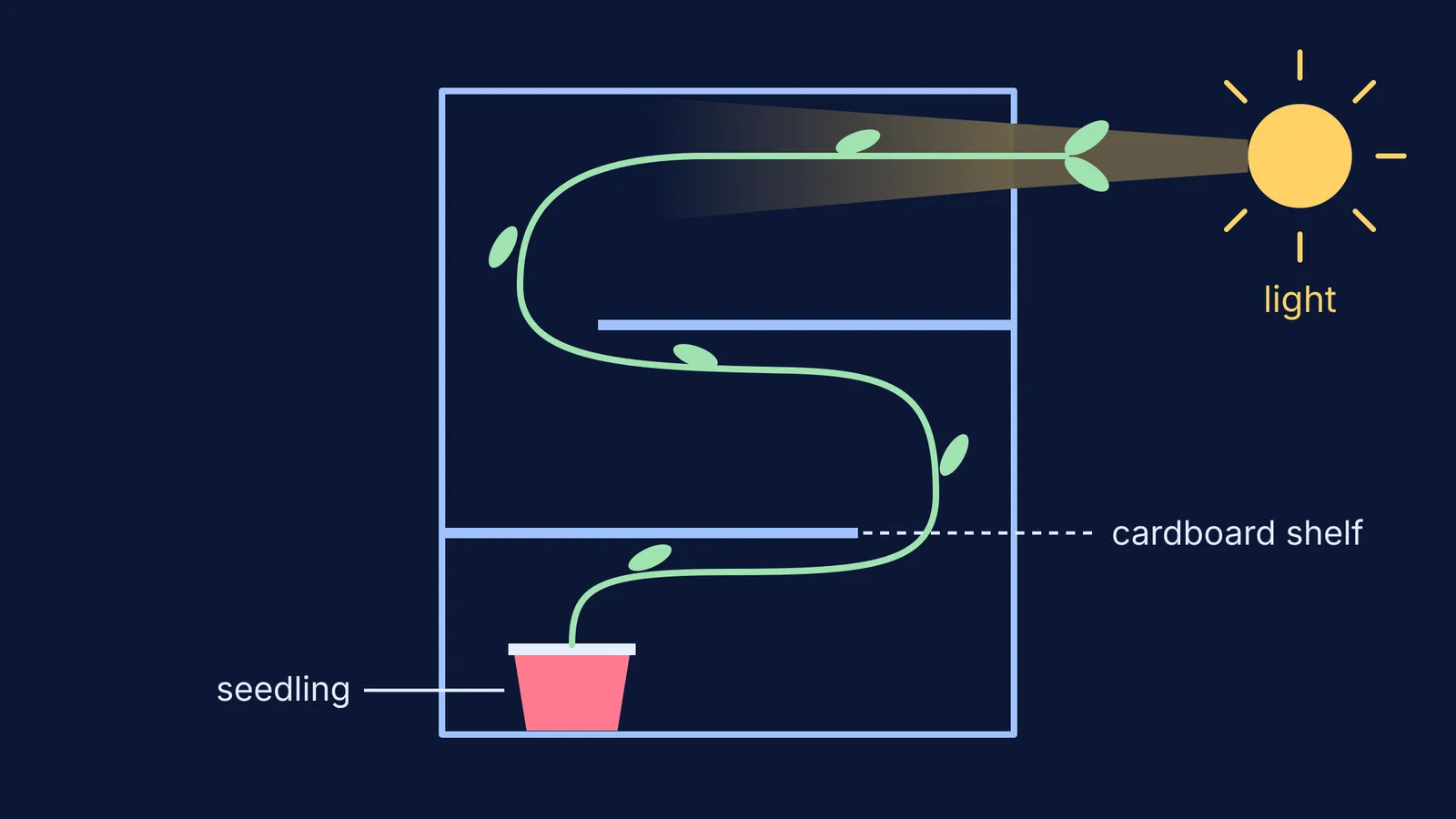
It shows phototropism, which means a plant growing towards light. NCERT's Class 10 science chapter Control and Coordination explains the mechanism simply: when light comes from one side, auxin, a hormone made at the shoot tip, diffuses towards the shady side and makes those cells grow longer, so the shoot bends towards the light. In the textbook's own version of this activity (Activity 6.2), germinated bean seeds in a box open on one side show shoots bending towards a window after two or three days.
The colour of the light matters too. A review in The Plant Cell by Craig Whippo and Roger Hangarter traces how botanists found that phototropism is strongest towards blue and violet light, which plants detect with light-sensing proteins called phototropins. It also cites Darwin's 1880 work showing that the tip senses light while the bending happens lower down. Our profile of Charles Darwin's phototropism experiments tells that story, and our explainer on how auxin makes a shoot bend goes a level deeper for older children.
How do you build a plant maze in a shoebox?
You need a shoebox with a lid, two strips of stiff cardboard, tape, scissors (an adult cuts), a small cup with a drainage hole, soil, and a few rajma, chana or moong seeds. Beans are a common choice because, as the teachers' practical site Preproom puts it, they are fast growers that produce long, spindly shoots.
Soak the seeds overnight, plant two or three in the cup, and wait until a shoot is up before you start the maze.
Stand the shoebox on one end. Cut a coin-sized hole near the top of one long side.
Tape in two cardboard shelves. Fix the lower shelf to the side without the hole, leaving a gap at the far end; fix the upper shelf to the side with the hole, leaving its gap on the opposite side.
Put the cup at the bottom, under the lower shelf, on the side away from its gap.
Close the lid and tape the seams, so the only light enters through the hole. Preproom also says the closed box should not leak too much light.
Turn the hole towards a bright window. Every two days, open briefly to water and observe.
What goes in the observation diary?
Give each check one line with the same five entries, so the records can be compared later:
Date and day number
Length of the shoot (lay a thread along it, then measure the thread)
Which compartment the tip has reached
Colour of the stem and leaves
One sentence: what changed since last time?
A phone photo from the same spot each time lets your child line them up at the end.
What questions should you discuss each day?
Timings vary. NCERT's open box shows bending within two or three days, while Preproom says a full maze takes a few weeks, so stretch this two-week plan if the shoot is slow.
Days 1-2: Which way will the shoot grow, and why? Draw your guess.
Days 3-4: Is the tip pointing straight up or leaning? Towards what?
Days 5-6: The shoot has reached a shelf. How could it find the gap without eyes?
Days 7-8: Compare the stem with a plant on the windowsill. What looks different, and why might that be?
Days 9-10: If we turned the box so the hole faced the room, what would the shoot do?
Days 11-12: Which part is bending, the very tip or lower down? This is the question Darwin asked.
Days 13-14: The shoot is out. Was your Day 1 guess right? What would you change in a second maze?
For a fair test, keep a second cup in an open box beside the window, so the maze is the only difference between the two plants.
What if the shoot gets stuck?
It bends towards a corner: light is leaking in. Tape the seam.
It droops: check the soil. It should be damp, not soggy.
It barely moves: bring the box closer to the window, or start again with just one shelf.
Let your child do the measuring and writing, even if the diary is messy. If this turns into a school project, our guide on how much to help with a school science project helps you decide where your part stops. Teenagers who want the textbook view can open the Fermi Concept Library, where each biology concept has its own lesson and its place in the map.
Find a shoebox this weekend, soak the seeds tonight, and let your child write Day 1.


