
On this page
Your teenager wants new earphones, and the checkout page offers "Pay in 3". It looks harmless, and the first purchase usually is. The trouble comes with the third or fourth, when small instalments from different apps fall due in the same month and the pocket money has already gone.
How do buy now, pay later apps trap young users?
Buy now, pay later (BNPL) is short-term credit that splits one purchase into a few instalments, often shown at checkout as "Pay later" or as an EMI option. It is still a loan. Under RBI's Digital Lending Directions, 2025, lenders must report digital loans, including deferred-payment credit, to credit information companies, so a missed instalment can show up in a young person's credit history.
Three patterns make these apps sticky:
Stacking. In a January 2025 report using 2022 data, the US Consumer Financial Protection Bureau (CFPB) found that about 63% of BNPL borrowers had several loans running at once at some point in the year, and 33% borrowed from more than one BNPL lender.
A heavier load on the young. The same CFPB report found that among borrowers aged 18 to 24, BNPL made up 28% of total unsecured debt in the months they borrowed, compared with 17% across all ages.
More spending, not just later spending. Economists Marco Di Maggio, Emily Williams and Justin Katz found that access to BNPL increased both total spending and the share going to retail shopping.
Most of this research comes from the US, and Indian data on teenage BNPL use is thin. The mechanics, though, are the same on Indian shopping and food apps.
What does stacking look like on pocket money?
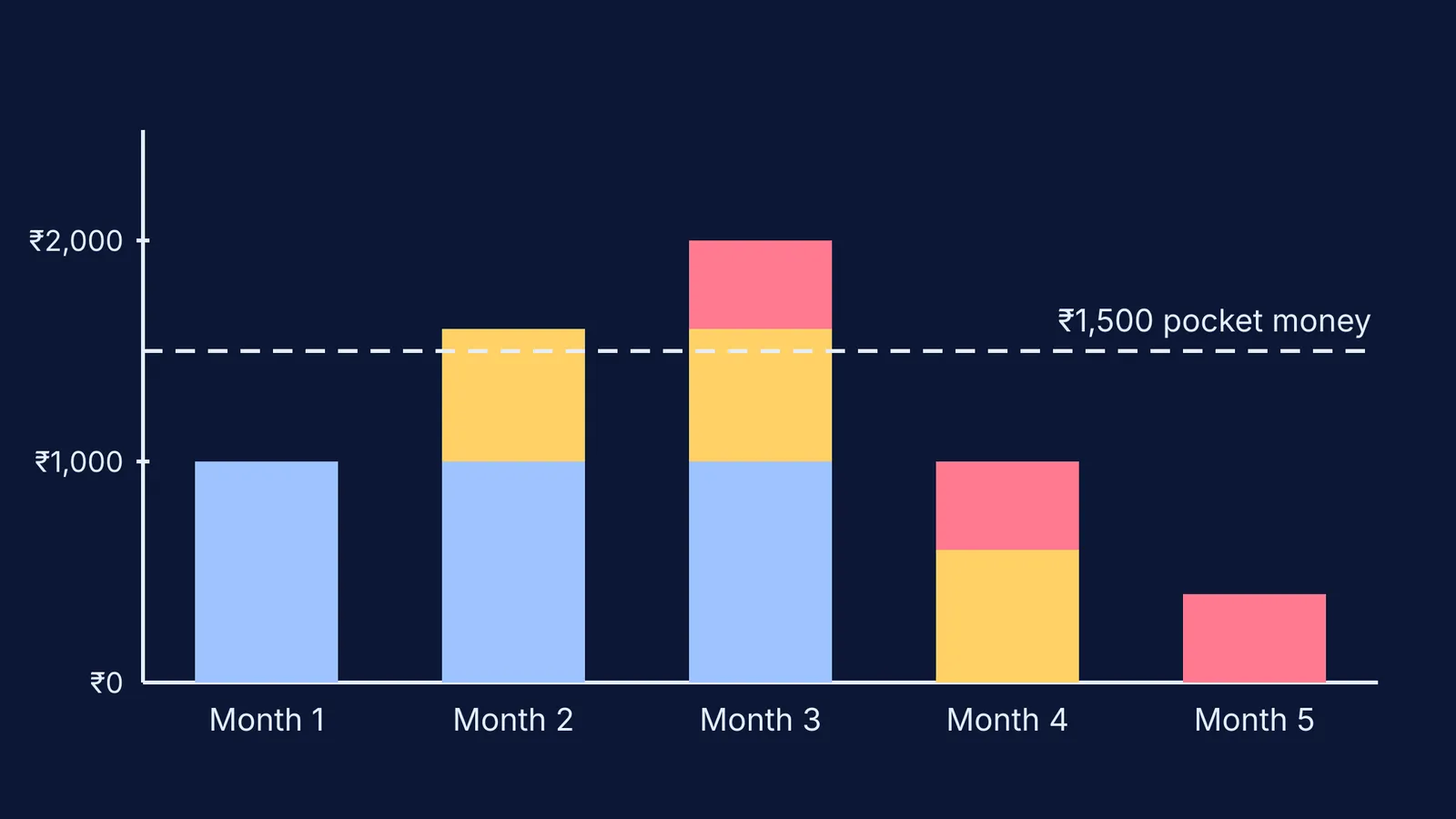
Here is a made-up but typical example. Your teen gets ₹1,500 a month.
Month 1: earphones for ₹3,000 in three parts, so ₹1,000 is due in months 1, 2 and 3.
Month 2: shoes for ₹1,800 in three parts, so ₹600 is due in months 2, 3 and 4.
Month 3: food orders worth ₹1,200 in three parts, so ₹400 is due in months 3, 4 and 5.
Add it up month by month: ₹1,000, then ₹1,600, then ₹2,000, then ₹1,000, then ₹400. Each decision looked affordable on its own, because ₹1,000, ₹600 and ₹400 are all below ₹1,500. Together they overshoot the pocket money in months 2 and 3. If you have not settled on an amount, our guide on how much pocket money a teenager should get in India is a good starting point.
If working this out leads to questions about percentages or how interest grows, the Fermi Concept Library gives every concept in mathematics its own lesson, so your teen can look it up properly.
How can you check if your teen has a pay-later app?
Do this with your teen, not behind their back. The aim is to see what is due.
Open shopping, food and payment apps together and look in the profile or wallet for a "Pay Later", "Credit" or "EMI" section.
Search SMS and email for words like "EMI", "due date", "instalment", "pay later" and "credit limit".
Check UPI apps for any linked credit line. Our post on UPI limits and scam rules for teenagers covers the settings to review.
Check any standalone loan app against the Digital Lending Apps directory, which RBI has run on its website since 1 July 2025 to list apps deployed by the lenders it regulates.
If an app is not in the directory, or anyone threatens or harasses your teen over a loan, report it on the National Cybercrime Reporting Portal (cybercrime.gov.in) or call the national cybercrime helpline 1930, as the government advises.
What family rules for borrowing actually work?
Start from these five, and let your teen help adjust them:
No credit without a talk. Any pay-later, EMI or loan option waits 24 hours and gets discussed first. RBI's 2025 directions already give digital borrowers a cooling-off period of at least one day to exit a loan; a family wait is the same idea, applied before signing.
One plan at a time. Never more than one instalment plan running.
A ceiling. All instalments together stay well under the monthly pocket money, so a surprise expense does not cause a missed payment.
Save first, with a match. For bigger wants, your teen saves and you add a fixed share once the target is close.
Due dates on a shared calendar, so nobody finds out from a reminder SMS.
To make the numbers real, try involving your teenager in the family budget for a month.
What should you say if you find one?
Start calm. Something like: "I'm not angry that you used it. I want to see what's due and when, so we can plan it together." If they reply "Everyone uses it", try: "That's fine. Show me the due dates and what happens if one is missed. If we can both explain it, we'll decide together."
The Tele MANAS toll-free numbers, 14416 or 1-800-891-4416, offer support in several languages. Tonight, sit down together and list every app that offers "Pay later".